MEDDIC: The 6 Elements, Stage-by-Stage Checklist, Scoring & MEDDPICC vs BANT (2026)
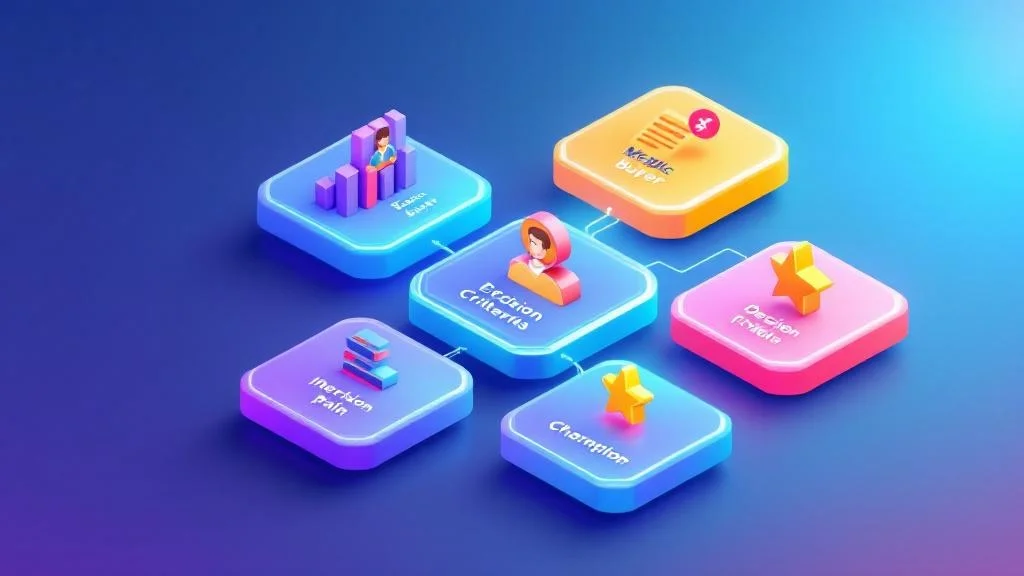
MEDDIC is an enterprise B2B sales qualification framework that evaluates deal viability across six dimensions: Metrics, Economic Buyer, Decision Criteria, Decision Process, Identify Pain, and Champion. Formalized at PTC (Parametric Technology Corporation) in 1996, MEDDIC is now the de facto standard qualification methodology in enterprise SaaS sales—used at Salesforce, Snowflake, Databricks, and beyond, and increasingly augmented with AI and Digital Sales Room (DSR) engagement signals.
TL;DR
- What MEDDIC is: A six-element qualification framework (Metrics · Economic Buyer · Decision Criteria · Decision Process · Identify Pain · Champion) for complex enterprise deals. Created at PTC in 1996, where it helped grow revenue from $300M to $1B in four years (MEDDIC Academy).
- Why it still wins in 2026: Forrester State of Business Buying 2024 shows B2B purchases now involve an average of 13 decision-makers, 89% spanning two or more departments, with 86% of buying processes stalling—exactly the multi-stakeholder complexity MEDDIC was built for.
- Proprietary 6×6 matrix: This guide includes a MEDDIC 6-element × 6-deal-stage checklist (Discovery → Close) so you know which element to verify at each stage instead of treating MEDDIC as a flat checklist.
- 0-12 scoring: Score each element 0/1/2 for an objective S/A/B/C deal rank that removes rep guesswork.
- MEDDIC × DSR signal map: Pricing-page dwell signals Metrics interest, executive-domain access signals Economic Buyer engagement, repeat case-study views signal Champion activity—auto-augmenting qualification data without a single extra hearing.
- MEDDIC vs MEDDPICC vs BANT: A side-by-side table plus a BANT→MEDDIC migration map so IS and AE teams can run both without friction.
According to Salesforce State of Sales 2026 (n=4,050), 87% of sales organizations now use AI and roughly nine in ten plan to adopt AI agents by 2027. Yet AI cannot close a deal where the economic buyer was never identified or the decision process was never mapped. The framework that has anchored 30 years of enterprise qualification—and that AI now accelerates rather than replaces—is MEDDIC.
This article covers MEDDIC from definition and origin to the six elements with hearing questions, a Metrics/ROI calculation template, the five-stage Champion development model, a proprietary 6-element × 6-stage qualification checklist, 0-12 scoring with S/A/B/C thresholds, the MEDDIC → MEDDICC → MEDDPICC evolution, a MEDDIC vs BANT comparison with a migration path, a MEDDIC × DSR engagement-signal map, common failure patterns, and a 2026 benchmark table from first-party research.
You will learn:
- The six MEDDIC elements with practical hearing questions for each
- A three-step Metrics/ROI calculation template that turns discovery into a board-ready business case
- The five-stage Champion development model (Discover → Validate → Develop → Activate → Retain)
- A proprietary MEDDIC 6-element × 6-deal-stage checklist matrix
- A 0-12 scoring model with S/A/B/C thresholds and a weekly review cadence
- When to use MEDDIC, MEDDICC, MEDDPICC, or BANT instead
- A BANT → MEDDIC migration map for IS→AE handoff
- A MEDDIC × DSR 6-element engagement-signal map for the rep-free buying era
- 2026 benchmarks from Salesforce, Forrester, Gartner, Ebsta×Pavilion, and HubSpot
What MEDDIC Is — Origin, Overview, and Three Benefits
MEDDIC is a deal qualification framework whose acronym combines six English terms. Rather than scoring a lead's "temperature" quickly, MEDDIC rigorously assesses how winnable a complex deal is and how accurately you can forecast it.
| Element | Full Name | Core question |
|---|---|---|
| M | Metrics | What quantified outcome does the buyer want, and what is it worth? |
| E | Economic Buyer | Who holds final budget authority for this purchase? |
| D | Decision Criteria | What requirements will the buyer use to choose a solution? |
| D | Decision Process | What internal steps, reviews, and approvals lead to a signed contract? |
| I | Identify Pain | What business pain is severe enough to justify action now? |
| C | Champion | Who inside the account actively sells on your behalf? |
The Origin — The Framework Behind PTC's Hypergrowth
In 1996, Dick Dunkel and Jack Napoli developed MEDDIC inside PTC's sales organization under SVP John McMahon. PTC ran a ~300-person sales team with high turnover; by analyzing what separated won deals from lost ones, they converged on six recurring factors (Sales MEDDIC Group).
After adopting the framework, PTC grew revenue from $300M to $1B over four years (MEDDIC Academy; Flow State Sales — Dick Dunkel interview). As PTC alumni dispersed into sales leadership roles across the industry, MEDDIC spread as the shared language of enterprise SaaS selling.
Three Problems MEDDIC Solves
1. Forecast precision. Visualizing the confirmation status of each element lets you objectively separate "high-confidence deals" from "at-risk deals," replacing gut-feel calls with data-backed deal management. Coffee.ai's 2026 analysis reports that on $50K+ enterprise deals, MEDDIC users see forecast precision improve from roughly 60-70% to 85-95%.
2. Sales-resource allocation. Because loss risk surfaces early, you avoid pouring time into deals that will never close. Knowing which element is unconfirmed lets you act before a deal stalls.
3. A common team language. Phrases like "no Champion identified" or "Decision Criteria unconfirmed" let the whole team discuss deals against the same standard. Following the framework lets even junior AEs manage deals at a high level. Coffee.ai reports MEDDIC delivers roughly a +25% win-rate lift on large enterprise deals versus unstructured qualification.
Where MEDDIC Is Most Effective
Forrester State of Business Buying 2024 found that B2B purchases involve an average of 13 decision-makers, with 89% spanning two or more departments—and that 86% of buying processes stall while 81% of buyers are dissatisfied with their own selection. MEDDIC is built precisely for this reality: deals with multiple decision-makers and a complex internal approval process, typically running 3-12 months from evaluation to contract. Pair it with a clear view of your sales pipeline stages so each element is verified at the right moment.
The Six MEDDIC Elements in Detail
The six elements are not independent checkboxes—they interlock. Without a Champion you cannot reliably learn the Decision Process; without Identified Pain your Metrics are hollow. Below, each element includes a definition and practical hearing questions.
Metrics — The Quantified Success Indicator
Metrics is the measurable outcome the buyer wants from your solution—not "seems useful," but "increase revenue 20%" or "cut processing time 50%." The test: can the buyer write "this delivers a quantified return" in their internal approval document?
Hearing questions:
- "Which numbers will you track to call this project a success?"
- "What is the current problem costing you annually—labor, opportunity loss, churn?"
- "Do you have an ROI formula or an expected payback period in mind?"
- "If we cut [process] time by half, how many more deals could your team run per month?"
Without confirmed Metrics, the buyer cannot even explain to themselves why to act now.
Metrics / ROI Calculation Template — Three Steps
Turn discovery into "numbers that pass an approval committee" by building the formula with the buyer. Keep it co-editable so your Champion can reproduce it internally.
Step 1 — Quantify the Cost of Inaction
Annual loss = unit cost × annual occurrences × number of people
Example: $30/hr of prep time × 250 hrs/yr × 10 reps = $75,000/yr
Step 2 — Agree the Target Metric
Target = current value × improvement rate (cite a prior or public case study)
Example: cut prep time 50% → $75,000 × 50% = $37,500/yr productivity gain
Step 3 — Calculate the Payback Period
Payback (months) = (one-time cost + annual cost) ÷ (annual benefit ÷ 12)
Example: ($20,000 + $30,000) ÷ ($37,500 ÷ 12) ≈ 16 months
Shorter payback periods generally clear approval faster, but the acceptable threshold varies by company—confirm it directly with the Economic Buyer.
Economic Buyer — The Budget Authority
The Economic Buyer holds final spending authority. They are often senior, but title alone is not proof—identify who actually says "go." A deal where you have never met the Economic Buyer is high-risk. Use your Champion to arrange an executive briefing.
Hearing questions:
- "Who gives final sign-off on this investment?"
- "Is the budget already secured, or does it need a new request?"
- "Could we get a short window to present the business case to that person?"
Decision Criteria — How They Will Choose
Decision Criteria are the requirements and weights the buyer applies when selecting a solution: technical fit, security, price, support, references, and more. The advanced move is to influence the criteria so they align with your strengths—shaping what "good" means before competitors do.
Hearing questions:
- "What evaluation axes matter most in this selection?"
- "How are those axes prioritized against each other?"
- "Are the criteria documented—do you have an RFP or scorecard?"
Decision Process — The Path to a Signature
Decision Process is the internal sequence—who is involved, which approvals are required, and on what timeline. Deals with an unknown Decision Process forecast badly.
Hearing questions:
- "Walk me through the internal approval steps from agreement to signed contract."
- "Will Legal, IT/Security, or Procurement need to review?"
- "On a similar past purchase, how long did internal sign-off take?"
Mapping this process collaboratively is exactly what a Mutual Action Plan is for—co-owning the steps to close.
Identify Pain — The Compelling Problem
Identify Pain is the buyer's business pain severe enough to compel action—not a surface annoyance, but "if unresolved, this materially hurts the business." Shallow or vague pain leads to price competition even when you win.
Hearing questions:
- "What problems does the current approach create?"
- "If this stays unsolved for six months, what happens?"
- "What monthly or annual cost—or opportunity loss—does this problem cause?"
A "co-thinking," not "interrogating" posture. MEDDIC elements are confirmed through trusted dialogue, not a Q&A checklist. Show up as a partner solving the problem together; it yields deeper, more accurate information than cross-examination. Combine with strong discovery and qualification technique for higher precision.
Champion — Your Internal Seller
A Champion is someone inside the account who actively drives adoption of your solution—not merely a friendly contact, but a person with internal influence and the will to act.
A true Champion has three traits:
- Influence — credibility and a voice with decision-makers
- Motivation — genuinely invested in solving their problem
- Action — actually runs internal selling, approval pushes, and stakeholder alignment
Two Champion types. A lateral Champion spreads value to peers and teammates, building ground-level support. A vertical Champion reports value upward, opening access to the Economic Buyer. Finding and connecting both dramatically lifts win rate. We cover how to verify a true Champion in the five-stage model below.

The Five-Stage Champion Development Model
The Champion is MEDDIC's most decisive element—and the most prone to becoming personality-dependent. This five-stage model makes Champion development a repeatable process.
Stage 1 — Discover
Find Champion candidates early. Signals to watch for:
- They ask proactive, probing questions
- They voice strong dissatisfaction with the status quo
- They volunteer information about internal stakeholders and the approval process
- They take follow-up actions on their own after meetings
Multiple candidates at this stage is fine—you validate next.
Stage 2 — Validate
Test whether a candidate is a true Champion via small asks that reveal influence, motivation, and action:
- "Could you introduce me to a colleague in another department?" → Do they?
- "Could you share this material internally?" → Do they actually circulate it?
- "Could you bring a senior stakeholder to our next meeting?" → Do they arrange it?
If asks go unanswered, the person is a "friendly bystander," not a Champion. Find another candidate.
Stage 3 — Develop
Arm your validated Champion to sell internally:
- Co-build internal persuasion materials (ROI model, outcome report)
- Refine an "elevator pitch" they can deliver comfortably
- Prepare answers to anticipated internal objections
- Prioritize references from their industry and company size
The point: never leave it all to the Champion. Reduce their internal lift so they feel "with this rep, I can move my organization."
Stage 4 — Activate
Use the Champion to secure Economic Buyer access and accelerate the decision:
- Arrange an executive briefing (giving the Champion a stage to escalate)
- Build an Economic-Buyer summary (exec-level ROI, competitive comparison)
- Draft-support their internal approval document
- Multi-thread across several Champions in parallel
Stage 5 — Retain
After the contract, keep the relationship alive—your Champion is the seed of upsell, cross-sell, and referrals:
- Share post-implementation results (Metrics attainment) on a regular cadence
- Give them data that showcases "the win I drove" internally
- Explore lateral expansion to other departments together
- Invite them to user communities and events
These five stages turn Champion development from "instinct" into a reproducible motion.
Proprietary: MEDDIC 6-Element × 6-Stage Qualification Checklist
The most common MEDDIC failure is treating it as a flat checklist you try to "fill in" all at once. In reality, each element matures at a different deal stage. The matrix below—a Terasu Editorial Team original—maps which MEDDIC element to verify at each of six deal stages, with the specific check that signals "ready to advance."
| Stage | Metrics | Economic Buyer | Decision Criteria | Decision Process | Identify Pain | Champion |
|---|---|---|---|---|---|---|
| 1. Discovery | Surface a rough "what good looks like" number | Note the likely budget owner's title | Listen for stated priorities | Ask how similar buys were decided before | Pin down the core business pain | Spot a candidate who engages proactively |
| 2. Qualification | Agree a draft target KPI | Confirm the named Economic Buyer | Capture top 3 evaluation axes | Sketch the approval steps | Quantify the cost of inaction | Validate the candidate with a small ask |
| 3. Validation (PoC) | Co-build the ROI formula | Secure first Economic Buyer touch | Influence criteria toward your strengths | Identify Legal/IT/Procurement gates | Tie pain to a measurable PoC success metric | Develop: arm Champion with materials |
| 4. Proposal | Lock the agreed ROI in writing | Deliver an exec-level business case | Map your fit to every criterion | Confirm step owners and dates | Reconfirm pain is still top priority | Activate: Champion escalates internally |
| 5. Negotiation | Defend ROI against discount pressure | Get explicit Economic Buyer commitment | Neutralize competitor-set criteria | Pre-clear paper/security review | Frame inaction risk vs. delay | Champion drives internal consensus |
| 6. Close | Hand off Metrics for post-sale tracking | Obtain final sign-off | All criteria formally met | Contract executed on the mapped path | Pain resolution becomes the success story | Retain: convert Champion to advocate |
How to use it: In your weekly review, locate each deal's stage column and confirm every cell above and to the left is satisfied. An empty cell behind the current stage is a back-fill risk—the most common cause of a late-stage surprise ("Security said no," "the real budget owner was someone else"). This matrix is also the natural backbone of a deal management process and an SFA stage-gating design.
MEDDIC Scoring — Managing Win Confidence Quantitatively
Beyond confirming the six elements, scoring each element's completeness sharpens prioritization and resource allocation.
Scoring Matrix (0-2 points × 6 elements = max 12)
| Element | 0 (unconfirmed) | 1 (partial) | 2 (confirmed) |
|---|---|---|---|
| Metrics | No quantified target | Qualitative expectation only | Specific KPI / ROI formula agreed |
| Economic Buyer | Not identified | Name known, no contact | Met directly, interest confirmed |
| Decision Criteria | Unknown | Heard verbally | Documented criteria obtained, aligned to your strengths |
| Decision Process | Unknown | Outline understood | Steps, stakeholders, timeline confirmed |
| Identify Pain | Unclear or minor | Pain exists, low urgency | Severe pain identified and quantified |
| Champion | None | Friendly contact only | Acting, validated Champion exists |
Score-to-Action Guide
| Rank | Score | Verdict | Action |
|---|---|---|---|
| S | 10-12 | Strong win | Accelerate closing and final-proposal prep |
| A | 7-9 | Promising | Identify missing elements; back-fill in the next meeting |
| B | 4-6 | Needs work | Re-validate Champion, deepen Pain, secure Economic Buyer access |
| C | 0-3 | Re-evaluate / disqualify | Pause resource investment; nurture or walk away |
Operating tips:
- Update each deal's score in the weekly review
- Track score movement to catch stalling deals early
- Prioritize resources on A-rank and above
- Store scores in SFA/CRM custom fields and link to the forecast
This replaces subjective "80% likely" calls with data-driven management grounded in per-element completeness. For the team cadence around it, see the sales pipeline management guide.
MEDDIC → MEDDICC → MEDDPICC, and MEDDIC vs BANT
MEDDIC has evolved variants, and it is frequently compared with BANT. Here is the full landscape in one table.
The Qualification-Framework Comparison
| Framework | Elements | Added vs. MEDDIC | Best for |
|---|---|---|---|
| BANT | 4 (Budget · Authority · Need · Timeline) | — | SMB / mid-market, sub-45-day cycles, IS screening |
| MEDDIC | 6 | baseline | Standard enterprise deals, AE qualification |
| MEDDICC | 7 | + Competition | Competitive enterprise deals |
| MEDDPICC | 8 | + Paper Process + Competition | Large, complex, multi-vendor deals with heavy legal/procurement |
Paper Process and Competition
Paper Process covers the legal, procurement, and security review steps between "yes" and a signed contract—often months even after executive approval. Confirm: legal review and duration, security review needs (ISO 27001, SOC 2), procurement/PO flow, e-signature vs. paper, and fiscal-year order deadlines. Surface security and contract drafts early, in parallel with the deal, to compress weeks of review lead time. For mid-deal sequencing, fold this into your Mutual Action Plan.
Competition covers the alternatives the buyer is evaluating—including "do nothing." Gartner's 2025 sales survey (n=632) found 74% of B2B buying teams experience "unhealthy conflict" during the decision process. Mapping stakeholder interests and defusing conflict early is often what keeps a competitive deal alive.
MEDDIC vs BANT — Six-Axis View
| Axis | MEDDIC | BANT |
|---|---|---|
| Phase | Mid-to-late deal (qualification) | Early lead evaluation |
| Deal size | Large enterprise | SMB to mid-market |
| Depth | Deep (decision process, Champion) | Shallow (4 elements, fast) |
| Purpose | Deal-health assessment, forecast precision | Lead screening |
| Skill required | High (executive access needed) | Moderate (works for inside sales) |
| Time cost | High (verified over multiple meetings) | Low (confirmable in the first call) |
Most enterprise teams run a hybrid: inside sales screens leads with BANT, then AEs qualify deals with MEDDIC. Coffee.ai's 2026 analysis supports this split—BANT for sub-45-day cycles, MEDDIC for $50K+ complex deals.
BANT → MEDDIC Migration Map
If your team runs BANT today, migrate gradually by mapping existing elements forward.
| BANT element | Maps to MEDDIC | Direction to deepen |
|---|---|---|
| Budget | Metrics + Economic Buyer | Budget exists → ROI formula → identify the spending authority |
| Authority | Economic Buyer + Champion | Find the approver → develop an internal Champion |
| Need | Identify Pain + Metrics | Need exists → quantify the pain → agree success Metrics |
| Timeline | Decision Process + Paper Process | Target date → internal approval flow → full contracting path |
Three-step handoff: (1) IS confirms BANT in the first one or two touches and prioritizes the lead; (2) at handoff, carry BANT findings into the mapped MEDDIC elements and flag what is still unconfirmed; (3) AE deepens the confirmed elements and adds Champion, Decision Criteria, and Decision Process.
MEDDIC × DSR — A Six-Element Engagement-Signal Map
Gartner's 2026 buying research (n=646) found that 67% of B2B buyers prefer a rep-free buying experience, while hybrid buying with a rep plus digital tools produces 1.8× higher-quality deals than pure self-service. The implication: buyers advance decisions before you get a hearing window, so hearing-only MEDDIC cannot keep pace. A Digital Sales Room (DSR) makes the buyer's between-meeting behavior visible—and that behavior auto-augments your MEDDIC data.
MEDDIC Element × DSR Signal
| MEDDIC element | DSR engagement signal | What it tells you | Sales action |
|---|---|---|---|
| Metrics | Long dwell on pricing / ROI pages | Quantified-value interest is rising | Send a tailored ROI model for their numbers |
| Economic Buyer | Access from an executive email domain | The budget authority is now engaged | Offer an exec briefing while interest is warm |
| Decision Criteria | Repeat views of comparison / feature pages | Their evaluation axes are forming | Influence criteria toward your strengths |
| Decision Process | Download of approval / security templates | Internal approval is in motion | Pre-stage Paper Process materials |
| Identify Pain | Repeat views of an industry problem page | Pain empathy is deepening | Send matching case studies and proof |
| Champion | New first-time viewers appear in the room | Your Champion shared materials internally | Follow up to widen the stakeholder set |
Identifying and Developing a Champion via DSR
DSR access data is a powerful, objective Champion indicator:
- New-viewer tracking — A new person appearing in the room is a sign your Champion circulated materials internally (a lateral-Champion signal).
- View-pattern analysis — Someone repeatedly opening pricing and contract pages is a Champion candidate.
- Dwell time — Long, repeat viewing suggests someone is preparing an internal pitch (a vertical-Champion signal).
Add an "internal-persuasion content section" to the DSR—ROI model, references, objection-handling—to directly support Stage 3 (Develop) of the Champion model.
Note: DSR signals are auxiliary. A shared screen, an accidental click, or a competitor's research can all create noise. Use auto-score suggestions as a starting point for hearing and updates—the final score is always the rep's judgment.
Run MEDDIC on Terasu
Terasu's Digital Sales Room auto-augments MEDDIC elements from buyer engagement signals—identifying Champions, visualizing Decision Criteria, and sharing deal health across the team in real time. Try it free.
Start freeCommon MEDDIC Failure Patterns
MEDDIC is powerful, but several pitfalls recur on adoption.
1. Turning it into a checklist
Treating the six elements as boxes to mechanically fill misses the point. MEDDIC is information gained through deep dialogue, not a Q&A form.
2. Applying it uniformly to every deal
Full MEDDIC on a short SMB deal is overhead-heavy. Use the scoring matrix and the 6×6 stage checklist to flex the depth of verification to deal size.
3. Misjudging the Champion
Mistaking a "friendly contact" for a Champion is the most frequent error. Confirm with Stage 2 (Validate)—if asks go unanswered, find another candidate.
4. Letting CRM records go stale
Adding MEDDIC fields is useless if no one updates them. The fix is a weekly review that inspects MEDDIC data and tracks score movement so records stay live.
5. Ignoring multi-layer approval reality
In organizations with multi-step approval and consensus decision-making, the Economic Buyer may stay hidden and the Decision Process may run long. Map not only "who signs" but "who can veto," and reverse-engineer the timeline from the fiscal-year order deadline.
2026 MEDDIC-Related Benchmark Table
To anchor this guidance in current first-party research, the Terasu Editorial Team has organized major 2024-2026 B2B sales sources below, each with a direct link.
| Research (year) | Sample | Key indicators | Source |
|---|---|---|---|
| Salesforce State of Sales 2026 | 4,050 | 87% use AI / 54% use AI agents / ~9 in 10 plan adoption by 2027 | salesforce.com |
| Forrester State of Business Buying 2024 | — | Avg 13 decision-makers / 89% span 2+ departments / 86% stall / 81% dissatisfied post-selection | forrester.com |
| Gartner B2B Buying 2026-03 | 646 | 67% prefer rep-free / hybrid buying 1.8× higher-quality deals / 45% used AI during purchase | gartner.com |
| Gartner Sales Survey 2025-05 | 632 | 74% of B2B buying teams show "unhealthy conflict" in the decision process | gartner.com |
| Ebsta × Pavilion 2025 GTM Benchmarks | 2,000 CROs / $48B pipeline | Top performers close 11× faster than laggards (8.9× in 2024) | ebsta.com |
| HubSpot State of Sales 2025 | 1,000 | 84% report time savings from AI | hubspot.com |
| Coffee.ai 2026 BANT vs MEDDIC | — | $50K+ deals: MEDDIC +25% win rate / forecast precision 60-70% → 85-95% | coffee.ai |
| MEDDIC Academy | — | PTC grew $300M → $1B in 4 years post-MEDDIC / ~20-30% win-rate lift reported | meddic.academy |
Frequently Asked Questions
What does MEDDIC stand for?
MEDDIC is an acronym for Metrics, Economic Buyer, Decision Criteria, Decision Process, Identify Pain, and Champion. It is an enterprise B2B sales qualification framework developed at PTC in 1996 by Dick Dunkel and Jack Napoli under SVP John McMahon. The six elements are confirmed through dialogue to assess how winnable and forecastable a complex deal is.
What is the difference between MEDDIC and MEDDPICC?
MEDDPICC adds two elements to MEDDIC's six: Paper Process (the legal, procurement, and security steps to a signed contract) and Competition (the alternatives the buyer is evaluating, including doing nothing). MEDDICC is the seven-element version that adds only Competition. Use MEDDPICC for large, multi-vendor deals with heavy legal and procurement review; MEDDIC suffices for standard enterprise deals.
What is the difference between MEDDIC and BANT?
BANT (Budget, Authority, Need, Timeline) is a fast, shallow lead-screening framework suited to inside sales and sub-45-day SMB cycles. MEDDIC is a deeper deal-qualification framework for mid-to-late-stage enterprise deals, covering Champion development and Decision Process. Many teams run a hybrid: IS screens with BANT, then AEs qualify with MEDDIC. Coffee.ai's 2026 data shows MEDDIC lifts win rate ~25% on $50K+ deals.
What is the MEDDIC sales process, step by step?
Run MEDDIC across six deal stages: Discovery (surface pain and a rough metric, spot a Champion candidate), Qualification (confirm the Economic Buyer and top criteria, quantify pain), Validation/PoC (co-build the ROI model, develop the Champion, find approval gates), Proposal (lock ROI in writing, deliver an exec business case, activate the Champion), Negotiation (defend ROI, pre-clear paper/security review), and Close (final sign-off on the mapped path). The 6-element × 6-stage checklist in this article shows which element to verify at each stage.
What is the difference between a Champion and an Economic Buyer?
The Economic Buyer holds final budget authority—they say "go." A Champion is an internal advocate who actively sells your solution and opens access to the Economic Buyer. You typically reach the Economic Buyer through the Champion. They are distinct roles: a Champion without budget authority cannot approve, and an Economic Buyer rarely does your internal selling for you.
How much does MEDDIC improve win rates?
Organizations that adopt MEDDIC systematically report win-rate improvements around 20-30% (MEDDIC Academy), and PTC—where MEDDIC originated—grew revenue from $300M to $1B in four years. Coffee.ai's 2026 analysis reports a ~25% win-rate lift and forecast precision rising from 60-70% to 85-95% on $50K+ deals. Results depend heavily on operating quality: weekly reviews and scoring discipline, not just adding CRM fields.
How do I implement MEDDIC in Salesforce or another CRM?
Add the six elements as custom fields managed on a 0/1/2 picklist, then use a formula field to auto-calculate the 0-12 total. Surface deal rank on a dashboard (S: 10-12, A: 7-9, B: 4-6, C: 0-3) and gate stage progression on the score. Update scores in the weekly pipeline review. Integrating a DSR lets engagement signals auto-suggest score updates—pricing dwell for Metrics, executive-domain access for Economic Buyer, new viewers for Champion.
How do I identify a true Champion versus a friendly contact?
Use the Validate stage: make small asks and watch for action. "Could you introduce a colleague?" "Could you share this internally?" "Could you bring a senior stakeholder next time?" A true Champion follows through because they have influence, motivation, and the will to act. A friendly contact stays warm but never moves anything internally—when asks go unanswered, find another candidate.
How can a Digital Sales Room (DSR) improve MEDDIC?
A DSR makes between-meeting buyer behavior visible, auto-augmenting MEDDIC data without extra hearing. Pricing/ROI dwell signals Metrics interest, executive-domain access signals Economic Buyer engagement, comparison-page repeats signal forming Decision Criteria, approval-template downloads signal Decision Process motion, problem-page repeats signal deepening Pain, and new room viewers signal Champion activity. Treat signals as auxiliary—the rep makes the final score call.
Is MEDDIC too heavy for small or mid-market deals?
For deals under roughly $10K ARR, full six-element MEDDIC is overkill. A common lightweight variant is "MEDD" (Metrics, Economic Buyer, Decision Criteria, Decision Process). Pairing BANT with MEDD gives an eight-point check that is sufficient for mid-market deals, while reserving full MEDDIC or MEDDPICC for enterprise. Flex the depth using the scoring matrix rather than forcing every deal through the full framework.
When should I use MEDDIC versus MEDDPICC?
Use MEDDIC for standard enterprise deals with a manageable competitive set and a straightforward contracting path. Step up to MEDDPICC when the deal is large, multiple vendors are in play, or legal, security, and procurement review will be heavy and time-consuming. The added Paper Process element forces you to pre-stage contracting and security review in parallel with the deal, which is often the difference between closing this quarter and slipping.
Why did MEDDIC become the enterprise SaaS standard?
MEDDIC was created at PTC in 1996 to manage complex deals across a large, high-turnover sales team. After it helped PTC grow from $300M to $1B in four years, PTC-trained sales leaders carried it into Salesforce, Snowflake, Databricks, and many others, making it the shared language of enterprise SaaS qualification. Official training organizations like MEDDIC Academy continue to formalize and spread the methodology today.
Summary
MEDDIC is the global standard for qualifying complex enterprise deals. Continuously confirming and updating its six elements raises forecast precision and focuses scarce sales resources on winnable deals.
Key takeaways:
- The point is qualification — concentrate on deals you can win and raise pipeline quality
- The six elements interlock — without a Champion you cannot reliably learn the other elements
- Champion development is a five-stage motion (Discover → Validate → Develop → Activate → Retain) that removes personality dependence
- The 6-element × 6-stage checklist tells you which element to verify at each stage, preventing late-stage surprises
- 0-12 scoring makes win confidence objective and routes S/A/B/C action
- MEDDPICC adds Paper Process and Competition for large, complex, multi-vendor deals
- MEDDIC vs BANT — BANT for IS screening and short cycles, MEDDIC for AE qualification, with a clean migration path
- MEDDIC × DSR — in the rep-free 67% era, engagement signals auto-augment every element from Metrics to Champion
MEDDIC is not a checklist; it is a thinking framework for advancing deals through deep buyer dialogue. Combine the scoring matrix, the five-stage Champion model, and the 6×6 stage checklist, and the precision and efficiency of enterprise selling improves dramatically.
Put MEDDIC into practice with Terasu
Terasu visualizes every MEDDIC element in a Digital Sales Room—using buyer engagement signals to identify Champions, manage Decision Criteria agreement, and run enterprise deals from one place. Start free.
Start free