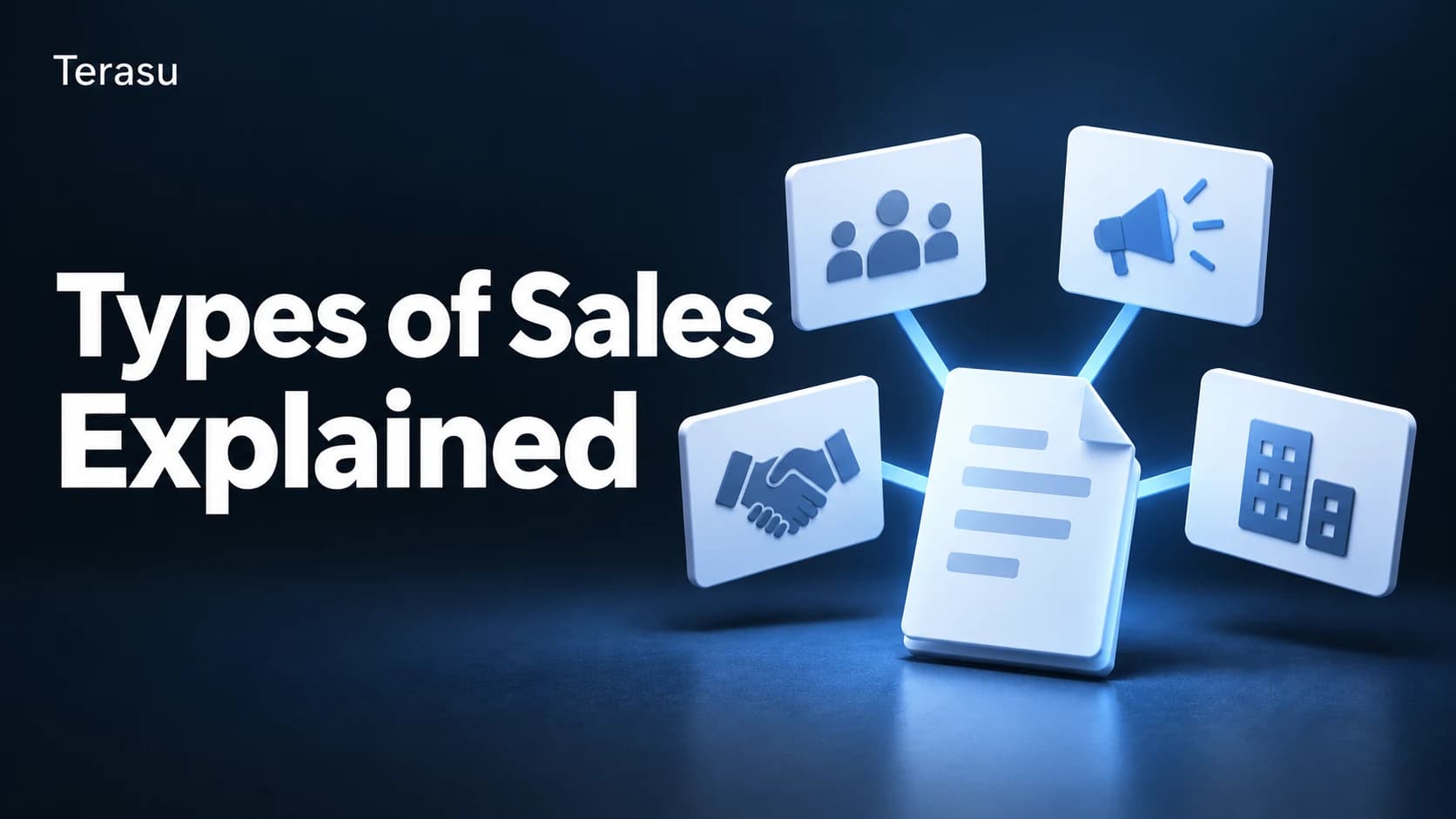
Types of Sales Explained: 4 Axes to Understand Every Sales Style and Role
The "types of sales" refer to a way of organizing sales activity along four classification axes: target customer (who you sell to), approach (how you make contact), relationship stage (new vs. existing), and company position (your own business model). B2B and B2C sales, new-business and account sales, inside and field sales, and manufacturer/distributor/agency sales are not mutually exclusive categories — they are simply different points on these four axes, and any real sales job is defined by the combination.
Key takeaways (TL;DR):
- Sales types can be organized along four axes: ① target customer (B2B / B2C), ② approach (push = proactive outreach / pull = inbound), ③ relationship stage (new business / existing-account / farming), ④ company position (manufacturer / distributor / agency). Most explainers just list methods vertically, but a real sales role sits at the intersection of these four axes
- Types overlap, they don't exclude each other: for example, "B2B inside sales for a SaaS product" is axis ① B2B × axis ② pull-leaning × axis ③ new business × axis ④ manufacturer (own product). Rather than forcing one job into one label, read it as a combination of axes and the confusion disappears
- The one overview you can actually compare with: this guide lines up every sales type in a unified format — definition / who it suits / key KPIs / hardest part / the operations that fit it. Unlike explainers that stop at definitions, you can apply it directly to your own fit or your org design
- A diagnosis to find the sales type that fits you: four branching questions — "who → how → what relationship → how deep a proposal" — point you to the right type and to a deeper guide for each
- Operational challenges common to every type: sharing customer information, making deals visible, and removing key-person dependency are needed regardless of sales type, and a Digital Sales Room (DSR) supports all of them as a single connecting layer
People look up "types of sales" for many reasons: job seekers who want the big picture and the differences between sales roles; managers wondering how to classify and design their own sales organization; people trying to untangle "how is inside different from field?" or "B2B vs. B2C — which suits me?" What they share is a desire to organize, once and clearly, all the sales labels that get thrown around separately.
Yet most explanations just stack methods vertically — "new-business sales, account sales, inside sales…" — and bolt on a description for each, without showing on what basis they are classified. So even after reading, the question "OK, but what actually makes this type different from that one?" remains.
This article reduces the types of sales to a single map of four classification axes, and lines up every type so you can compare them in a unified format — a pillar overview. Each type's work, fit, and difficulties are organized compactly, and for anything you want to go deeper on, we point you to a dedicated guide. The goal is not to memorize sales labels but to understand "on which axis, and how, they differ."
What you'll learn:
- The four axes that organize sales types (target customer, approach, relationship stage, company position)
- The differences between every type — B2B/B2C, new-business/account, inside/field, and more
- A side-by-side table comparing every type by fit, KPIs, and hardest part
- How sales differs by industry (real estate, finance/insurance, pharma, IT/SaaS, staffing, trading)
- A diagnosis flow to find the sales type that suits you, with an entry point into each deeper guide
- The operational challenges common to every type — and how to solve them
Sales types can be organized along four axes
Sales types are confusing because one sales job carries several labels at once. A salesperson who runs online meetings to win new customers at an IT company is, depending on how you look at it, "B2B sales," "new-business sales," "inside sales," and "intangible-product sales" all at the same time. These aren't contradictions — they're just the same job seen from different classification axes.
So let's organize sales into four representative axes. Any sales label can be understood as a combination of positions on these four axes.
| Axis | The question | Typical split | What changes |
|---|---|---|---|
| ① Target customer | Who do you sell to? | B2B / B2C | Number of decision-makers, length of cycle, buying logic |
| ② Approach | How do you make contact? | Push (new-business, cold visits, cold calls) / Pull (inbound) | Whether contact originates with you or the customer; psychological load |
| ③ Relationship stage | New or existing? | New-business sales / Account, farming, order-taking sales | Required skills, how you set KPIs |
| ④ Company position | Where do you sit? | Manufacturer / Distributor / Agency | Breadth of products, stakeholders, freedom of proposal |
How to read this table: to understand a single sales job, work through each of the four axes on the left and decide "which split does it fall into?" For instance, "in-store car sales to individuals at a dealership" is ① B2C × ② pull (you respond to people who walk in) × ③ new-business-leaning × ④ manufacturer (affiliated dealer). "Account sales at a trading company" is ① B2B × ③ existing (account) × ④ distributor, and so on.
Later we'll add two more important lenses: role (the inside/field division of labor) and proposal level (order-taking → proposal → solution). Strictly speaking these overlap with axes ② and ③, but they're indispensable for understanding modern sales organizations, so we give them their own chapters.
One last premise before the axes. There is no ranking among these types. It's not that new-business sales is noble and account sales is easy — each simply demands different strengths and carries different difficulties. Read on treating this as a map for spotting the type that suits you, and the type your organization needs.
【Axis 1】By target customer: B2B and B2C sales
When classifying sales, the biggest fork is "who do you sell to." Whether the other party is a company (business) or a consumer (individual) changes both how the deal unfolds and the skills required.
What is B2B sales?
B2B (Business to Business) sales targets companies and organizations. The defining trait is that multiple stakeholders are involved in the decision and the cycle is long. You have to win over a chain of people in different positions — the contact, the line manager, the decision-maker, the purchasing department — one by one.
That's why B2B sales prizes the ability to explain return on investment logically over emotional appeal, along with the skill to coordinate internal and external stakeholders. Because each deal is large and the relationship is expected to last beyond signing, building trust matters more than a quick close. For a deeper look at how to run B2B sales, see Designing the B2B sales process.
What is B2C sales?
B2C (Business to Consumer) sales targets individual consumers. It often deals with high-ticket items for individuals — real estate, cars, insurance, housing, financial products.
The decision-maker is essentially the person in front of you (or their family), and emotion, intuition, and trust tend to drive the purchase. So you need to empathize, dispel anxieties, and give the final nudge (the close) that helps the customer decide. That said, with high-ticket items like housing or investment products, even individuals weigh competitive comparisons and cost-benefit logic heavily — so rather than empathy alone, answering both the emotional and the logical side is what determines results. Compared with B2B, the cycle is shorter and on-the-spot conversation skill drives results more directly, but rejection is frequent, so mental toughness is required.
B2B vs. B2C sales
The differences can be summarized as follows.
| Item | B2B sales | B2C sales |
|---|---|---|
| Customer | Companies / organizations | Individual consumers |
| Decision-maker | Multiple (contact to approver) | Usually the individual / family |
| Cycle | Long (weeks to years) | Short (same day to weeks) |
| Deciding factor | ROI / logic | Emotion / trust / intuition |
| Deal size | Large | Varies by product |
| Main skill needed | Problem-solving, stakeholder coordination | Empathy, closing |
"Which suits you" depends heavily on personality: if you're good at building strategy logically, B2B fits; if you're good at engaging deeply with people and winning quick decisions, B2C fits. The questioning technique for surfacing issues in B2B is covered in detail in Sales discovery techniques.
【Axis 2】By approach: push and pull
The second axis is "how you make contact" — the direction of approach. Reaching out from your side to the customer is push (outbound); getting the customer to come to you is pull (inbound). Even for the same product, this design changes the sales style dramatically.
Push sales (new-business, cold visits, cold calls)
Push sales proactively reaches out to people you have no contact with yet. The three representative methods are:
- New-business sales: the umbrella term for building relationships from scratch with companies and customers you don't trade with. It spans list building, securing appointments, and the first meeting.
- Cold visits: visiting companies or homes without an appointment to create a deal opportunity on the spot, regardless of whether the other party is a qualified prospect.
- Cold calls: reaching out by phone to set up meetings or appointments, contacting many people in a short time.
The strength of push is that you can proactively target exactly who you want and open the market yourself. The downside is that the other party isn't in "buy now" mode, so rejection is likely and strong mentality and high activity volume are required. Push is sometimes described as the "hunter" style.
Pull sales (inbound)
Pull sales gets people to learn about you through advertising, web content, and word of mouth, then has interested customers reach out from their side. A representative form is the inbound/inquiry-response style, widely used in real estate, housing, insurance, and web services.
The biggest trait is that the prospect is already interested or actively evaluating, so conversion tends to be higher, product explanations go more smoothly, and the psychological load is lighter than cold visits or cold calls. However, because pull is "waiting," the promotion design that generates inquiries (advertising, content, SEO) drives results. The salesperson needs the counseling skill to accurately read the inquirer's needs and guide them to a decision with the right proposal. Pull leans toward the "farmer" style.
Push and pull are used in combination
In recent years, the mainstream design is to combine both rather than picking one. Gathering prospects on the web (pull) and then having sales proactively engage those whose interest has risen (push) is exactly the foundation of the inside/field division of labor discussed below. The direction of approach is inseparable from the design of the whole sales organization.
【Axis 3】By relationship stage: new-business vs. account and farming sales
The third axis is "what stage the customer relationship is at." Whether you're opening up customers you don't trade with yet, or deepening customers you already serve, changes both the sales style and how you set KPIs.
New-business sales
New-business sales builds relationships from scratch with customers you've never traded with. Beyond the push methods above (cold visits, cold calls), it includes first meetings from referrals and inquiries. It's the offensive sales that grows your base of revenue, and because rejection is routine, activity volume and stress tolerance decide results.
Account sales (existing-customer sales)
Account sales regularly visits existing customers you already trade with, hearing requests, making add-on proposals, and replenishing products. Compared with new business, there's less "fear of rejection," and you can sustain a stable relationship with set partners. Sincerity, diligent follow-up, and reliability in keeping promises are your weapons. At the same time, even what looks like routine work demands the sensitivity to catch shifts in existing customers' issues and turn them into new proposals.
Farming sales
Farming sales is a step beyond account sales, growing existing-customer business deeper and wider. With the same customer, you expand the deal size through proposals for new departments, new use cases, and upper-tier plans (upsell and cross-sell). Because it rests on a deep understanding of the customer's organization and business and a long-term relationship of trust, it demands both relationship-building and proposal skills.
Order-taking sales
Order-taking sales is the old-fashioned style of regularly visiting existing customers and responding to "is there anything you need?" requests. The customer is close and the relationship is stable, but it tends to be passive, and when the customer hasn't noticed their own issues, it's hard to create new value. As we'll see, sales styles evolved from this order-taking model toward a "proposal" model.
The relationship stage is easiest to grasp as a flow over time — "new → existing (account) → farming" — and can be read as a single story: open the door with new business, then grow lifetime value (LTV) through account and farming.
【Axis 4】By company position: manufacturer, distributor, and agency sales
The fourth axis is "where your business sits." Even for the same product, the sales style differs between "the company that makes it," "the company that sources and sells it," and "the company that sells on behalf of others."
Manufacturer sales
Manufacturer sales sells products your company makes. You promote and sell your own products to wholesalers, retailers, and end users. The strength is understanding one product deeply and being able to speak to its appeal better than anyone. Affection for and expertise in your own product, plus an understanding of industry conventions, are your weapons. Since the products you handle are limited to your own, the breadth of proposal is narrower, but you have product strength as a foundation.
Distributor (trading) sales
Distributor/trading sales sources products from many manufacturers and proposes to fit the customer's needs. Not being tied to your own products, the strength is proposing the best combination from a wide range of options. Information-gathering, coordination, and (depending on the field) language skills matter more than knowledge of any single product. It suits people who want to "build the optimal answer without being boxed in."
Agency sales
Agency sales recruits and develops partner companies (agents/resellers) that sell your products. Rather than selling directly to end users yourself, the job is to "increase the people who sell, and teach them how to sell." Consulting ability and the management skill to move others are required. It suits people who prefer supporting others to deliver results over standing in the front line themselves.
| Company position | What you handle | Strength | Skill required |
|---|---|---|---|
| Manufacturer sales | Own products only | Deep product knowledge / affection | Expertise, industry understanding |
| Distributor sales | Diverse sourced products | Freedom of proposal, breadth of options | Information-gathering, coordination |
| Agency sales | Own products (via partners) | Leverage (moving people) | Consulting, partner development |
This axis is especially useful when sizing up "what kind of company's sales" a job is. Even within the same "sales role," the day-to-day differs entirely between a manufacturer, a distributor, and an agency.
Sales by role: inside sales, field sales, and customer success
On top of the four axes, what's indispensable for understanding modern B2B sales is "the division of labor by role (function)." A single salesperson used to handle everything end to end — from securing appointments to closing to after-sales follow-up. But the "The Model" style of division of labor, which breaks the sales process into specialized parts, spread, and each role came to be called a separate job.
Inside sales (IS)
Inside sales uses phone, email, and web meetings to build relationships and qualify deals remotely. It nurtures prospects (leads) and hands them to field sales when interest rises. Because there's no travel and you can contact many people a day, it's efficient, and activity history is recorded digitally. See What is inside sales? for details.
Field sales (FS)
Field sales meets the customer in person (or runs key meetings online) to move from concrete proposal to closing the contract. It takes over deals inside sales has warmed up and advances full negotiations involving decision-makers. It's the position that delivers the "decisive blow" of divided sales, demanding high negotiation skill and problem-solving proposal ability. Practical preparation for field sales is covered in the Field sales preparation guide.
Customer success (CS)
Customer success accompanies the customer after signing, helping them use the service to get results and leading to retention and expansion. Its importance rose alongside the spread of subscription (SaaS) businesses. It handles proactive proposals to prevent churn and expands the deal through upsell and cross-sell, moving on the belief that "signing isn't the goal — the customer's success is."
Why divide the labor?
The aim of role division is specializing each process to raise productivity and repeatability. When one person does everything, you get variance between strengths and weaknesses and an inability to focus on the deal. With division of labor, IS handles lead nurturing, FS handles closing, and CS handles adoption and expansion, so each focuses on their strength.
But division carries the risk of "handoff fragmentation." If the customer's temperature and context that IS grasped don't reach FS, the customer is forced to repeat the same explanation and the experience degrades. The mechanism for smoothing this handoff connects directly to the common operational challenges discussed below. The practical work of linking inside and field sales is covered concretely in the Inside sales DSR workflow.
Sales by proposal level: order-taking → proposal → solution selling
Another important lens for understanding sales is the proposal-level axis: "how deep into the customer's issues you go with your proposal." This roughly overlaps with the historical evolution of sales styles.
① Order-taking sales (reactive)
The starting point is order-taking sales, which hears and answers the customer's requests. "Any orders?" "Shall I replenish stock?" — it responds to the explicit needs the customer already recognizes. The relationship is stable, but it can't reach issues the customer hasn't put into words.
② Proposal sales (proactive)
The next stage is proposal sales. Before the customer asks, you proactively propose "isn't this an issue?" or "wouldn't this product help?" Where order-taking is "waiting," proposal sales observes the customer's situation and presents value from your side.
③ Solution selling / consultative selling
Further along is solution selling (consultative selling). Instead of selling individual products, you dig up the customer's latent issues themselves and propose a custom solution combining your products and services. Because it shines a light on issues the customer hasn't even noticed, it demands deep discovery skill, industry understanding, and the ability to build hypotheses.
This evolution in proposal level reflects the market's shift from a "good product sells itself" era to an era where "the party that can solve the problem gets chosen." The concrete steps of solution selling are covered in the Complete guide to solution selling, and the frameworks for advancing deals in 18 sales frameworks.
| Proposal level | Customer's needs | Sales motion | Skill needed |
|---|---|---|---|
| Order-taking | Explicit (aware) | Answers requests (waiting) | Relationship upkeep, sincerity |
| Proposal | Explicit + some latent | Proposes proactively | Observation, proposal skill |
| Solution selling | Latent (unaware) | Digs up issues, designs solutions | Discovery, hypothesis building |
More recently, advanced forms like challenger selling — which "teaches" the customer a new perspective — are also drawing attention. The proposal level is, in a sense, the very history of how sales evolved from mere "selling" into a "problem-solving partner for the customer."
Quick-reference unified comparison of sales types
This is the core of the article. Many explainers of sales types just line up definitions and offer no side-by-side comparison. So here we list the major sales types in a unified format: definition / who it suits / key KPIs / hardest part / operations that fit. Whether you're searching for your own fit or thinking about which role to place in your org, you can start from this single table.
| Sales type | Rough definition | Who it suits | Example key KPIs | Hardest part |
|---|---|---|---|---|
| B2B sales | Sells to companies | Logical, good at coordination | Won amount, deal-progress rate | Long cycle and internal coordination |
| B2C sales | Sells to consumers | Empathy, quick decisions | Conversion rate, contract count | Rejection tolerance, reading emotion |
| New-business sales | Creates customers from zero | Activity volume, resilience | Deals created, new bookings | Continuous rejection stress |
| Account / farming sales | Retains and grows existing | Sincere, relationship-building | Retention, upsell amount | Going passive, relationship staleness |
| Pull (inbound) sales | Handles inquiries | Listening, counseling | Inbound conversion, throughput | Inbound volume depends on marketing |
| Inside sales | Remote nurture and qualify | Efficiency, data management | Qualified deals, calls/touches | Passing temperature accurately to FS |
| Field sales | In-person proposal and close | Negotiation, problem-solving | Win rate, won amount | Handoff gaps, large-deal management |
| Customer success | Post-sale guidance and expansion | Hands-on support, anticipation | Retention, churn rate, NRR | Catching churn signals early |
| Manufacturer sales | Sells own products | Expertise, product passion | Units sold, market share | Proposal limited to own products |
| Distributor sales | Sells sourced products | Information-gathering, coordination | Trading volume, gross margin | Coordinating many stakeholders |
| Agency sales | Sells via partners | Development, consulting | Partner-sourced revenue, activation | Can't move revenue directly yourself |
| Solution selling | Designs and sells solutions | Discovery, hypothesis building | Win rate, proposal adoption | Surfacing latent issues |
How to use this table: first find the "who it suits" row closest to your personality and strengths, then check whether you can tolerate that type's "hardest part." From an org-design angle, identify where your sales process has a hole (not enough new business / existing not growing / poor handoffs) and choose the type to reinforce. Note that the KPIs are representative examples; the optimal metrics vary by industry and product. How to set each metric is also covered in the Sales strategy guide.
Note that the KPIs in this table are "representative examples that are easy to set as targets on the ground." For instance, an activity KPI like inside sales' "call count" easily degenerates into "chasing numbers" unless operated together with a result KPI (qualified deals), so always design it in combination with a result metric.
Clearing up common confusions about sales types
Sales types get confusing when you compare words from different classification axes on the same footing. Finally, let's sort out the "difference between X and Y" pairs that often appear in searches, by which axis they belong to.
- "Account sales vs. inside sales": different axes. Account sales is about axis ③ relationship stage (existing); inside sales is about role (the remote-nurturing function). "Inside sales handling existing customers remotely" is possible, so they aren't opposing concepts.
- "Inbound sales vs. inbound marketing": nearly the same concept, both pointing to axis ② pull. One is the name of the sales role/style, the other describes the direction of demand generation — mostly a difference in phrasing.
- "Solution selling vs. proposal sales": adjacent stages on the proposal-level axis. Proposal sales is proactive proposal for explicit needs; solution selling goes further to dig up latent issues.
- "Field sales vs. B2B sales": different axes. B2B sales is about axis ① target customer (companies); field sales is about role (the in-person closing function). They coexist, as in "field sales for B2B."
Just by being conscious of "which axis the word belongs to," the differences between similar terms sort themselves out cleanly.
Sales types by industry
So far we've sliced sales by "classification axis." In practice, though, the actual jobs and work vary strongly by industry. Let's look at the characteristics of sales in representative industries.
Real estate
Split between individual (homes, investment) and corporate (land sourcing, tenants), and because it deals with high-ticket items, the commission per deal is large. Both inbound (inquiry response) and new business exist, and while results are reflected in income, the pressure is also high.
Finance and insurance
To individuals, it proposes deposits, loans, insurance, and securities; to companies, financing and corporate insurance. Expertise and qualifications are required, and trustworthiness drives results. Some forms have a high performance-pay ratio, so top performers earn well, but the numbers management tends to be strict.
Pharma and medical (MR)
An MR (Medical Representative) is the sales role at a pharmaceutical company, providing information on drugs to hospitals and healthcare professionals. Rather than selling itself, the focus is accurate provision and collection of information on quality, efficacy, and safety. Advanced expertise and an understanding of the medical industry's particular conventions are essential.
IT and SaaS
Centered on intangible-product B2B sales for software and cloud services. It's also the field where the inside/field/customer-success division of labor (The Model) is most advanced. Logical proposal skill and the ability to articulate adoption value are tested, and it's a field where openings have grown especially in recent years.
Staffing
Handles job advertising, recruiting agencies, and staffing dispatch. It often faces both sides — companies (who want to hire) and job seekers (who want to work) — so issue-discovery and matching skills matter. It's an intangible product, and proposal skill strongly drives results.
Trading companies and manufacturers
Here the company-position axis itself becomes the industry characteristic. General and specialized trading companies center on a coordination-type sales handling a wide range of products; manufacturers center on a specialist-type sales pitching their own products deeply. B2B account and farming sales make up much of the work.
When choosing an industry, applying the axes — "tangible or intangible" (how easy the product is to explain), "individual or corporate," "new business or account" — makes it easier to narrow down the environment that suits you.
How sales styles evolved
The reason there are so many sales types is no accident. It's the result of sales styles evolving in stages alongside changes in the market and the buyer. Captured as a flow of history, it becomes clear why each type was born.
The shortage era: order-taking sales
When goods were scarce and "if you made it, it sold," sales' role centered on taking orders and delivering. Visiting customers regularly and answering their requests — order-taking sales — was the mainstream. Customers knew what they wanted, and sales just had to meet demand.
The saturation era: toward proposal sales
As the market matured and similar products flooded in, just waiting no longer got you chosen. So proposal sales, which presents value from your side, spread. It was a shift from "moving after being told" to "making a useful proposal before being told."
The problem-solving era: solution selling
Further, when products alone no longer differentiated, it became recognized that what customers truly want is not "a product" but "a solution to their problem." Solution selling (consultative selling), which digs up latent issues the customer hasn't even noticed and designs solutions, took hold as high-value-added sales.
The buyer-led, divided-labor era: inside / field / CS
Then, with the spread of the internet, buyers came to gather information and compare on their own before ever meeting sales. As the buyer's purchasing process changed, sales evolved from "one person doing everything" to dividing roles into lead nurturing (IS), deal closing (FS), and post-sale success (CS). The spread of SaaS accelerated this.
What's next: the era of data and customer sharing
Today, deals have moved online and the customer's evaluation process can be made visible as data. Which materials were viewed, where evaluation stalled — the movement to put such behavioral data to work in sales is spreading, and mechanisms like the Digital Sales Room (DSR), which advance decisions together while sharing information with the customer, are drawing attention. The evolution of sales styles is still ongoing.
Knowing this flow makes questions like "why did inside sales become necessary?" or "why is solution selling valued?" understandable as market inevitabilities. The types of sales are best read as the strata of history created by the buyer's changes — organized by understanding rather than memorization.
【Diagnosis】How to choose the sales type that suits you
Using the classification axes above, you can narrow down "which sales suits me" and "which sales I should research." Answer the following four questions in order. For detailed explanations of each type, we provide entry points both within this article and into individual guides.
Narrow it down with four questions
- Who do you want to sell to? → If you want to work logically with companies, B2B sales; if you want to face consumers directly, B2C sales.
- How do you want to make contact? → If you want to initiate yourself, new-business / push; if you want to respond to interested parties, inbound / pull.
- What kind of relationship do you want? → If you want to keep creating new encounters, new-business sales; if you want long relationships with set partners, account / farming sales.
- How deep do you want to propose? → If answering requests feels comfortable, order-taking to proposal sales; if you want to dig up the issues themselves, solution selling.
The combination of these four answers forms the outline of the sales type that suits you. For example, "B2B × pull × new-to-existing × solution" points to candidates like SaaS inside sales / field sales.
Let's work a concrete example. Diagnosing someone who says "I want deep, lasting relationships," "I'd rather build trust than pitch from zero," and "I want to make proactive proposals after reading the situation" — ① can be either B2B or B2C, ② leans pull, ③ existing (account/farming), ④ proposal to solution. In that case, farming sales that deepens existing customers or customer success that accompanies customers after signing are strong candidates. Conversely, someone who says "I want to keep creating new encounters," "rejection doesn't bother me," and "chasing numbers is fun" centers on ② push × ③ new business, so new-business sales or field sales fits. Just by lining up the answers to four questions, the types worth considering naturally narrow to two or three.
A reverse-lookup hub into deeper guides per type
Once a type catches your eye, head to its detailed explanation. The "guide" column below collects the entry points (individual guides are published progressively).
| Sales type | For people / orgs who… | Guide |
|---|---|---|
| B2B sales | Want to run B2B logically | Individual B2B sales guide coming soon |
| Inbound sales | Want to master inquiry response | Individual inbound sales guide coming soon |
| Field sales | Handle in-person proposal and close | Field sales preparation guide |
| Inside sales | Nurture and qualify remotely | What is inside sales? / DSR workflow |
| Farming sales | Want to grow existing customers | Individual farming sales guide coming soon |
| Order-taking sales | Want to rethink existing-account work | Individual order-taking sales guide coming soon |
| Proposal sales | Want to strengthen proactive proposals | Individual proposal sales guide coming soon |
| Solution selling | Want to sell problem-solving | Complete guide to solution selling |
| Agency sales | Want to expand via partners | Individual agency sales guide coming soon |
If you want to systematically build the sales "form" itself, the Complete guide to sales skills and techniques; for the thinking frameworks that advance deals, 18 sales frameworks — reading these together turns type understanding into practice.
What every sales type needs in common
We've divided sales types finely, but there are also things needed in common regardless of type. In fact, this common part is the very foundation of sales results.
1. Sharing customer information
Whether B2B sales or inside sales, if the information — who has what issue, and how far evaluation has progressed — isn't shared across the organization, details fall through the cracks at each handoff, and the customer is made to repeat the same explanation. Especially as role division (IS → FS → CS) advances, the quality of information sharing shapes the customer experience.
2. Making deals visible
If you can't see how far a deal has progressed and what to do next, managers can't help, and the rep themselves can't catch omissions. Making deal progress and actions visible is indispensable in both new business and account sales.
3. Removing key-person dependency
"Only that person understands it," "the relationship broke when the rep changed" — key-person dependency is a universal challenge that happens in every type. Leaving top performers' moves and customer interactions as a team asset raises repeatability across the whole organization.
A DSR as the connecting layer
What supports these three common challenges across every sales type is the Digital Sales Room (DSR). A DSR provides a dedicated online space per customer, advancing the deal while sharing proposal materials, meeting notes, and next actions with the customer.
- Sharing customer information: centralizes the information and materials from deals, smoothing the IS → FS → CS handoff
- Making deals visible: grasp the temperature of evaluation from behavioral data on which materials the customer viewed and when
- Removing key-person dependency: interactions remain as records, making rep changes and org-wide knowledge sharing easy
Whatever sales style you choose, what ultimately decides results is less the "form" itself than the operations that keep it running across the organization. To turn type understanding into practice, keep an eye on the common foundation, too.
Whatever your sales style, manage every customer deal in one place with Terasu
With Terasu's DSR, from inside sales to field sales to customer success, you can support sharing customer information, making deals visible, and removing key-person dependency end to end. Try it free.
Start for freeSales that are easy to start without experience, and the structure of "tough" sales
What many people researching "types of sales" care about is how easy it is to start without experience and how tough (demanding) it is. Finally, let's structure these two points using the classification axes so far.
Sales that tend to be easy to start without experience
The types easy to start without experience have the following traits:
- Account sales: the counterpart is existing customers you already have a relationship with, so there's less of new business's "rejection stress," and the workflow is easy to learn.
- Inbound sales (consumer-facing): the counterpart is a customer who "wants to buy," so you can quickly build a track record of conversions.
- Inside sales: division of labor and manualization are advanced, and as an inside role you get feedback easily.
What a newcomer should look at first is less the role itself than "whether the training system is in place" and "whether the process to results is systematized." At first, tangible products (physical goods) tend to be easier to explain value for and easier to internalize knowledge.
The true nature of "tough" sales
The reasons sales is called "tough" differ by type — the kind of toughness is different. Confusing them leads to the misunderstanding that "all sales is hard."
| Kind of toughness | Types where it shows strongly | Direction of relief |
|---|---|---|
| Mental load of continuous rejection | New business, cold visits, cold calls | Move to pull / account; improve list accuracy |
| Long cycle and internal coordination | Large B2B sales | Systematize deal management; visualize progress |
| Pressure of numbers (quota) | B2C, commission-based | Design to evaluate the process via activity KPIs |
| Handoff and relationship fragmentation | Divided (IS/FS/CS) | Systematize information sharing (DSR, etc.) |
What matters is separating "I dislike sales itself" from "the current type/environment doesn't fit me." If you're bad at continuous rejection, move to pull or account sales; if chasing numbers is painful, move to an environment that evaluates activity — in this way, problems are often solved just by changing type. The real value of knowing the types of sales lies here.
Frequently asked questions (FAQ)
What types of sales are there?
The types of sales can be broadly organized along four classification axes: ① target customer (B2B / B2C), ② approach (push, like new-business and cold visits / pull, like inbound), ③ relationship stage (new-business / account and farming), ④ company position (manufacturer / distributor / agency). On top of that, there are views by role division — "inside sales, field sales, customer success" — and by proposal level — "order-taking, proposal, solution selling." A single sales job is determined by the combination of these axes; they aren't mutually exclusive.
What are the four types of sales?
By crossing two axes — "target customer (B2B / B2C)" and "approach (new-business = offensive / existing-and-inbound = defensive, waiting)" — you can split sales into four quadrants. For example, "B2B × new-business" is B2B new-business sales, "B2B × existing" is account/farming sales, "B2C × new-business" is cold-visit/door-to-door sales, and "B2C × inbound" is in-store/inquiry-response sales. Captured this way, as a crossing of axes, "the four types of sales" become easier to understand.
What is the difference between B2B and B2C sales?
The biggest differences are "the number of decision-makers" and "the deciding factor." B2B sales faces companies, with multiple stakeholders and a long cycle, demanding the ability to explain ROI logically and to coordinate internal and external parties. B2C sales faces individual consumers, where the person is usually the decision-maker, emotion and trust tend to decide, and empathy plus closing skill matter. For B2B, each deal is large and long-term relationship-building matters; for B2C, on-the-spot conversation drives results.
What types of sales by company position are there?
"Sales by company position" usually refers to classification by your position in the business model, with manufacturer, distributor (trading), and agency sales being representative. Manufacturer sales sells your own products, with expertise and product knowledge as strengths. Distributor sales handles diverse sourced products, with freedom of proposal and coordination as weapons. Agency sales recruits and develops partner companies that sell your products, demanding the consulting ability to move people. Even for the same product, the style differs between the maker, the sourcer, and the agent.
What sales methods are there?
As a classification of methods by approach: push (reaching out from your side) includes new-business, cold visits, and cold calls; pull (having customers come to you) includes inbound sales. By relationship stage, it splits into new-business and account sales; by role, into inside and field sales; by proposal level, into order-taking, proposal, and solution selling. These view sales methods from different axes, and in practice sales combines multiple methods.
Which type of sales is the toughest?
You can't say "this one is the toughest" uniformly — the kind of toughness differs by type. New-business, cold visits, and cold calls bring "the mental load of continuous rejection"; large B2B sales brings "the long cycle and internal coordination"; B2C and commission-based bring "the pressure of numbers (quota)"; divided types (IS/FS/CS) bring "handoff and relationship fragmentation." What matters is choosing a type that lets you avoid the toughness you're weak against. For instance, if you're bad at rejection, just moving to pull or account sales changes the load substantially.
How should I choose the sales type that suits me?
You can narrow it down by answering four questions in order. ① Who do you want to sell to (companies = B2B / consumers = B2C), ② how do you want to make contact (initiate yourself = new-business/push / respond = inbound/pull), ③ what relationship do you want (new encounters = new-business / long relationships = account/farming), ④ how deep do you want to propose (answer requests = order-taking/proposal / discover issues = solution selling). This combination forms the outline of the type that suits you. Because personality fit matters greatly, choosing based on whether you can avoid the toughness you're weak against is recommended.
Which types of sales are easy to start without experience?
Account sales (where the counterpart is existing customers, with little rejection stress), consumer-facing inbound sales (where the counterpart is a customer who "wants to buy"), and inside sales (where division of labor and manualization are advanced and you get feedback easily as an inside role) tend to be easy to start without experience. Prioritizing "whether the training system is in place" and "whether the process to results is systematized" over the role itself reduces the chance of failure, and at first tangible products are easier to explain value for and easier to internalize knowledge.
What is the difference between inside sales and field sales?
The role (the sales process they handle) differs. Inside sales (IS) nurtures prospects remotely via phone, email, and web meetings, and hands them to field sales once qualified. Field sales (FS) handles everything from concrete proposal to closing, in person or in key online meetings. With IS "creating the deal" and FS "closing the deal," each focuses on their strength. In their collaboration, accurately passing the customer's temperature and context that IS grasped over to FS shapes both the customer experience and the win rate.
There's no point in memorizing sales labels for their own sake. What matters is understanding "on which axis, and how, they differ," and being able to spot the type that fits you or your organization. Keep this article's four-axis matrix and unified comparison table at hand as a map, and dig deeper into any type that catches your eye via its individual guide. And whatever type you choose, what ultimately decides results is the "operations" foundation — sharing customer information, making deals visible, and removing key-person dependency. By all means, turn your understanding of types into real results.
![What Is Lead-to-Opportunity Conversion Rate? Formula, Average & How to Improve It [2026]](/_next/image?url=%2Fimages%2Fblog%2Fbrand-20261011-all-en-opportunity-conversion-rate-guide.webp&w=828&q=75)