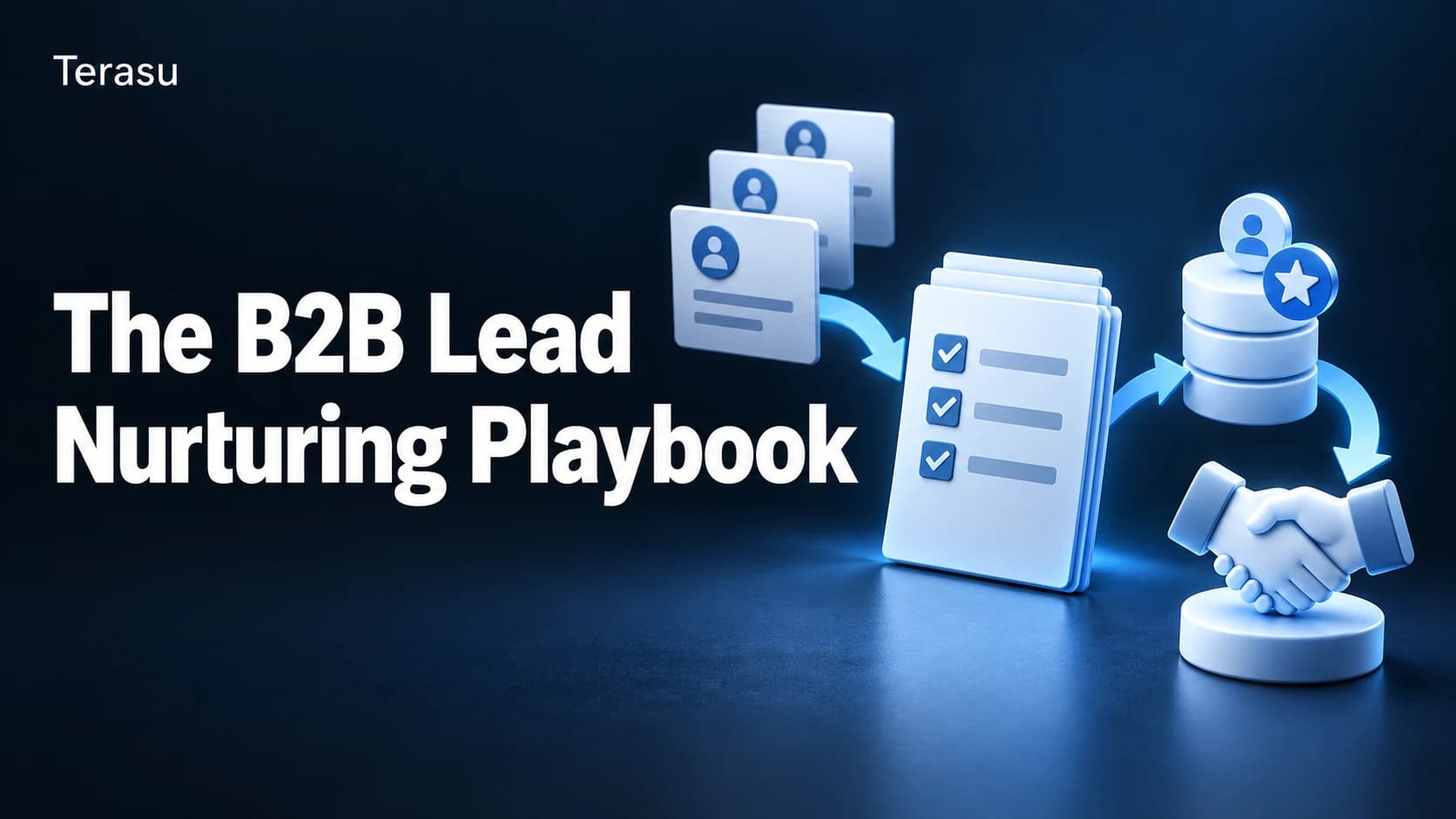
The B2B Lead Nurturing Playbook: Process Templates, Scoring Models, and Sales Handoff Design (2026)
Lead nurturing is the practice of maintaining continuous touchpoints with acquired prospects (leads), gradually raising their buying intent through useful information, and converting them into sales opportunities. The term combines "lead" (a prospective customer) and "nurturing" (cultivation and development).
You collected leads at trade shows and through content downloads—but "sales says the list is useless," or "we can't keep up with follow-ups and the untouched list keeps growing." Most people researching lead nurturing start from exactly this situation.
Most articles explain what lead nurturing is and list five tactics, but they stop short of the actual blueprint you need to run it: how to write scenarios, how many points to assign in your scoring model, and at what state you hand a lead to sales. This guide was written to fill that gap, for B2B practitioners.
Key Takeaways
- Lead nurturing is the middle step of "generate → nurture → qualify." Most acquired leads are not ready to buy now, so without a nurturing system, acquisition spend leaks away.
- Before choosing tactics, decide the first move per lead source and the behavioral triggers for each play. Listing tactics without triggers leads to initiative sprawl.
- Process design has six steps: persona → scenario → trigger → content → scoring → handoff. The fill-in templates in this article let you design it as you read.
- Score on two axes—attributes × behavior—and the model only works as a four-part set: thresholds, decay, and MQL/SQL handoff criteria included. A complete point table is provided below.
- Marketing automation (MA) automates delivery, but it does not create your scenarios, content, or handoff criteria. Locking down operations manually before buying a tool is the shortest path around failure.
What Is Lead Nurturing? The Big Picture
Lead nurturing means continuously delivering information matched to each prospect's stage of consideration, raising their buying intent, and converting them into sales conversations. In the demand funnel, it sits between acquiring leads and qualifying them.
Nurturing derives from the English verb "nurture" (to raise, to cultivate); in business it means "developing" customers. A useful mental model: just as you water a plant and feed it at the right time, you grow a lead (a seed) into a deal (the fruit).
Clearing up the terminology
Different people use different words, but the meanings largely overlap. Here is a quick map of easily confused terms.
| Term | Primary target | Nuance |
|---|---|---|
| Nurturing | Both prospects and existing customers | The broadest concept; an umbrella for development activities |
| Lead nurturing | Prospects (leads) | Growing pre-purchase prospects toward a deal; most common in B2B |
| Customer development | Prospects and existing customers | The everyday phrase for nurturing |
| Customer nurturing | Existing customers | Developing existing customers for upsell and retention |
Unless noted otherwise, this article uses "nurturing" in the sense of lead nurturing (targeting prospects).
The "nurture" step inside demand generation
Lead nurturing is not a standalone tactic; it is the middle stage of the end-to-end process that creates sales opportunities (demand generation).
| Layer | Concept | Role |
|---|---|---|
| Whole | Demand generation | The umbrella for all activities that create opportunities (acquisition through qualification) |
| Step 1 | Lead generation (acquire) | Collect prospect contact information and build the list |
| Step 2 | Lead nurturing (develop) | Raise the buying intent of acquired leads ← this article |
| Step 3 | Lead qualification (select) | Identify the high-probability leads and pass them to sales |
This positioning matters because nurturing that is not connected to the steps before and after it does not work. If acquisition does not capture lead quality and source data, you cannot segment your nurture streams; if the qualification criteria are not agreed with sales, the leads you developed never become deals.
How nurturing differs from generation and qualification
The three steps differ in purpose, audience, and goal.
| Dimension | Lead generation | Lead nurturing | Lead qualification |
|---|---|---|---|
| Purpose | Collect prospects | Raise buying intent | Select high-probability leads |
| Audience | Potential customers with no prior contact | All acquired leads | Leads whose development has progressed |
| Main means | Ads, SEO, trade shows, content downloads | Email, webinars, content, inside sales | Scoring, discovery conversations |
| Goal | Contact information captured (a list) | Leads raised to a sales-ready state | Confirmed leads handed to sales |
| Main owner | Marketing | Marketing + inside sales | Inside sales + sales |
Why B2B Revenue Depends on Lead Nurturing
Lead nurturing has become indispensable in B2B because buying behavior shifted from "sales meets and persuades" to "buyers research and decide on their own."
Buyers spend only 17% of the purchase process with vendors
According to Gartner, B2B buying groups spend only 17% of the total purchase journey meeting with potential suppliers, and complex solution purchases involve six to ten decision makers (source: Gartner, The B2B Buying Journey).
In other words, buyers spend more than 80% of their consideration time gathering information and aligning internally—where no salesperson is present. Lead nurturing is the system that serves that other 83% of the journey: delivering useful information that moves the evaluation forward when you cannot be in the room. This thinking is closely related to buyer enablement—helping buyers buy, rather than helping sellers sell.
Most acquired leads are not ready to buy now
Of the leads captured through downloads or trade shows, only a small fraction are "buy-now" prospects. The majority feel the problem but have not started evaluating. That is where this vicious cycle begins:
- Sales calls the entire list → almost everyone says "we're not evaluating yet"
- Sales concludes "this list is low quality" and stops following up
- Leads sit untouched; by the time they enter an evaluation cycle, they have gone to a competitor
- Marketing pours budget into acquiring yet more new leads
Nurturing breaks this structure and turns the "not yet" majority into a pipeline asset over time. Forrester Research's often-quoted finding—that companies that excel at lead nurturing generate roughly 50% more sales-ready leads at about 33% lower cost—dates from the early 2010s and circulates mostly as a second-hand citation, so treat the exact figures with caution. Still, the direction—organizations with a nurturing system convert more opportunities from the same acquisition volume—matches what practitioners see.
Long cycles and group consensus make nurturing mandatory
In B2B, months can pass between a champion's first interest and final internal approval—and as noted above, six to ten stakeholders are involved. Raising one person's buying intent is not enough; you must keep supplying information that answers the distinct questions of executives, IT, finance, and other stakeholders as the evaluation progresses. Serving "a long timeline × many stakeholders" is physically impossible as an individual selling effort. It requires nurturing as a system.
Nurturing Tactics and Their Operating Design
The standard lead nurturing tactics are email (newsletters and drip sequences), webinars, whitepapers, owned media, inside sales, and retargeting ads. But picking from a list of tactics is how programs die. What matters in practice is the operating design: what starts each play, how often it runs, how much effort it takes to stand up, and what you measure.
Operating design table by tactic
| Tactic | Trigger | Typical cadence | Setup effort | Primary KPIs |
|---|---|---|---|---|
| Newsletter (batch email) | Fixed schedule | Weekly to twice monthly | Low (reuse existing content) | Open rate, click rate, unsubscribe rate |
| Drip / sequence email | Origin behavior (download, signup) | 3–5 emails at 3–7 day intervals | Medium (scenario design required) | Completion rate, click rate, next-action rate |
| Segmented sends | Attribute/behavior condition match | Whenever conditions trigger | Medium (segment definitions required) | Click rate, opportunity conversion |
| Webinars | Scheduled with promotion window | Monthly to quarterly | High (planning, promotion, operations) | Registration, attendance, survey responses, conversions |
| Whitepapers | Always-on (download form) | Added over time | Medium–high (asset production) | Downloads, post-download behavior |
| Owned media articles | Always-on (search traffic) | Continuous publishing | High (sustained production) | Traffic, engagement, conversion rate |
| Inside sales calls | Score threshold or key action detected | Per signal | Medium (team and criteria needed) | Connect rate, conversation rate, opportunity rate |
| Retargeting ads | Site visit without conversion | Always-on | Low–medium (ad ops) | Return visits, CVR, CPA |
| Digital sales room (DSR) | Around active evaluations | Persistent per lead | Low (consolidate assets and invite) | View time, return visits, number of viewers |
The key column is "Trigger." Only the newsletter runs on your schedule; everything else runs on the lead's behavior. A program's maturity can be measured by how much of its activity has shifted from schedule-driven to behavior-driven.
The first move, by lead source
A common stumbling block is "leads arrive from different channels—what do we send first?" Temperature varies by source, so the first move should too.
| Lead source | Temperature | First move | What not to do |
|---|---|---|---|
| Inquiry / demo request | High | Personal outreach within 24 hours (sales or inside sales) | Dropping them into a drip sequence |
| Pricing / product sheet download | Medium–high | Thank-you email plus relevant case studies by next business day | Pushing for a meeting immediately |
| Educational whitepaper download | Medium | Drip sequence delivering related topics in stages | Leading with pricing or contract talk |
| Webinar attendance | Medium | Follow-up within 24 hours, segmented by survey answers | Calling every attendee indiscriminately |
| Trade show badge scan | Low–medium | Thank-you email, then a light question to identify interest | Handing raw badge scans to sales as "qualified" |
| Newsletter signup only | Low | Maintain the relationship via regular sends; wait for behavior | Adding them straight to a call list |
Deciding "source × temperature × first move" closes the single largest leak in nurturing: the days right after acquisition.
A drip sequence design example (five emails)
The drip sequence at the heart of most nurture programs follows one principle: push the selling toward the end. Here is a five-email structure starting from an educational download.
| Timing | Content | Purpose | Sales intensity | |
|---|---|---|---|---|
| #1 | Immediately after download | Thank you + key takeaways of the asset + one related article | Build the open habit; initialize trust | None |
| #2 | Day 3 | Content exploring adjacent problems to the downloaded topic | Deepen problem understanding | None |
| #3 | Day 7 | A customer case study solving the same problem | Help them picture the solved state | Low (your product appears in the story) |
| #4 | Day 11 | Webinar or consultation invitation | Escalate to a two-way touchpoint | Medium |
| #5 | Day 15 | "Resources for your evaluation" + a reply path for questions | Elicit behavioral signals; present the exit | Medium |
Three design principles: first, never sell in email #1—if the first email pitches a meeting, every subsequent email gets treated as a sales email and goes unopened. Second, one message per email; stacking topics makes click data unreadable. Third, exactly one call-to-action link per email, so each click becomes clean behavioral score and interest data.
Chasing leads who ignore all five emails backfires. Define the exit condition in advance (for example: three consecutive unopened emails → downgrade to the monthly newsletter) to protect the list from fatigue.
Determining Funnel Stage from Behavioral Signals
Nurturing changes the play based on where the lead sits in the funnel (awareness → interest → evaluation → pre-deal). The hard part is knowing which stage that is. Surveys work but only a fraction answer; in practice, you infer the stage from behavioral signals.
| Stage | Detection signals (behavior) | Interpretation | What to deliver next |
|---|---|---|---|
| Awareness | Newsletter opens only; blog reading | Aware of the problem; not yet exploring solutions | Problem explainers, how-to content |
| Interest | Whitepaper downloads; webinar attendance | Learning the solution landscape | Method comparisons, research reports, webinars |
| Evaluation | Case study views; pricing page views; repeat visits | Comparing specific products and vendors | Case studies, comparison assets, ROI estimates |
| Pre-deal | Long pricing-document sessions; multi-person document viewing; demo request | Internal review and approval prep underway | Tailored proposal, quote, security docs, FAQ |
"Multiple people viewing the same document" is one of the most valuable signals in B2B: the champion has started circulating materials internally, meaning the internal approval process is in motion. Email opens cannot capture this; the engagement data from a digital sales room (DSR), discussed below, is what makes it visible.
Laid out by stage, the move, content, KPI, and the approach to avoid look like this. Sending a price sheet to an awareness-stage lead won't land; conversely, sending introductory educational content to a lead near the decision makes them feel "they don't understand me."
| Stage | Lead's mindset | Move | Content to provide | Main KPI | NG approach |
|---|---|---|---|---|---|
| Awareness | Beginning to notice a problem | Maintain touch via blog, social, newsletter | Problem explainers, how-to articles | Traffic, opens, recall | Hard selling, price up front |
| Interest | Starting to look for solutions | Webinars, white papers | Solution methods, research reports | Downloads, attendance, click-through | Pushing a list of features |
| Consideration | Comparing specific products | Case studies, comparisons, inside sales | Case studies, comparison tables, ROI estimates | View time, deal conversion | Repeating generalities, neglect |
| Comparison / Decision | Internal approval, final compare | Individual proposals, materials in a DSR | Quotes, proposals, FAQ, security docs | Proposal rate, win rate | Slow responses, drip-feeding info |
The Lead Nurturing Process Design Template (Fill-In)
Process design means putting "who, in what order, triggered by what, with what content, and handed off under what conditions" onto one page. Here is a six-step fill-in template—replace the examples with your own values and you have a working design document.
Step 1: Define the persona and the goal state
Decide "whose, and what state, you are creating." The persona only needs enough granularity to drive segmentation, not a full character study.
| Design item | Your entry | Example |
|---|---|---|
| Target persona | (fill in) | Sales operations lead at a 50–300 employee software company |
| Persona's core problems | (fill in) | Deal knowledge trapped in individuals; scattered proposal materials |
| Goal state of nurturing | (fill in) | Can articulate the problem in our vocabulary and asks for a demo |
| Exclusions | (fill in) | Students, competitors, companies under 10 employees |
Step 2: Design the scenarios
A scenario is the flow from origin behavior to delivery order. Start with two or three, grounded in the persona's journey from problem awareness to purchase.
| Design item | Your entry | Example |
|---|---|---|
| Scenario name | (fill in) | Post-whitepaper nurture |
| Entry condition | (fill in) | Educational asset download completed |
| Flow | (fill in) | Day 1 thank-you + related article → day 4 case study → day 8 webinar invite |
| Exit (move to next scenario) | (fill in) | Case study view or webinar signup → "evaluation scenario" |
| Dropout handling | (fill in) | Three consecutive unopened → monthly newsletter only |
Step 3: Define the triggers
Triggers are the interrupt rules: detect this behavior, take that action. If scenarios are the "line," triggers are the "points" that cut across it.
| Trigger (behavior detected) | Action taken | Owner | Intent |
|---|---|---|---|
| Pricing page view | Next-day email explaining how pricing works | MA (auto) | Detect price interest |
| Case study revisit (2+ times in a week) | Inside sales calls | Human | Detect evaluation heating up |
| Multi-person document viewing | Notify account owner; add decision-maker materials | Human | Detect internal approval starting |
| 30 days of no activity | Re-engagement email (new case study, research) | MA (auto) | Prevent dormancy |
Step 4: Content inventory and supply plan
The number one reason nurture programs stall is not the delivery mechanics—it is running out of content. Inventory what you have first, then plan to fill the gaps.
| Stage | Current inventory | Missing | Supply plan |
|---|---|---|---|
| Awareness | (fill in) e.g., 10 blog posts | Problem checklist | Create this month |
| Interest | (fill in) e.g., 2 whitepapers | Evaluation criteria explainer | Create next month |
| Evaluation | (fill in) e.g., 3 case studies | ROI estimation sheet | Co-create with sales |
| Pre-deal | (fill in) e.g., pricing sheet | Security questionnaire answer pack | Create with IT |
You do not have to create everything from scratch. The fastest-growing programs start by repurposing existing assets:
- Proposal decks sales already uses in deals: strip account-specific details and they speak directly to evaluation-stage leads.
- Frequently asked customer questions and sales' answers: turned into FAQ content, they resolve evaluation anxiety. The richest product knowledge in the company lives in sales inboxes.
- Past webinar recordings: cut into short segments, one recording yields several interest-stage videos.
- Customer interview notes: raw material for case studies—with permission, the strongest evaluation-stage content there is.
If the team that creates content and the team that hears raw customer questions are different departments, designing this repurposing route alone transforms your content supply.
Step 5: Design the scoring
Quantify how developed each lead is and decide when to hand off to sales. The next chapter covers the full design with point values, so here is just the checklist of decisions:
| Design item | What to decide |
|---|---|
| Attribute score | Which companies and roles earn high points (point table) |
| Behavior score | Which actions count for how many points (point table) |
| Hot-lead threshold | At what total do you hand off to sales |
| Decay rules | How points decrease when behavior stops |
| Review cycle | How often you recalibrate the point values |
Step 6: Design the hot-lead handoff
Finally, define the criteria and procedure for passing developed leads to sales. "Score crosses the threshold → hand off" is not enough; you also need to decide what information accompanies the lead and what happens if sales does not act. That is covered in the handoff chapter below.
Fill in these six steps and your nurturing blueprint is complete. Resist perfection: start with the minimum viable configuration—two scenarios and four triggers. The more operating data you accumulate, the sharper your point values and scenarios become.
The Lead Scoring Model, with Complete Point Values
Lead scoring quantifies two things—fit with your business and momentum of buying intent—to prioritize outreach and time the handoff to sales. Most explanations stop at "assign points for attributes and behavior." To actually run it, you need the four-part set: point tables, thresholds, decay, and handoff criteria. Here is a complete example.
Attribute score example (max 40 points)
Attribute score measures fit with your target market. The rule: weight the segments where you actually win deals.
| Axis | Condition | Points |
|---|---|---|
| Company size | 50–300 employees (core target) | 15 |
| Company size | 301+ employees | 10 |
| Company size | 49 or fewer employees | 5 |
| Role | Director level or above | 15 |
| Role | Manager / team lead | 10 |
| Role | Individual contributor | 5 |
| Industry | High win-rate industries (e.g., software, manufacturing) | 10 |
| Industry | Other | 3 |
Behavior score example (max 60 points)
Behavior score measures how far the evaluation has progressed. The rule: the closer to purchase, the higher the points.
| Behavior | Points | Rationale |
|---|---|---|
| Newsletter open | 1 | Confirms the touchpoint exists; do not over-weight |
| Email link click | 3 | The smallest unit of active interest |
| Educational asset download | 5 | A declared problem interest |
| Webinar signup | 7 (+5 for attending) | Willingness to invest time |
| Case study view | 10 | Signal of entering evaluation |
| Pricing page / pricing doc view | 15 | Signal of budget consideration |
| Multi-person document viewing (internal sharing) | 15 | Signal of internal approval starting |
| Demo / contact form reached (not submitted) | 10 | One step from the final action |
Threshold and MQL/SQL definition example
| Classification | Example condition | Treatment |
|---|---|---|
| Cold lead | Total ≤ 39 | Continue nurturing via newsletter and regular touchpoints |
| Warm lead | Total 40–69 | Segmented sends plus scenario escalation |
| Hot lead (MQL) | Total ≥ 70 and attribute ≥ 20 | Inside sales contacts within 48 hours |
| SQL | MQL where problem, timeline, and budget were confirmed in conversation | Handed to field sales as an opportunity |
The "and attribute ≥ 20" condition is critical. A lead can cross 70 on behavior alone—a student or a competitor browsing your pricing—and never become a deal. Never classify MQLs on behavior score alone; that is what keeps the model honest. MQL (Marketing Qualified Lead) is a lead marketing judges worthy of sales attention; SQL (Sales Qualified Lead) is one sales accepts as a real opportunity.
Score decay rules
A score that only accumulates will mislabel "was hot, has gone cold" leads as hot. Pair the point table with decay rules:
| State | Example decay rule |
|---|---|
| 14 days of no activity | Reduce behavior score by 20% |
| 30 days of no activity | Reduce behavior score by 50%; move to re-engagement scenario |
| 90 days of no activity | Reset behavior score (keep attribute score) |
| Unsubscribe / explicit decline | Remove from nurturing (no recycling) |
Operating rules that prevent the model from going stale
Scoring fails in operation more often than in design. Commit to at least these two rules:
- Quarterly recalibration: review the score histories of closed-won deals, raise the points of behaviors that predicted wins, and lower those that did not. Data-driven repricing is the real substance of scoring.
- A feedback loop from sales: when sales rejects an MQL, record why, and feed it back into thresholds and point values. Without this, trust between marketing and sales erodes and the score becomes a number nobody reads.
KPI Design and Measurement
Nurturing KPIs should pair final outcomes (opportunities, revenue) with intermediate metrics per process step—watching only the final conversion makes it impossible to locate what needs fixing.
KPIs by program component
| Component | Intermediate KPIs | Outcome KPIs |
|---|---|---|
| Open rate, click rate, unsubscribe rate | Opportunities sourced via email | |
| Webinars | Registration rate, attendance rate, survey response rate | Opportunities sourced via webinars |
| Content | Downloads, view time, engagement | Opportunity rate of content-touched leads |
| Scoring | MQL count, MQL→SQL conversion | SQL→win rate |
| Overall | Average days from lead to opportunity | Opportunity rate, win rate, revenue contribution |
Benchmarks—and the open-rate trap
As a reference point, Mailchimp's published benchmarks put average email open rates around 35% (roughly 30–40% by industry) and click rates around 2–3% (source: Mailchimp, Email Marketing Benchmarks).
One major caveat: with Apple's Mail Privacy Protection (MPP), emails are counted as opened even when nobody actually read them, inflating open rates above reality. Treat opens as directional only, and anchor your program on higher-intent metrics—clicks and downstream behavior (document views, return visits). That is the practical consensus as of 2026.
Also beware of "the industry-average opportunity rate is X%" claims: the number changes dramatically depending on the denominator (all leads vs. MQLs), so comparing yourself against unsourced averages is risky. Benchmark against your own history and track quarter-over-quarter improvement instead.
How long until results
Lead nurturing is not a quick-win tactic. As a general guide: one to two months to design scenarios and prepare initial content, two to three more months for behavioral data to accumulate and scoring to start working, and roughly six months before the impact shows up in opportunity and revenue numbers (varies with your sales cycle). During ramp-up, track intermediate KPIs—click rates, MQL counts—rather than final outcomes.
Three common measurement pitfalls
- Watching only the final conversion: "opportunities aren't growing, so nurturing failed" can mask a problem that actually lives in sales' first response after the handoff. Step-level KPIs locate the real bottleneck.
- Fighting over attribution: forcing every deal into "webinar-sourced vs. email-sourced" buckets complicates measurement and damages collaboration. B2B deals come from accumulated touchpoints; looking at the full contact history reflects reality better than last-touch attribution.
- Ignoring list health: per-send open and click rates can hold steady while unsubscribes and dormancy quietly shrink your active list. Track active leads (any behavior in the last 90 days) as a standing metric.
What Marketing Automation Can and Cannot Do
Much of the lead nurturing literature recommends adopting a marketing automation (MA) platform—and much of it is written by MA vendors, so genuinely neutral guidance is scarce. The neutral conclusion first: MA is a tool that automates an operation you have already designed. It does not design the operation for you.
The can/cannot table
| Area | What MA can do | What MA cannot do (you build this) |
|---|---|---|
| Delivery | Automated, branched sending per scenario | The scenario design itself |
| Tracking | Collect site-visit and email-response logs | Deciding which behaviors matter |
| Scoring | Automatic point addition/decay per configured rules | Designing the point table, thresholds, and decay |
| Segmentation | Auto-extract lists matching conditions | Defining the segments and conditions |
| Content | Sending, forms, landing-page tooling | The content itself (articles, assets, case studies) |
| Sales alignment | Auto-notify when scores cross thresholds | Agreeing on MQL/SQL criteria and post-handoff behavior |
Notice that everything that determines success sits in the right-hand column. Most companies that "bought MA but saw no results" purchased the left column first and started operating with the right column empty.
Three things to lock down manually before buying
If you are evaluating MA, prove these three things first with your existing email tool and a spreadsheet:
- Run two scenarios by hand: send a post-download sequence manually and learn which intervals and content get responses.
- Run scoring in a spreadsheet: operate the point tables above and verify that leads crossing your threshold actually convert to conversations.
- Agree the handoff with sales in writing: the MQL definition, and how fast sales commits to act on one.
If these three are running, you will capture MA's value immediately after adoption. Conversely, at a few dozen leads per month, MA is not a requirement—the right time to buy is when manual segmentation starts to break down under volume.
One more framing that helps: MA, CRM, SFA, and DSR cover different ground. MA handles pre-opportunity lead development; CRM centralizes customer data; SFA manages opportunities after they are created; and a DSR handles document sharing and engagement visibility around active evaluations. For nurturing specifically, think of it as "MA automates delivery and scoring; the DSR supplies the detection resolution"—a complementary pair rather than competing options.
Detecting Hot Leads and Handing Off to Sales
The final step is detecting developed leads and converting them into sales conversations. Drop the ball here and everything upstream was wasted. Two things decide the outcome: detection resolution and handoff standardization.
Standardizing handoff criteria and the information packet
The handoff from marketing or inside sales to field sales should be templated:
| Item | What to decide | Example |
|---|---|---|
| Handoff criteria | The conditions for passing a lead | Score ≥ 70 with attribute ≥ 20, or a demo request |
| First-response SLA | How fast sales must act | First contact within 24 hours of notification |
| Information packet | What accompanies the lead | Company and role; source; content and event history; inferred problem; most recent key action |
| Return criteria | How a "not ready" lead comes back | "Too early" returns with a reason to the nurture scenario |
| Post-return handling | The re-nurture rule | 90 days of re-nurturing; new behavior makes it eligible for handoff again |
The "return" design is the most overlooked piece. If a lead sales deems "too early" has nowhere to go back to, it vanishes from everyone's memory and is never followed up again. Building the exit—a return is a re-entry into the nurture scenario—keeps leads from leaking out of the system.
A DSR gives you resolution beyond email opens
Detection accuracy is bounded by the resolution of your behavioral data. Email tells you opens and clicks—nothing about how seriously a document was read or who it was shared with internally. That is the blind spot a digital sales room (DSR) removes.
A DSR consolidates proposals, case studies, FAQs, and quotes into a dedicated online space per prospect, available anytime (see what a digital sales room is). For nurturing, the DSR is powerful because it is both the content delivery hub and the measurement instrument:
- As the delivery hub: instead of attaching documents to drip emails, consolidate assets, case studies, and FAQs in the lead's dedicated room and send only the room link. The lead can browse everything—including past materials—in one place, and sharing with internal stakeholders becomes effortless.
- As the measurement instrument: you see who viewed which document, for how many seconds, how many times, and with how many colleagues—per document and per page. Long pricing-document sessions and multi-person viewing—the signals that an internal approval process has started—become detectable at a resolution email opens can never reach.
Feed this engagement data into the behavior score above, and the handoff becomes evidence-backed: "this lead crossed 70 points, and three people viewed the pricing document this week." Sales starts the first call understanding exactly why this lead, now—and the credibility of the handoff transforms.
Manage client projects more efficiently. Try it free.
Start for freeFive Failure Patterns and How to Avoid Them
First, the beginner mistakes that surface at launch:
| Failure pattern | Symptom | Cost incurred | How to avoid it |
|---|---|---|---|
| 1. Neglecting acquired leads | No follow-up after a download | Acquisition spend wasted; leads drift to competitors | Always prepare a follow-up scenario for the moment of capture |
| 2. Same email to everyone | Untargeted blasts only | Unsubscribes and falling response rates | Segment by attribute and behavior, then differentiate |
| 3. Selling too early | Price and contracts at the awareness stage | Distrust and drop-off | Match the information to the funnel stage |
| 4. Scoring on paper only | Scores assigned but never acted on | Hot leads missed | Codify thresholds, degradation, and sales handoff |
| 5. Marketing–sales disconnect | MQLs handed over but sales doesn't act | Nurtured leads never convert | Agree the MQL→SQL bar across both teams |
With those covered, this section focuses on failures that emerge after the program is running—the system exists, but results stall. Each can be corrected if caught at the symptom stage.
| Failure pattern | Symptom | Damage | Countermeasure |
|---|---|---|---|
| 1. Over-sending fatigue | Rising unsubscribes; steadily falling opens | List asset erosion (unsubscribers never return) | Cap frequency (e.g., two emails per week); prioritize behavior-triggered sends over volume |
| 2. Scoring gone stale | Nobody looks at scores; MQLs don't convert | Sales loses trust in marketing; the whole system stalls | Quarterly recalibration plus a sales feedback loop, as standing rules |
| 3. Content exhaustion | Re-sending the same assets; scenarios stop mid-flow | Lead fatigue; development stalls | Plan the repurposing route (sales decks, FAQs, webinar recordings) before launch |
| 4. Broken sales alignment | MQLs are handed off but nobody acts | Zero conversion of developed leads—total loss on the investment | Written SLA for first response and return criteria; involve leadership |
| 5. No measurement | "We just keep sending" with no review | No improvement loop; budget gets cut | Design step-level KPIs upfront; iterate on intermediate metrics, not final conversions |
The root cause common to all five is treating nurturing as a delivery job. Delivery is one step of the process; the real substance is the maintenance work—content supply, score operations, and sales alignment. Securing an owner and hours for that maintenance at launch is the single best failure prevention available.
What Success Looks Like: Two Illustrative Scenarios
Here is how the operation flows in practice, shown through fictional scenarios (not real companies or figures).
Scenario A: From whitepaper download to opportunity
A sales operations lead at a mid-sized software company downloads a problem-focused whitepaper. A drip sequence delivers related case studies and a webinar invitation; she attends in week two. The follow-up email invites her to a dedicated case-study room (a DSR). Days later, that room is viewed by several people from the same company. Her score crosses the threshold, and the lead is handed to inside sales with the multi-viewer signal attached. On the call, the timing is right—"we just started evaluating internally"—and a demo is scheduled naturally.
The point: not a single selling action occurred. Information was supplied in step with the lead's behavior, and a human moved the moment the internal-approval signal appeared. That is what functioning nurturing looks like.
Scenario B: Long-cycle nurturing of a trade show lead
A badge-scan lead from a trade show shows almost no response at first. With twice-monthly newsletters maintaining the touchpoint, behavior resumes six months later with a click on one article. Switching to interest-matched segmented sends, the lead progresses—whitepaper download, then case study views—and converts through the same flow as Scenario A.
The point: the silent period was never labeled a failure. B2B evaluations restart on the buyer's schedule—budget cycles, reorgs, a new boss. Low-cost touchpoint maintenance plus the readiness to catch the restart signal is what turns cold trade show lists into assets.
What both scenarios share: the protagonist of nurturing is detection, not delivery. In Scenario A it was multi-person viewing; in Scenario B, the post-dormancy click. The delivery machine exists to generate these signals—but the timing of the harvest is decided by the lead's own behavior. When auditing your program, check "which behaviors can we see?" before "what should we send?"
Redesigning Nurturing for the AI Era
With generative AI and AI SDRs (automated initial outreach), the "work"—drafting and sending emails, scoring—is being automated fast. Does that make humans unnecessary? The opposite. The more delivery is automated, the more results hinge on the quality of the design: "which signals you define as hot" and "which content you apply at which stage."
AI speeds up content drafting and segmentation, but defining the signals that indicate your customers are heating up, and the content strategy, is the domain humans should own. AI-era nurturing is best redesigned around a clear split: "let AI handle the work that can be automated; humans focus on signal definition and experience design."
Frequently Asked Questions
What does lead nurturing mean?
Lead nurturing is the practice of continuously providing acquired prospects (leads) with useful information matched to their stage of consideration, gradually raising their buying intent until they become sales opportunities. Rather than pitching someone who just downloaded a document, you build trust through helpful content and webinars, and sales reaches out when the evaluation has matured.
What is the difference between lead generation and lead nurturing?
Lead generation is the step that collects prospects (capturing contact information through ads, SEO, and events); lead nurturing is the step that develops them. They are consecutive stages in the generate → nurture → qualify flow. Because most acquired leads are not ready to buy, generation without nurturing wastes much of your acquisition spend.
What is the difference between lead nurturing and lead qualification?
Nurturing raises a prospect's buying intent; qualification selects the high-probability leads from those that have developed. In practice, scoring bridges the two: behavioral data accumulated during nurturing is scored, and leads crossing the threshold are qualified and handed to sales.
What are typical lead nurturing tactics?
The standard set is email (newsletters and drip sequences), webinars, content such as whitepapers and case studies, inside sales follow-up, retargeting ads, and document sharing through a digital sales room (DSR). What matters is not the number of tactics but designing behavior-based triggers: when, to whom, and what to deliver.
Is a marketing automation tool required for lead nurturing?
No. MA automates scenarios and scoring you have already designed; the scenarios, content, and sales handoff criteria must be built by people. At a few dozen leads per month, an email tool and a spreadsheet are enough to start. Adopting MA after manual segmentation starts breaking down lets you use far more of the platform's value.
How should I measure lead nurturing?
Pair final outcomes (opportunities, revenue) with intermediate metrics (open rate, click rate, MQL count, MQL-to-SQL conversion). Note that Apple's Mail Privacy Protection inflates open rates, so treat opens as directional and anchor on higher-intent behaviors such as clicks and document views. Benchmark against your own history rather than unsourced industry averages.
How long does lead nurturing take to show results?
As a general guide: one to two months to set up scenarios and initial content, two to three more for behavioral data to make scoring functional, and around six months before the impact appears in opportunity numbers (varies with your sales cycle). During ramp-up, judge the program on intermediate KPIs such as click rates and MQL counts—expecting final outcomes too early leads to false negatives.
What is an example of lead nurturing in action?
A typical flow: a prospect downloads a whitepaper, a drip sequence delivers related case studies and a webinar invitation, and when high-intent signals appear—long pricing-document sessions, or several colleagues viewing shared materials—inside sales reaches out and books a demo. The "What Success Looks Like" chapter in this article walks through two illustrative scenarios, including a long-cycle trade show lead.
Does lead nurturing work outside B2B?
Yes, but the emphasis differs. B2B involves long cycles and group decisions, so scoring and sales alignment matter most. In B2C, decisions are individual and faster, so well-timed personalized delivery is the center of gravity. See the terminology map near the top of this article for how the adjacent terms relate.
Conclusion: Build the System, Not the Sends
Lead nurturing is the system that refuses to abandon acquired leads—developing buying intent through behavior-matched information and converting it into opportunities at the right moment. The essentials:
- Position: nurturing is the middle of generate → nurture → qualify. It only works when connected to acquisition upstream and sales alignment downstream.
- Design: six steps—persona → scenario → trigger → content → scoring → handoff. Start minimal with the fill-in templates.
- Scoring: attribute × behavior point tables plus thresholds, decay, and a sales feedback loop. Never classify MQLs on behavior alone.
- Tools: MA automates a designed operation. Prove scenarios, scoring, and handoff criteria manually before you buy.
- Detection: hot-lead accuracy is bounded by data resolution. DSR engagement signals—revisits, long sessions, multi-person viewing—capture the internal-approval moment that email opens cannot.
Nurturing succeeds on unglamorous foundations: leads whose behavior you can see, and handoff criteria both teams have agreed to. The templates and point values in this guide are starting points—refined against your own win data, they only get sharper. Start small: two scenarios and a draft point table.
Run client projects more intelligently.
Manage client projects more efficiently. Try it free.
Start for free
![What Is Lead Generation? Meaning, Channel Map, and KPI Design for B2B Teams [2026]](/_next/image?url=%2Fimages%2Fblog%2Fbrand-20261011-all-en-what-is-lead-generation.webp&w=828&q=75)