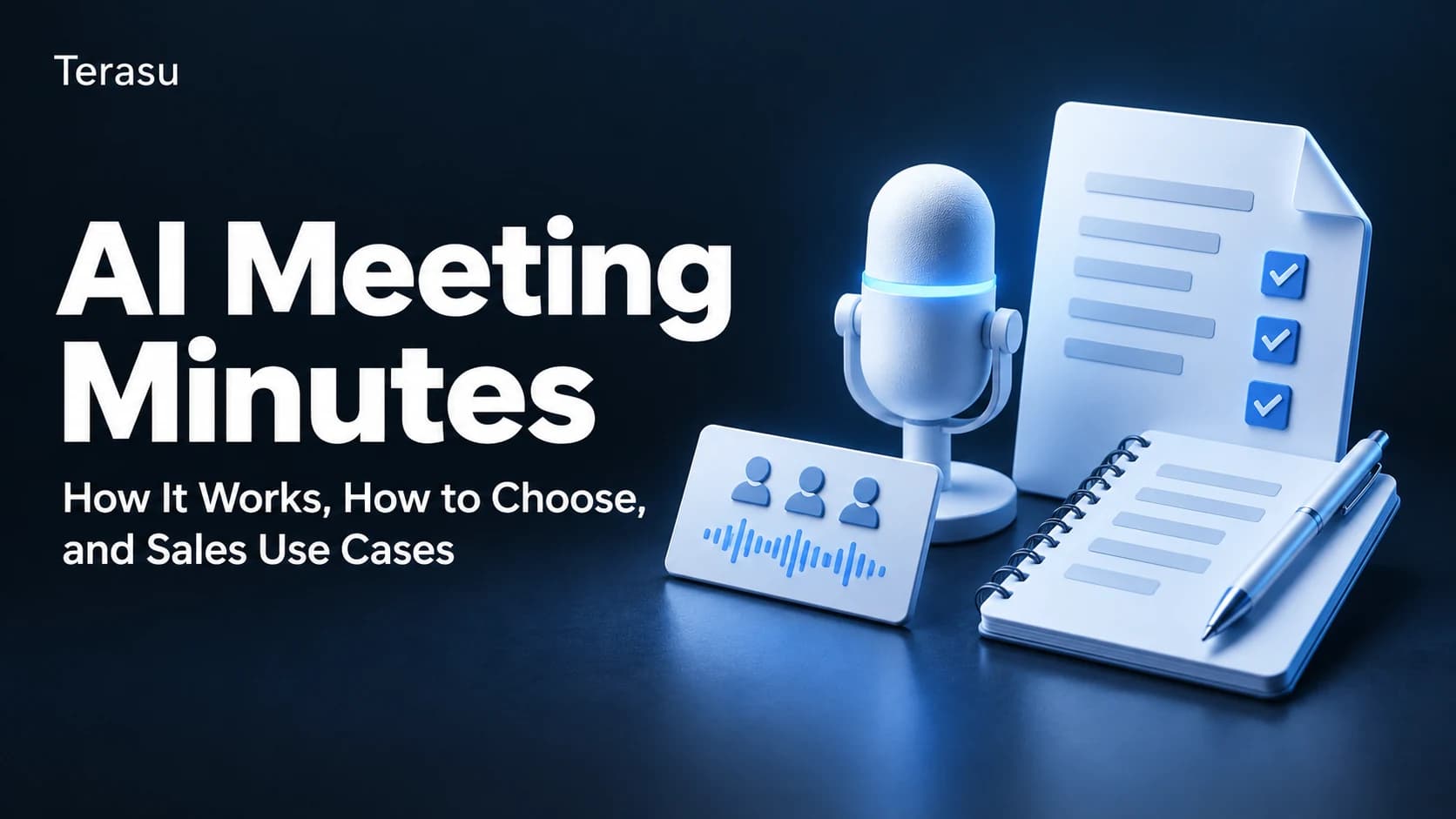
AI Meeting Minutes: How It Works, How to Choose, and Sales Use Cases (2026)
Key takeaways:
- AI meeting minutes tools automatically transcribe, separate speakers, and summarize the audio of meetings and sales calls, automating minute-taking. They eliminate manual note-taking and clean-up, and prevent "he said, she said" misunderstandings.
- The mechanism is a three-layer structure: (1) speech recognition, (2) speaker separation, and (3) generative-AI summarization. When accuracy is poor, isolating which layer is the cause makes improvement faster.
- General meeting minutes and sales (deal) minutes differ in what must be captured. In sales, the value lies in capturing the decision-maker's remarks, budget, next steps, objections, and competitors.
- Minutes deliver value at the "share, follow up, and reuse across the organization" stage more than at the "create" stage. You only recoup the investment once you design the post-creation workflow.
"It takes too long to write up minutes after a meeting or sales call." "We keep recordings, but no one ever reviews them." "We can't accurately share with the team what the decision-maker said in the deal." Many sales organizations and business professionals share these frustrations.
AI meeting minutes spread rapidly as a tool that resolves this effort and these gaps at once. At the same time, with dozens of tools on the market, questions never cease: "Which one should I actually choose?" "How far can I go for free?" "Is it safe to input confidential information?"
This article comprehensively organizes how AI meeting minutes work and how to choose one, and then covers what most competing articles barely touch: how to leverage deal minutes specifically—creating minutes, sharing them, tracking who viewed what and when, and turning them into organizational knowledge. Rather than stopping at a tool roundup, it is written from the perspective of "turning minutes into results."
What Are AI Meeting Minutes?
AI meeting minutes is an AI tool that automatically transcribes, separates speakers, and summarizes the audio of meetings and sales calls to automate minute-taking. It removes manual note-taking and clean-up, prevents "he said, she said" misunderstandings, and structures decisions and tasks within minutes.
"AI meeting minutes" simply means a mechanism or tool that uses AI to automate minute-taking. Traditional minute-taking was a double effort: frantically taking notes during the meeting, then cleaning them up afterward while replaying the recording. AI meeting minutes change this process as follows.
- During the meeting: AI converts speech to text in real time. People can focus on the discussion itself rather than on note-taking.
- Immediately after: Key points, decisions, and to-dos (action items) are automatically summarized and extracted by AI.
- After the meeting: Text and audio are stored together in the cloud, so you can review past remarks instantly via keyword search.
In other words, AI meeting minutes are not merely a "transcription tool." They are a mechanism that handles "recording (transcription)," "organizing (summarization)," and "accumulating (search and sharing)" end to end. How much of these three stages a tool covers is the dividing line in tool selection discussed later.
Recently, Web conferencing tools themselves—Zoom, Microsoft Teams, Google Meet—come with built-in AI summarization, so you can produce basic minutes without a dedicated tool. That is exactly why it is important to understand "what is the point of deliberately adopting a dedicated AI meeting minutes tool." One answer is the "use in sales" theme this article returns to repeatedly.
Why Did AI Meeting Minutes Spread So Quickly?
AI meeting minutes is not itself a new concept, but it reached practical quality in the last few years and spread rapidly. Three shifts lie behind this.
- The evolution of generative AI (LLMs): Traditional tools stopped at "transcription," outputting long spoken-word text. With generative AI, transcripts can be summarized and structured into "readable minutes," dramatically increasing practicality.
- The normalization of remote and online sales meetings: As Web conferencing became standard, meeting audio now exists as digital data from the start, making it easier for AI to ingest and process.
- Labor shortages and the demand for productivity: The trend of handing routine work like minute-taking to AI so people can focus on higher-value work grew stronger.
In short, AI meeting minutes became practical when "improved speech recognition," "summarization by generative AI," and "the entrenchment of online meetings" overlapped. Understanding this background makes it clear why "summary customization" and "sales-specific use" discussed later matter.
The Three Layers of AI Meeting Minutes and the Factors That Determine Accuracy
To choose and use AI meeting minutes well, it helps to understand the internal mechanism broken into "three layers." Many articles stop at "it transcribes and summarizes," but in reality the factors affecting accuracy differ by layer.
| Layer | Role | Main technology | Factors determining accuracy |
|---|---|---|---|
| (1) Speech recognition | Convert audio to text (transcription) | ASR | Mic environment, noise, speaking speed, accents |
| (2) Speaker separation | Distinguish/identify "who spoke" | Speaker diarization | Number of speakers, overlapping speech, online/in-person |
| (3) Summarization | Summarize, structure, extract tasks | Generative AI (LLM) | Terminology dictionary, prompt design, context length |
(1) Speech recognition layer (transcription)
The first layer is speech recognition (ASR: Automatic Speech Recognition), which converts audio to text. If this breaks down, the downstream summary breaks down in a chain reaction.
The main factors that lower accuracy are ambient noise, microphone quality, fast or quiet speech, jargon and proper nouns, and accents. Especially in in-person meetings and sales calls, air-conditioning noise, rustling paper, and multiple people speaking at once tend to make transcription harder than in Web conferencing. Using a Japanese-optimized engine, registering jargon in a dictionary, and using microphones or devices that record clearly are all effective countermeasures.
(2) Speaker separation layer (who spoke)
The second layer is speaker separation (diarization) and the speaker identification that links it to real names. It is essential for preserving the structure of "A said this, and B replied that."
Speaker separation becomes harder the more participants there are, the more similar voices sound, and the more speech overlaps. Accuracy tends to drop with audio over the phone or when one mic picks up several people in an in-person meeting; with three or more people, cases of misattributing "who said what" increase. In deal minutes, "who said it" is extremely important, so this layer's accuracy is central to tool selection (detailed later in the selection section).
(3) Summarization layer (organizing with generative AI)
The third layer is where generative AI (a large language model, LLM) summarizes and structures the transcribed text. It extracts decisions, to-dos, and discussion points, and shapes them into readable minutes.
Summary quality depends on the accuracy of the input text, the handling of jargon, the design of the summarization instruction (prompt), and the context length the model can handle. If the upstream transcription is messy, the summary will be wrong too. Conversely, even with accurate transcription, if the design of "what to prioritize in the summary" is weak, important sales items like "budget" or "next step" can drop out of the summary.
Isolating the cause when accuracy is poor
When you are dissatisfied with AI meeting minutes accuracy, isolating which layer is responsible—before concluding "the tool is bad"—speeds up improvement.
- The words themselves are wrong (proper nouns/jargon mistranscribed) → a layer (1) problem. Consider dictionary registration, mic improvement, a Japanese-optimized engine.
- Speakers are a mess (misattributing who spoke) → a layer (2) problem. Review mic placement, number of participants, and recording method.
- The text is right but the summary is off (key points missing) → a layer (3) problem. Adjust the summary template, prompt, and extraction-item settings.
Simply holding this isolation perspective prevents giving up too early with "accuracy is low, so it's unusable."
What AI Meeting Minutes Can Do, and the Benefits of Adopting Them
Let's organize what AI meeting minutes concretely do, and what changes upon adoption.
Main features
- Automatic transcription: Convert meeting/deal audio to text in real time or from a recording file.
- Speaker separation/identification: Record who said what, distinguished by speaker.
- Automatic summarization: Summarize decisions, points, and conclusions into readable minutes.
- Action-item extraction: Automatically pull out to-dos of "who, by when, does what."
- Search and knowledge base: Search across past meetings/deals by keyword and review remarks instantly.
- External integrations: Automatically sync minutes and summaries to CRM/SFA, chat tools, calendars, etc.
What changes upon adoption
- You can focus on discussion and dialogue: Freed from note-taking, you can talk while watching the other person's expressions. In sales, you can concentrate on the hearing and proposal themselves.
- Sharing becomes faster: Because a summary is finished right after the meeting, sharing with absentees and managers speeds up dramatically.
- Dependence on individuals dissolves: "What was promised in that deal" remains as a record, so the organization can grasp the situation even when the rep is away.
- Misunderstandings and trouble decrease: You can prevent "he said, she said" disputes with an objective record.
For sales organizations, points 3 and 4 are especially important. If promises and conditions exchanged in a deal proceed while ambiguous, they lead to trouble downstream and to lost deals. Having an accurate record holds value beyond mere time savings. For managing deal progress organizationally, see B2B sales progress management and the basics of deal management.
Don't measure ROI by "time savings" alone
When considering the impact of AI meeting minutes, many people first estimate "how much time spent writing minutes is reduced." It is certainly a big effect that the time once spent cleaning up after every meeting approaches zero. However, measuring the effect by "creation-time reduction" alone undervalues AI meeting minutes.
The real effect can be estimated accurately by thinking in three layers.
- First effect (creation time savings): Note-taking and clean-up time disappears. The clearest direct effect.
- Second effect (faster sharing): With a summary shared right after the meeting, catch-up for absentees and decision-making speed up. The whole organization's wait time decreases.
- Third effect (preventing leakage): "He said, she said" trouble, and lost deals or rework from missing to-dos, decrease. This is hard to convert to money, but in sales it can be the largest effect.
In sales especially, the third effect is decisive. If one large deal is lost to a "misunderstanding," it can be a loss dozens of times the effect gained from minute-creation time savings. When examining ROI, evaluate not only creation-time reduction (the first effect) but also faster sharing and leakage prevention.
Note that figures seen in advertising—"reduce minute-creation time by XX%," "from X hours/week to X minutes"—are often estimates under specific conditions or vendor claims, and do not necessarily apply to your situation as-is. Measuring in an actual trial, based on your own meeting count, participant numbers, and current creation effort, is the reliable approach.
General Minutes vs. Deal Minutes: What You Must Capture Differs
Here is the crux that most "AI meeting minutes tool comparison" articles do not touch. Internal-meeting minutes and deal (customer-meeting) minutes—though both are "minutes"—differ fundamentally in what must be captured.
Internal-meeting minutes are often sufficient if they record decisions and to-dos. But deal minutes need more. A deal is a process of "moving the other party to a closed deal," and the minutes need to preserve the information that advances that process.
| Aspect | General (internal) minutes | Deal minutes |
|---|---|---|
| Purpose of recording | Record decisions/homework | Situational awareness and the next move toward closing |
| Important items | Decisions, to-dos | Decision-maker's remarks, budget, timing, objections, competitors |
| "Who said it" | Nice to have | Decisively important (meaning changes if decision-maker vs. staff) |
| Who reviews it | Participants, absentees | Rep, manager, successor, related departments |
| Where accuracy matters | The conclusion | Amounts, deadlines, specific concerns |
| Where it's used | Next meeting | Next deal meeting, internal review, handover |
The 5 items deal minutes must capture
The five items you want AI to capture in deal minutes (i.e., must not let drop from the summary) are as follows.
- Remarks by the decision-maker / key person: Even the same "We're positive about it" changes deal probability greatly depending on whether the staff member or the decision-maker said it. Capturing who said it, together, is crucial.
- Budget and timing: Budget size, the timing of budgeting, the desired implementation timing. These become the basis for judging deal probability and priority.
- Next step (the next agreement): "Who does what, by when, next." Deals where this is vague stall.
- Objections, concerns, negative reactions: Concerns like "the price is high" or "internal coordination is hard" are precisely the starting point for the next move. Capturing only positive remarks leads to misjudgment.
- Competitors / comparison status: Which competitors they are comparing, and on what evaluation axes.
General AI meeting minutes create a "meeting summary" without considering these. So for sales use, you must confirm "can it reliably capture these items" and "can the summary template be customized." For analyzing winning patterns from deal conversations, see Gong's deal-execution research.
This article focuses on "recording, creating, and sharing deals." The perspective of analyzing winning patterns from recorded conversation data is covered in a separate article. This article and analysis-focused articles are complementary, divided as record → analyze.
How a general summary and a sales summary differ for the same deal
Consider a concrete example. Suppose in a deal, the customer's front-line contact says, "Functionally it looks good. But the budget is hard to secure until next fiscal year, and we'll need the director's approval. We're also comparing with competitor A."
If a general AI meeting minutes tool summarized this, it might come out as something like "Positive product evaluation; mention of budget and approval." At a glance it seems fine, but almost all the information that matters to sales has dropped out.
By contrast, a summary tuned for sales (or a prompt that specifies the five items above) structures it like this:
- Evaluation: Positive on functionality (the speaker is a front-line contact)
- Budget/timing: No budget secured this fiscal year; possible budgeting next fiscal year
- Decision-maker: Director's approval needed (= the front-line contact is not the decision-maker)
- Competitor: Comparing with competitor A
- Next step (implied): Need to support the internal approval process toward next-year budgeting, win a chance to present to the director, and present differentiation materials against A
For the same remark, the latter makes "what to do next" clear. Because even "who said it" (a front-line contact, not the decision-maker) is preserved, you won't misjudge the deal's probability or priority. What deal minutes require is exactly this "structuring that connects to the next move." Realizing this with a general tool requires either summary customization or human review.
Types of AI Meeting Minutes
AI meeting minutes broadly fall into three types. Which type fits you is decided by "where you mainly hold meetings and deals."
| Type | Best for | Characteristics | Typical form |
|---|---|---|---|
| Web-conferencing integrated | Online deals, remote meetings | Joins/integrates with Zoom/Teams/Meet to auto-record | AI bot joins / extension / platform built-in feature |
| Recording / file upload | In-person meetings, processing existing audio | Convert audio/video files to text afterward | App / Web service |
| Hardware integrated | In-person deals, where clear recording is needed | Physically high-quality recording via a dedicated IC recorder, etc. | Recording device + app |
Web-conferencing integrated
A type where an AI bot joins a Web conference (Zoom, Microsoft Teams, Google Meet) or integrates via a browser extension to transcribe and summarize in real time. It is the best fit for sales organizations centered on online deals.
Note that as of 2026, Web conferencing tools themselves come with built-in AI summarization. Zoom's "AI Companion" and Microsoft Teams' "Copilot" automatically compile the overview, decisions, and action items (with owners) after a meeting ends (official features of each company; a compatible plan is required). A realistic approach is to first try these built-in features and supplement what's lacking (sales-specific item extraction, CRM integration, external sharing) with a dedicated tool. For automating minutes in Zoom/Teams, also check each tool's official help.
Recording / file upload
A type where you record an in-person meeting with a smartphone or IC recorder, then upload that audio file to transcribe and summarize. It also suits processing past meeting audio. Services strong in Japanese, like Notta and Rimo Voice, excel at this type.
Hardware integrated
A type that uses a dedicated AI voice recorder to physically capture clear audio, then turns it into minutes with AI. Products like PLAUD NOTE are representative, with strengths in recording in-person deals and calls. The advantage is physically raising the quality of the speech recognition layer (the (1) above).
Which type to choose — a rough guide
Which of the three types to choose can be organized by starting from "where meetings and deals take place."
- Mostly online deals/meetings → First try the Web conferencing tool's built-in AI features (Zoom AI Companion, Teams Copilot, etc.), and if lacking, add a Web-conferencing-integrated dedicated tool.
- Many in-person meetings / want to process past recordings → Choose the recording/file-upload type. A Japanese-optimized engine is even better.
- In-person, and high transcription accuracy needed (important deals, noisy environments) → Secure physically clear recording with the hardware-integrated type.
- Both online and in-person → Choose a tool that supports both Web-conferencing integration and recording upload.
Since many sales organizations mix online and in-person, they often settle on either a both-compatible tool or a "built-in feature + dedicated tool" combination.
A Selection Checklist That Avoids Failure (with a Sales-Use Evaluation Column)
Choosing AI meeting minutes by "seems accurate" or "it's famous" leads to failure. Use the following checklist to evaluate whether it fits your use case.
Selection checklist
- Transcription accuracy: Does it deliver sufficient accuracy in your meeting environment (online/in-person, amount of jargon)? Did you actually try a meeting in the free trial?
- Speaker-identification accuracy: Is "who said it" distinguished accurately? Essential for sales.
- Web-conferencing integration: Does it support the tools you use—Zoom, Teams, Google Meet?
- Summary quality / customization: Can the summary template be adjusted for your use (sales)? Can it capture decisions, to-dos, and concerns?
- Pricing model: Monthly or usage-based? What are the limits on number of users and recording time?
- Security: On the premise of handling confidential and personal information, does it conform to your security policy? Did you confirm the data storage location and whether data is used for training?
- CRM / sharing integration: Can minutes integrate with SFA/CRM or the customer-sharing environment? (Important for sales use.)
The "evaluation for sales use" perspective
A general comparison article's selection stops at "accuracy, pricing, integration." But for sales, always add the following "sales-use evaluation axes."
| Evaluation axis | Importance in general meetings | Importance in sales | Checkpoint |
|---|---|---|---|
| Speaker-identification accuracy | Medium | High | Can it distinguish decision-maker from staff? |
| Summary customization | Medium | High | Can it capture budget, next step, concerns? |
| Customer sharing / view tracking | Low | High | Can you share minutes with the customer and grasp view status? |
| CRM/SFA integration | Medium | High | Does it link to deal records automatically? |
| Security | High | High | Is the standard fit for handling customer confidential info? |
In particular, "customer sharing / view tracking" is a perspective general AI meeting minutes almost never have, covered in detail in the workflow section later.
Conditions where speaker identification breaks down, and countermeasures (deep dive)
Speaker identification is the lifeline of deal minutes, but it tends to break down under the following conditions.
- Three or more participants: Misattribution increases when voices sound similar.
- Overlapping speech: Many back-channels or simultaneous remarks blur the boundaries.
- Phone / single-mic in-person meetings: Physically hard to separate voices.
As countermeasures: (1) in online deals, have each person use an individual mic (headset); (2) in person, use directional or multiple mics; (3) use a feature that has each person say a word at the start to "register their voice"; (4) have a human review and correct speakers before finalizing the minutes. Designing the operation on the premise that AI output is not perfect—and having a human do a final check for important deals—is safer.
Comparison of Major Tools
Here we organize representative recommended AI meeting minutes, adding the sales-use perspective. Because "which is recommended" depends on use rather than ranking, read it by applying it to your own usage. Since specific features and pricing are updated frequently, ultimately confirm with the official site and a free trial.
| Tool | Type | Characteristics | Note for sales use |
|---|---|---|---|
| Notta | Recording / Web conf | Multifunctional. Transcription, summary, translation, task extraction | Rich integrations. Check summary customization |
| LINE WORKS AiNote | Web conf / recording | Reputed for speech recognition and speaker separation. Smartphone-ready | Speaker separation accuracy suits sales |
| YOMEL | Web-conferencing integrated | One-click support for various Web conf tools; no bot entry needed | Convenience for online deals |
| Rimo Voice | Recording / Web conf | Japanese-optimized. Noise removal, dictionary registration | Strong for deals with much jargon |
| ACES Meet | Web conf / deal-focused | Strength in summarizing deals and meetings | Designed with deal analysis in mind |
| AI Gijiroku Toreru-kun | Web-conferencing integrated | Low price band. Real-time collaborative editing | Cost-focused small teams |
| toruno | Recording / Web conf | Simultaneous screen-capture recording | Recording deals where you share materials |
The above are merely representative examples; the market has dozens of tools. What matters is not "because it's top of the ranking," but choosing what fits you against the previous checklist (especially the sales-use evaluation axes). For overall sales tool selection, also see the sales DX tools comparison.
Note that figures each tool touts—"transcribe one hour of audio in minutes," "drastically cut work time"—are the vendors' own claims, and the actual effect varies with the meeting environment and usage. Trying it in your own actual meetings before adoption is the only reliable way to evaluate.
Building Your Own Minutes with ChatGPT/Gemini/Copilot, Plus Confidentiality Masking
Even without adopting a dedicated tool, you can build minutes yourself using generative AI like ChatGPT, Gemini, or Copilot. It suits individuals and small teams who want to start without cost.
The basics of building your own
- Prepare a transcript: Because chat-based generative AI often can't handle audio directly, you first need a transcript. Convert to text using a Web conferencing tool's transcription feature or a free transcription service.
- Give a summarization prompt: Paste the transcript into generative AI and specify concretely "how you want it summarized."
- Check and correct the output: A human checks the AI's summary and corrects errors and omissions in proper nouns and figures.
A prompt example for deal minutes
A generic "summarize this" drops the items sales needs. Specifying the items as below yields output usable as deal minutes.
The following is a transcript of a sales meeting. Extract the following items thoroughly and
compile them into minutes. Output as bullet points, and mark any inference with "(inference)."

[Items to extract]
1. Participants and roles (specify if you can tell decision-maker vs. staff)
2. Customer's challenges/needs
3. Remarks about budget and implementation timing
4. Objections, concerns, negative reactions
5. Mentions of competitors / comparison targets
6. Decisions
7. Next step (who, by when, does what)

[Transcript]
(Paste the transcript text here)
By building the "5 items deal minutes must capture" into the prompt this way, you can bring even generic generative AI closer to sales-grade minutes.
Differences in role and limits vs. dedicated tools
Building your own with generative AI has limits too. Audio ingestion, speaker separation, recording storage, and CRM integration are not automated, so manual work occurs every time. You also have to handle the security considerations described below yourself. For "individuals who occasionally make minutes," DIY is enough, but for "sales organizations that want to continuously record, share, and accumulate deals," a dedicated tool or a DSR mechanism is the better fit. For applying generative AI to sales proposal work, see creating proposals with generative AI.
Confidentiality masking — information you must not input
Deal transcripts contain customers' personal information, transaction conditions, and confidential information. Inputting these into an external generative AI as-is is dangerous.
In Japan, the Personal Information Protection Commission published guidance on the use of generative AI services (June 2, 2023), requiring that when inputting prompts containing personal information you sufficiently confirm it is within the scope of the purpose of use, and that you make use of settings (opt-out) so the data isn't used for training (source: Personal Information Protection Commission, 2023, https://www.ppc.go.jp/news/careful_information/230602_AI_utilize_alert/ ). Equivalent guidance and regulations exist in many jurisdictions, so follow your own region's data-protection rules.
In practice, making the following guidelines an internal rule is safer.
- Turn off training use: Use a setting where input data isn't used for training (opt-out), or use an enterprise plan.
- Mask information that can identify individuals: Replace names, contacts, transaction amounts, etc. with "Company A," "Contact X" before inputting.
- Don't input sensitive personal information or contractual secrets: Keep information covered by NDAs out of external tools.
- Use only company-approved tools: Don't input confidential data into free services on individual judgment (shadow-IT countermeasure).
When choosing a dedicated AI meeting minutes tool, confirming "data storage location," "whether data is used for training," and "contractual handling" from the same perspective is important.
How to Use It for Free, and Free vs. Paid Differences
"AI meeting minutes free" is a very common search need. The conclusion: you can start for free, but in many cases paid is needed for continuous business use.
The main free options are as follows.
- Web conferencing tools' built-in features: Zoom/Teams/Meet transcription/summary (the free range differs by plan).
- AI meeting minutes free plans: Many tools have a free plan or trial.
- DIY with generative AI: ChatGPT's free version + free transcription.
On the other hand, free plans have typical constraints.
| Constraint | Common limit in free plans | When paid is needed |
|---|---|---|
| Usage time/count | Cap on monthly transcription time | Many deals/meetings |
| Storage/history | Short retention / count limits | Want to accumulate and search past deals |
| Speaker ID / summary | Feature limits or accuracy gaps | Want to accurately capture "who said what" in deals |
| Integration | CRM/SFA integration unavailable | Want to link to deal records |
| Security | Training opt-out / admin features on higher plans | Need confidentiality / organizational control |
| Users / admin | Individual use assumed | Want to share-operate across a team/org |
As a rough guide, "an individual who uses it occasionally" is fine with free, while "a team/org that continuously records, shares, and accumulates deals" should choose paid (and a tool that lets you design the operation and sharing described later).
The signs that it's time to switch from free to paid are when the following appear: "I hit the free plan's usage-time cap every month," "I want to review past minutes but they've vanished past the retention period," "I want my team members to use it too," "I want to accurately capture who said what in deals," "I want to link to CRM and tie it to deal records." When these emerge, it's a sign you've hit the limits of free. Start free to confirm usability, then move to paid once you judge you can build it into your work—this phased approach wastes nothing.
The Workflow That Doesn't End at "Creating": Create → Share → Track Views → Reuse Organizationally
Most AI-minutes explanations end at "choose a good tool and auto-create minutes." But the true value of minutes lies in what happens after you create them. Minutes no one reviews merely reduce clean-up effort and don't translate into results.
Deal minutes in particular only recoup the investment when operated through the following four steps.
Step 1: Create (automate it)
Auto-generate minutes with AI meeting minutes during or right after the deal. This is where many tools' scope ends. The point is to reliably capture the "5 items deal minutes must capture" mentioned earlier.
Step 2: Share (both internally and with the customer)
Share the created minutes internally (manager, related departments, successor) and, as needed, with the customer. Internal sharing dissolves individual dependence and speeds decisions; sharing with the customer ("here are today's minutes") aligns understanding and builds trust.
A key point here is not to send minutes, proposals, and quotes "scattered apart." In an operation where you attach materials to emails, the customer can't manage multiple files and won't review them later.
Step 3: Track views (grasp who viewed what, and when)
This is the decisive difference general AI meeting minutes lack. When you can track which of the customer's people viewed what, and when for the minutes and materials you shared, sales activity shifts from "intuition" to "data."
For example, if the decision-maker has viewed the shared minutes or proposal, it's a sign the deal is moving forward. Conversely, if nothing has been viewed since you shared it, it's a sign that follow-up is needed. Such view data tells you the timing of your next move.
The mechanism that provides this "tracking views of shared information" is the Digital Sales Room (DSR). A DSR aggregates minutes, proposals, quotes, and various documents into one online space (a room) per customer, and visualizes what the customer viewed and when. If you place the deal minutes created by AI meeting minutes into the DSR room, "create → share → track views" connects into a single line. For the full picture of DSRs, see the complete guide to Digital Sales Rooms.
The value view tracking brings to sales becomes clear when considered concretely. If "I shared last week's deal minutes, but no one has opened them three days later," it's a sign the deal's temperature is dropping and early follow-up is needed. Conversely, if "an executive whose name didn't appear in the minutes is viewing the shared proposal," it's a positive sign that consideration is rising internally. Such "timing for the next move" is never visible if you merely created the minutes or merely sent them by email. Only by pairing sharing with view tracking do deal minutes change from a "record of the past" into "data that guides future action."
Step 4: Reuse organizationally (turn it into knowledge)
The final step is turning accumulated deal minutes into organizational knowledge.
- Handover / follow-up: Even when the rep changes, the deal's history remains as a record.
- Sharing winning patterns: Turn the conversations in won deals into learning for the team.
- Management: If a manager reviews the minutes, they can grasp the deal's status without attending the field.
For the basics of meetings (a deal being a kind of meeting), see what business meetings are. Putting AI meeting minutes on this four-step workflow—rather than leaving it as a "time-saving tool"—is the true goal for a sales organization.
How to Make AI Meeting Minutes Adoption Succeed
Signing a tool contract doesn't automatically produce results. To embed AI meeting minutes in the organization, proceeding in the following steps reduces failure.
- Decide the use and evaluation axes first: Whether the goal is "saving time on internal meetings" or "recording/sharing deals" changes both the tool to choose and the evaluation axes. Starting to compare tools without deciding first leaves you dazzled by the number of features.
- Try small (free trial): Always run a free trial in your actual meetings/deals and experience transcription accuracy, speaker identification, and summary quality. Trying in your usual environment—not the clean audio of a demo environment—is important.
- Prepare summary templates and dictionaries: For sales use, build items like "budget, next step, concerns" into the summary, and register jargon and proper nouns in a dictionary. The initial setup greatly affects minute quality.
- Decide operational rules: Make rules for "who finalizes the minutes," "handling of confidential information (training off, masking)," and "where to store/share." Without rules, both quality and security become individual-dependent.
- Build the path for sharing and reuse: Decide where to aggregate created minutes and how to share and track them. Without designing this, you revert to the "create and forget" described earlier.
Points 1 and 5 are especially overlooked but determine whether adoption succeeds.
Common Failures with AI Meeting Minutes, and Countermeasures
Let's organize the typical patterns that trip up AI meeting minutes adoption, and their countermeasures. Reviewing them before adoption helps you avoid detours.
| Failure pattern | What happens | Countermeasure |
|---|---|---|
| Using AI output unedited | Mistranscribed proper nouns/amounts remain, becoming a source of trouble | For important deals, review with a human before finalizing |
| Concluding "low accuracy" and leaving it | Decided "unusable," so use stops | Isolate which layer (transcription/speaker separation/summary) is the cause and improve |
| Inputting confidential info unguarded | Risk of leaking customer info/transaction conditions to external AI | Make training-off, enterprise plan, and masking an internal rule |
| Creating and not sharing | Just reduces clean-up; doesn't translate to results | Put it on the create → share → track views → reuse workflow |
| Adding too many tools | Higher judgment cost of "which to use," leading to disuse | Narrow the use and embed one first before expanding |
| Using a general tool for deals as-is | Decision-maker remarks, budget, concerns drop from the summary | Customize the summary or specify sales extraction items |
What these failures share is "expecting AI meeting minutes to be 'magic that auto-creates perfect minutes.'" AI is a powerful drafter, but final quality, security, and reuse depend on operational design. Conversely, once the operation is in order, AI meeting minutes greatly lift a sales organization's productivity and knowledge.
Organizations and Situations Where AI Meeting Minutes Fit
Finally, let's organize the organizations and situations where AI meeting minutes deliver especially strong effects. Check whether yours applies.
- Many online deals/meetings: The benefit of auto-recording via Web-conferencing integration is large.
- Many deals, dependent on individuals: Accumulating records eases handover and management.
- "He said, she said" trouble is common: You can lower risk with an objective record.
- Spending much time cleaning up minutes: A direct time-saving effect appears.
- Want to share deal knowledge as a team: Accumulated minutes become an organizational asset.
On the other hand, when "there are almost no meetings" or "it's self-contained for an individual with no need to share," free DIY with generative AI is sometimes enough. Judge by the frequency of your meetings/deals and the size of your sharing and accumulation needs.
Frequently Asked Questions (FAQ)
Can AI meeting minutes be used for free?
Yes. Many tools have free plans or trials, and you can create minutes for free using Web conferencing tools' (Zoom, Teams, Meet) built-in features or generative AI like ChatGPT. However, free plans have many constraints—usage time, retention period, speaker identification, integration, security features—so for a team or organization to continuously record, share, and accumulate deals, a paid plan is realistic. The rough guide: free for "an individual using it occasionally," paid for "operating across an organization."
How accurate are AI meeting minutes?
It varies greatly by meeting environment and tool. Quiet environments, clear mics, and few people tend to yield high accuracy, while noise, fast speech, jargon, and overlapping speech from multiple people lower it. What matters is operating on the premise that "AI output is not perfect"—for important deals especially, having a human review and correct before finalizing the minutes. If you're dissatisfied with accuracy, isolating which layer—transcription, speaker separation, or summary—is the cause speeds improvement.
Can I trust the accuracy of speaker identification (who spoke)?
In online meetings with two or three participants each using an individual mic, it's relatively accurate, but misattribution increases under conditions like three or more people, similar voices, overlapping speech, or recording an in-person meeting with a single mic. As countermeasures, having each person use an individual mic (headset), using directional mics, using a feature to register voices at the start, and having a human correct speakers before finalizing are effective. In sales, distinguishing "decision-maker vs. staff" matters, so choose with an emphasis on this layer's accuracy.
Can it integrate with Zoom, Teams, or Google Meet?
Yes. Many AI meeting minutes support Web-conferencing integration, auto-recording by having an AI bot join the meeting or integrating via a browser extension. In addition, Web conferencing tools themselves now have built-in AI summarization, such as Zoom's "AI Companion" and Microsoft Teams' "Copilot" (a compatible plan is required). A realistic approach is to first try the built-in features and supplement what's lacking—sales-specific item extraction, CRM integration, external sharing—with a dedicated tool.
How do I create minutes with ChatGPT?
First convert the meeting audio to text (transcription), then paste that text into ChatGPT and specify concretely "how you want it summarized." For deal minutes, explicitly stating the extraction items—participant roles, challenges, budget/timing, objections/concerns, competitors, decisions, and next steps—in the prompt yields more practical output than a generic summary. However, audio ingestion, speaker separation, storage, and CRM integration aren't automated, so for organizations that continuously record deals, a dedicated tool or a DSR is the better fit.
What information must not be input into external generative AI like ChatGPT?
Customers' personal information, transaction conditions such as amounts, and confidential information covered by NDAs should not be input as-is. Japan's Personal Information Protection Commission also published guidance on generative AI use (June 2, 2023), and equivalent rules exist in many jurisdictions. In practice, enforce rules such as: turn off training use (opt-out) or use an enterprise plan; mask names and amounts as "Company A," "Contact X"; don't input sensitive personal information or contractual secrets; and use only company-approved tools.
How do I choose an AI meeting minutes tool suited to deals?
Unlike general meeting minutes, deal minutes hinge on whether you can capture the decision-maker's remarks, budget, next step, objections, and competitors. In selection, add evaluation axes for speaker-identification accuracy (can it distinguish decision-maker from staff?), summary customization (can it capture the items deals need?), CRM/SFA integration, and "can you share with the customer and track view status?" The last—view tracking—is something general tools almost never have; it's the domain a Digital Sales Room (DSR) handles.
What's the difference between AI meeting minutes and generative AI like ChatGPT?
AI meeting minutes is a dedicated tool that automates "recording → transcription → speaker separation → summary → storage/sharing" end to end. Generative AI like ChatGPT is a general-purpose text-generation tool; to use it for minutes, you must separately prepare a transcript and give prompts manually. In other words, generative AI is one engine that handles the "summarization layer" of AI meeting minutes, and AI meeting minutes automate the surrounding parts (audio ingestion, speaker separation, storage, integration) as well.
How should I share and use the minutes I create?
Minutes only translate to results when operated through four steps: create → share → track views → reuse organizationally. After creating, share internally (manager, related departments, successor) and with the customer as needed, then track who viewed the shared minutes and materials, and when, to judge the timing of your next move. Further, reusing accumulated deal minutes for handover, sharing winning patterns, and management turns them into organizational knowledge. A Digital Sales Room (DSR), which aggregates minutes, proposals, and materials into one room and tracks views, supports this operation.
Summary
AI meeting minutes is a tool that automates minute-taking by "transcribing, separating speakers, and summarizing" the audio of meetings and deals. Understanding the mechanism in three layers, and isolating which layer is the cause when accuracy is poor, makes mastery progress at once.
In tool selection, beyond the basic axes of accuracy, integration, pricing, and security, for sales use add evaluation axes of "can it capture the decision-maker's remarks, budget, next step, objections, and competitors?", "is speaker identification accurate?", and "can you share with the customer and track views?" You can start for free, but continuous organizational operation presupposes paid plus operational design.
Most important is not to leave minutes at "create and forget." Only by putting them on the four steps of create → share → track views → reuse organizationally does the investment in AI meeting minutes turn into results. A mechanism that aggregates deal minutes, proposals, and quotes into one room per customer and tracks who viewed what and when backs this operation.
Terasu (Digital Sales Room) aggregates deal-related information into one room and visualizes the customer's view status, connecting "creating minutes" to "moving the deal forward." Along with adopting AI meeting minutes, design the post-creation operation too.
![CRM vs SFA: Key Differences in Features, Roles, and How to Choose [2026 Guide]](/_next/image?url=%2Fimages%2Fblog%2Fbrand-20261011-all-en-crm-sfa-difference.webp&w=828&q=75)