Who Is the Decision Maker in B2B Sales? How to Identify and Engage Them (With Question Scripts)
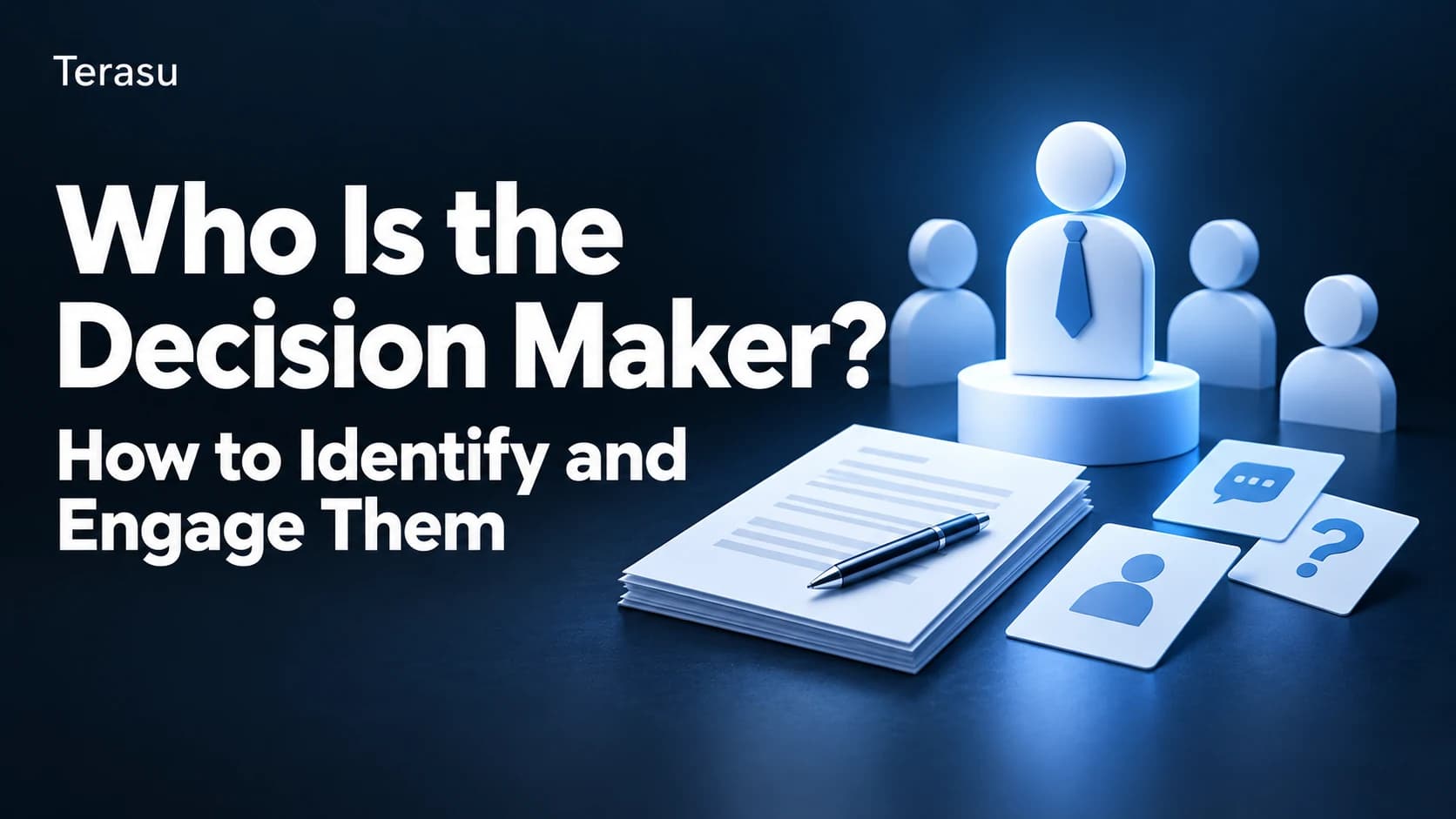
A decision maker is the person who holds final authority to approve a purchase, contract, or initiative. In B2B sales they are also called the economic buyer. Because no deal closes without their sign-off, identifying the decision maker early — and engaging them throughout the deal — is one of the strongest predictors of whether an opportunity will close.
"My contact loves the product, but the deal isn't moving." "We lost at the final stage because 'leadership didn't sign off.'" If you sell B2B, you've lived through this — and the root cause is usually the same: the decision maker was invisible, or never engaged.
This guide covers the definition of a decision maker and how the role differs from approvers, champions, and the broader buying committee; a branching discovery script that uncovers the approval process without awkward questions; a 5-step playbook for elevating a deal from a contact without authority to the real decision maker; and a company-size map of typical approval structures.
Key Takeaways
- The decision maker is the person with final authority over the purchase. Who that is depends on deal size and company size — it is not always the CEO.
- Never ask "Are you the decision maker?" Instead, ask about the process: "How do decisions like this usually get made on your side?"
- When your contact lacks authority, don't go over their head. Make them the hero of the internal sale and elevate the decision maker together, step by step.
- Approval structures change with company size: owner-led at small companies, department-head budgets at mid-market, cross-functional buying committees at enterprises. Design your approach by segment.
- Buyers spend only a fraction of their buying journey meeting with vendors. You need a way to engage decision makers asynchronously — with materials and data, not just meetings.
What Is a Decision Maker? Definition and Related Terms
Definition
A decision maker is the person in an organization who holds the authority to give final approval on spending, purchases, contracts, or initiatives. An approval from this person turns a proposal into a committed organizational decision.
In sales terms, the decision maker is "the person who ultimately says Yes or No to your proposal." No matter how enthusiastic your day-to-day contact is, the contract doesn't get signed until the decision maker approves it. Conversely, when the decision maker says "let's do it," deals accelerate dramatically. That's why identifying and engaging the decision maker sits at the center of any B2B deal strategy.
Decision maker, economic buyer, approver — who's who
The vocabulary around decision authority is easy to mix up. Here's the map:
| Term | Authority / role | Position in the approval flow | When sales should engage |
|---|---|---|---|
| Decision maker | Makes the final go/no-go call | End of the flow | Before the proposal climax and close |
| Economic buyer | The decision maker viewed through budget authority (MEDDIC term) | End of the flow | Same as above |
| Approver | Approves at intermediate stages (manager → director, etc.) | Middle of the flow | Around internal review milestones |
| Champion | Your internal advocate who drives the deal | Start to finish | From the first meeting onward |
| Buying committee / DMU | The full group involved in the decision | Distributed across the flow | Everyone, on large deals |
| Key influencer | Person whose opinion sways the decision maker (not necessarily the decision maker) | Anywhere | Identify early, win over early |
Two distinctions matter most in practice:
- Decision maker vs. approver: approvers can stop a deal (veto power) but cannot finalize it. If you ignore approvers, the deal stalls mid-process; if you only watch the decision maker, the internal request never gets drafted. You have to manage both.
- Decision maker vs. key influencer: titles and actual influence don't always align. The formal decision maker may be the CEO while a trusted VP effectively makes the call; an IT director may hold sign-off while a senior engineer's "this won't work" kills the deal. Track who signs and who sways the signer separately.
Who the decision maker is depends on deal size
It's tempting to assume "decision maker = CEO," but in reality, authority varies with the amount, importance, and company size:
- Small, routine spend: front-line managers
- Department-level purchases (tools, annual contracts): directors and department heads
- Company-wide, high-value investments: executives and the board
Most companies codify this in a delegation-of-authority policy: each spending band has a designated approver. That means the decision maker changes with your proposal's price tag — the same company that lets a director approve a small SaaS subscription may require executive sign-off for a six-figure platform. Estimating "for this product at this price, who approves it here?" is the first step of qualification.
Why Sales Must Reach the Decision Maker
"If my contact champions us internally, do I really need to meet the decision maker?" Three structural risks say yes.
Risk 1: Your proposal degrades in the telephone game
The 60-minute story you told your contact — context, pain, ROI logic — reaches the decision maker compressed into a few minutes of summary and a few slides. Your contact is not a professional advocate for your product; differentiation and ROI arguments they don't fully own won't survive the retelling. Every human relay decays your proposal's fidelity.
Risk 2: You're proposing blind to the real decision criteria
Your contact cares about day-to-day usability; the decision maker may care about ROI, risk, and strategic fit. If you've never engaged the decision maker, you're building a proposal without knowing whose criteria will judge it. Late-stage "unexpected pushback" is usually this risk materializing.
Risk 3: When the deal stalls, you have no lever
If your contact lacks authority, deal velocity depends entirely on their internal bandwidth and political skill. When they get busy, the request never gets drafted and the deal quietly freezes. All you can do is ask "any update?" — you hold no lever to move the deal yourself. That's the most painful property of single-threaded, low-authority deals.
The data: how little time you actually get
Buyers spend very little time with vendors in the first place. Gartner's research shows that complex B2B purchases involve a buying group of 6 to 10 decision makers, and buyers spend only 17% of their total purchase journey meeting with potential suppliers — split across all competing vendors (source: Gartner, The B2B Buying Journey).
Most of the decision happens where you aren't in the room. So alongside the effort to meet the decision maker, you need a mechanism to deliver the right information to them during the time you can't be there — more on that below.
How B2B Approval Workflows Actually Run
To identify and engage decision makers, you first need a model of how the customer's internal decision process moves. Most organizations follow some version of a multi-step approval workflow (in Japan this is formalized as the ringi system, but the structure is universal):
- Research and shortlisting: your contact evaluates options
- Internal request: the contact (initiator) drafts a purchase request — purpose, cost, expected impact
- Intermediate approvals: managers and directors review and approve in sequence, per the delegation-of-authority policy
- Final decision: the decision maker approves or rejects; only then can the order proceed
Two implications for sellers:
First, your proposal travels alone. In the approval meetings you'll never attend, the only things representing you are your contact's explanation and the documents you provided. Build your deck not to persuade the person in front of you, but to persuade a decision maker you've never met.
Second, the length of the approval chain is your lead time. The more approval stages, the longer from draft to decision. Mapping the process early dramatically improves forecast accuracy; reporting "should close this month" without knowing the process is wishful thinking.
Cast of characters — and what sales can do for each
| Role | What they do | What sales should provide |
|---|---|---|
| Initiator (your contact) | Drafts the request, explains it internally | Materials they can paste straight into the request |
| Approvers (managers, directors) | Review and approve or send back | An FAQ of anticipated objections, placed with your contact |
| Gatekeeper functions (IT, legal, procurement) | Audit security, contract terms, pricing | Security checklist, comparison sheet, contract draft — proactively |
| Decision maker | Final go/no-go | An executive summary answering ROI, risk, and proof |
An internal approval process is a marathon your contact usually runs alone. The seller's job is to act as the pacer who hands them exactly what each checkpoint requires, before they ask.
Approval Structures by Company Size
The single most predictive variable for "who decides" is company size. Typical patterns:
Small companies (up to ~50 employees): founder decides, speed wins
The founder/CEO is effectively the decision maker for almost all spend.
- Structure: contact → CEO (1–2 steps)
- Traits: decisions are fast — same-day if the CEO is convinced; dead if the pitch doesn't reach or resonate with them
- Play: get a CEO touchpoint early ("would your CEO like to join the next call?" lands naturally here) and frame the proposal in business-impact terms — revenue, cost, hiring
Mid-market (a few hundred employees): department budgets plus executive review
Delegation-of-authority policies are in place; the spending band determines whether a department head can approve or it escalates to executive review.
- Structure: contact → manager → department head; large deals add executive committee
- Traits: department heads decide freely within their budget; beyond it, the chain lengthens
- Play: find out whether your price fits within the department head's authority. If yes, focus there; if not, seed executive-grade material (company-level ROI) early. Offering a phased start that fits inside departmental authority is a classic unlock
Enterprise (1,000+): cross-functional committees
Decision rights are distributed across functions — the using department, IT, procurement, legal — with investment committees for large purchases.
- Structure: contact → manager → director → functional reviews (IT/legal/procurement) → executives/committee
- Traits: many stakeholders, multi-month lead times, and a veto structure where one No can stop ten Yeses
- Play: map not just "who decides" but how many gates exist. Prepare for the standard gates (security review, legal review, competitive bids) in advance, and build the full buying-committee map covered below
Quick-reference matrix
| Small | Mid-market | Enterprise | |
|---|---|---|---|
| Typical decision maker | Founder/CEO | Department head (execs for large deals) | Executives / committee |
| Approval steps | 1–2 | 2–4 | 4+ plus functional reviews |
| Lead time | Days–weeks | Weeks–2 months | Months+ |
| Proposal center of gravity | Business impact | Department pain + ROI | Company ROI, risk, proof |
| First priority | Direct CEO touchpoint | Confirm the head's authority band | Stakeholder map and gate list |
These are starting hypotheses, not facts — every company differs. Verify the real process with the discovery questions below.
How to Identify the Decision Maker — Ask About the Process, Not the Person
Is the person across the table the decision maker, or a contact without authority? There's a right and a wrong way to find out. The rule: don't ask about the person ("are you the decision maker?"); ask about the process ("how does this get decided?").
Why "Are you the decision maker?" backfires
- It threatens face. To a contact without authority, the question reads as "so you can't actually decide anything." Lose the contact's goodwill and you lose your internal engine.
- It produces bad data. "I make this call" often turns out to require executive sign-off. People misjudge (and sometimes inflate) their own authority — asking the person yields unreliable answers.
- It feels like being graded. Authority-probing questions signal "I'm sizing up whether you're worth my time," which corrodes the relationship.
The three process questions
Question 1 — the process:
"Suppose you decided to move forward — how do decisions like this usually get made on your side?"
The least confrontational way to surface the approval flow. The hypothetical framing makes it easy to answer, and responses like "I'd draft the request and my director approves" reveal the number of stages and the decision maker's title.
Question 2 — the people:
"Besides yourself, who else would typically weigh in on something like this?"
Surfaces the buying committee: "IT will need to review it," "I'd want our team lead to see it" — now you know the approvers, gatekeepers, and influencers.
Question 3 — the precedent:
"When you last brought in a similar tool, how long did it take from evaluation to sign-off?"
Past purchases are the most reliable sample of the company's real process, and the answer feeds your forecast directly.
Branching script: what each answer means
| Answer pattern | What it tells you | Next move |
|---|---|---|
| "I make this call" (instant) | Likely the decision maker — but the amount may still require higher sign-off | "Great — and is there any budget threshold where someone else would need to be involved?" Softly verify the authority band |
| "I'll need to check with my director" | You're talking to the initiator; the decision maker is elsewhere | "Understood — when your director evaluates this, what do they tend to weigh most?" Learn the criteria, then run the 5-step play below |
| "We'll discuss it as a team" (vague) | Unstructured process, or a deflection; likely a multi-stakeholder decision | Triangulate with Questions 2 and 3: "When you say the team — which functions usually get involved?" |
| "There's no formal process here" | Common at small companies; usually means the founder decides | Test the hypothesis: "So ultimately it would be your CEO's call?" Then propose an early executive meeting |
Whatever the pattern, never change your demeanor when you learn your contact lacks authority. That person is about to become your most important partner — the champion in the playbook below.
Signals you can read outside the meeting
- Company size and org structure: apply the size map above; the leadership page and org chart are baseline research
- Title and function: director-level and above may hold authority; staff-level contacts are usually initiators. But remember: titles and influence don't always align
- In-meeting behavior: someone who quotes budget figures as their own, answers timeline questions instantly, and never mentions "checking internally" is signaling authority. Frequent "let me take this back" signals a decision maker above them
- Who controls the room: in group meetings, watch where final confirmations are directed and where eyes turn before anyone commits — that's your de facto key influencer
The 5-Step Playbook for Engaging the Decision Maker
When you learn your contact isn't the decision maker, the one fatal move is going over their head straight to the decision maker. Burn your contact's face and you lose your internal engine — the deal is effectively dead. The correct play is the opposite: make your contact the hero, and elevate the decision maker into the deal together.
Step 1: Make your contact the hero of the internal sale
Give your contact a personal reason to drive this purchase: less daily grunt work, a visible win they get credit for, the improvement they've wanted to make for years. Then make the partnership explicit:
"From here, we'll prepare everything you need to make the internal case — the summary deck, the cost-benefit numbers, answers to the questions you'll get. Just tell us what would help."
This reframes the relationship from "being sold to" to "building the internal proposal together" — the foundation for every step that follows.
Step 2: Hand over an internal-proposal kit
Your sales deck doesn't work as an internal approval document. Re-package it into a kit the decision maker can judge in minutes:
- One-page summary: problem → solution → cost → impact → timeline on a single page
- Cost-benefit estimate: built on numbers the customer has already validated, not your marketing claims
- Comparison sheet: against competitors and the status quo — the decision maker will ask "what else did we look at?"
- Anticipated Q&A: security, contract terms, "what if it fails" — the questions approvers will raise
This kit directly reduces your champion's workload, which is why it gets used.
Step 3: Ask for the decision maker's seat at the table
Frame the request so it benefits your contact:
"When your director evaluates this, there may be technical and pricing questions that are hard to relay secondhand. If we could have 30 minutes together, we can answer those directly — and take that burden off you."
"Reducing your internal-explanation burden" is a framing both the contact and the decision maker can accept. Scale the format to the temperature: from "feel free to invite your director to the next demo" up to a dedicated executive briefing.
Step 4: Prepare an executive summary for the decision maker
Whether or not you get the meeting, prepare a decision-maker-only summary. The difference from the champion-facing deck: drop the feature talk, write only in the language of the business.
- The ask in one line: invest X to get Y improvement by when
- Cost of the status quo: what staying put keeps costing
- What changes: three bullets max — outcomes, not features
- Return on investment: cost, payback expectation, and the assumptions behind it
- Risks and mitigations: how this could fail, and what prevents it
- Proof: results at comparable companies (named references first)
- The decision needed: what to approve, by when
Volunteering item 5 is the trust move: a decision maker's job is risk assessment, and a deck with only good news raises alarms.
Step 5: Engage asynchronously in a shared deal room
The final step covers the time you can't be in the room — which, per the Gartner data above, is most of the buying journey.
A digital sales room (DSR) consolidates your proposal, pricing, case studies, and demo recordings into one shared online space the buying committee can be invited into. Ask your champion to "share this room with your director as-is," and the decision maker gets direct access to first-hand materials on their own schedule — structurally bypassing the telephone-game decay of Risk 1.
A DSR also shows who viewed which document, when, and for how long. "The director spent 15 minutes on the ROI page last night" tells you the evaluation is moving — and when to follow up. (Note: all dialogue and scenario examples in this article are fictional illustrations of common patterns, not real cases.)
Getting a Meeting With a Decision Maker (Outbound)
Everything above assumes an active deal. When you want decision-maker access from cold, ranked by success rate:
- Referrals — the highest-probability path. An introduction from someone the decision maker trusts (an existing customer's executive, an advisor, a board member) turns you from "unknown vendor" into "someone my trusted contact vouches for." Build the referral engine continuously: ask customers for introductions, build executive relationships through case-study interviews.
- Executive letters — physical mail reaches executives that email and gated phone lines don't. The bar: it must read as written specifically for them, grounded in public information (their strategy, expansion, hiring). Letter first, follow-up call second.
- Events and communities — conferences and invitation-only seminars are places where executives aren't braced against being sold to. Make the first contact informational, then ask for a proper meeting later. Hosting your own executive-topic seminars works too.
- Executive-matching services — platforms and advisor networks that broker introductions can accelerate access, at a cost and with competition on the same platform. Treat as a supplementary channel for well-defined target lists.
Across every channel, the same rule applies: open with the business problem, not the product. "In your industry, X has become a board-level issue, and we believe it touches your Y" creates a reason to meet; a product pitch doesn't.
Building a Proposal That Lands With the Decision Maker
The three criteria decision makers apply
- Return on investment: what goes in, what comes back, over what period — expressed in numbers the customer has already accepted ("8 hours per rep per month, worth $X annually"), not vendor claims
- Risk: implementation failure, security, vendor viability, adoption. Don't minimize risk — show it's identified and mitigated
- Proof and defensibility: results at similar companies are proxy evidence it will work here; a credible comparison answers "why this one?"
Champion deck vs. decision-maker deck
| Champion-facing | Decision-maker-facing | |
|---|---|---|
| Subject | Features, workflows, daily impact | The investment decision (return, cost, risk) |
| Length | Detailed is fine (tens of pages) | 1–3 pages, readable in 2–3 minutes |
| Language | The team's working vocabulary | Business language (revenue, cost, risk) |
| Numbers | Operational metrics | Dollar terms, payback period, company impact |
| Goal | "I want to use this" | "I can safely approve this" |
Navigating Buying Committees (DMU)
So far we've spoken of "the decision maker" in the singular — but the larger the company, the more the decision is made by a group: the DMU (Decision Making Unit), or buying committee.
Gartner's research puts the typical complex-purchase buying group at 6 to 10 decision makers, each gathering information independently and reconciling it as a group (source: Gartner, The B2B Buying Journey).
| Role | What they care about | Your move |
|---|---|---|
| Final approver | ROI, risk, strategic fit | Executive summary, proof |
| Using team | Usability, workflow fit | Demos, trials, team sessions |
| Champion | Project success, their own standing | The internal-proposal kit, partnership |
| IT | Security, integrations | Security checklist, technical docs |
| Procurement | Price defensibility, terms | Bid support, pricing rationale |
| Legal | Contract risk | Contract draft and terms upfront |
Two rules govern committee deals. First: one No can stop ten Yeses — identify potential blockers early and defuse their specific concern before it's raised formally. Second: multi-thread. A deal held together by one contact dies with that contact's reorg, departure, or busy quarter. Build parallel relationships by giving each stakeholder a venue that matches their interest: invite the using team to demos, IT to technical sessions, the approver to an executive briefing at escalation time.
Operationalizing Decision-Maker Intelligence With MEDDIC and BANT
Identifying the decision maker isn't a one-time event — it's a field your team should qualify and update on every deal.
- In BANT, the A (Authority) check is exactly the work of this article; the process questions above are how you actually execute it.
- In MEDDIC, the discipline splits into the Economic Buyer (who holds the budget authority — the size map helps you hypothesize) and the Decision Process (the approval flow — the process questions reveal it).
What matters most: the decision intelligence you gather — who decides, through what process, against what criteria — must live in your team's shared deal record, not in one rep's notebook. Personal notes reset to zero with every handover.
Solving "We Can't Reach the Decision Maker" With a Digital Sales Room
The structural problem this article keeps returning to — you'll spend far more of the deal away from the decision maker than with them — has a practical answer in the digital sales room (DSR).
A DSR is a dedicated online space per deal where proposals, pricing, case studies, meeting notes, and timelines are consolidated and shared with the buyer. For decision-maker engagement, three uses matter:
- Invite the decision maker into the room. Through your champion, the decision maker gets first-hand access to the executive summary, ROI materials, and case studies on their own schedule — no meeting required, no telephone-game decay.
- Keep the decision process on the deal record. The approval flow, stakeholders, criteria, and timeline you uncovered with the process questions live with the deal, visible to your whole team — the operational home for MEDDIC's Economic Buyer and Decision Process.
- Read engagement signals. View tracking shows who opened which document and for how long. A director repeatedly reviewing the ROI page means the evaluation is advancing; a decision maker who has never opened the room means the internal request probably hasn't been drafted yet.
Terasu is a digital sales room built for exactly this workflow — asynchronous decision-maker engagement, deal-level decision-process tracking, and engagement visibility in one room. For the full picture of the category, see What Is a Digital Sales Room?
Frequently Asked Questions
What is a decision maker in sales?
A decision maker is the person who holds final authority to approve a purchase, contract, or budget expenditure. In B2B sales they are also called the economic buyer. Because no deal closes without their approval, identifying and engaging the decision maker early is a core part of deal qualification and strategy.
What is the difference between a decision maker and an approver?
Approvers sign off at intermediate stages of the approval workflow (for example, a manager approving before a director), while the decision maker makes the final call. Approvers hold veto power — they can stop a deal — but cannot finalize it. Sellers need to manage both: ignored approvers stall deals mid-process, while focusing only on the final decision maker means the internal request may never get drafted.
Is the decision maker always the CEO?
No. Decision authority depends on the purchase amount and company size. Routine spend is typically approved by front-line managers, department-level purchases by directors, and only company-wide or high-value investments reach executives or the board. Most companies codify this in a delegation-of-authority policy, so the same vendor can face a different decision maker depending on the proposal's price.
How do you identify the decision maker without asking directly?
Ask about the process, not the person. Three questions work reliably: "Suppose you moved forward — how do decisions like this usually get made?" (the process), "Who else would typically weigh in?" (the people), and "How long did your last similar purchase take to approve?" (the precedent). These surface the approval flow, the buying committee, and the realistic timeline without putting your contact on the spot.
What should you do when your contact has no buying authority?
Don't go over their head — that destroys your internal engine. Instead, make your contact the champion: give them a personal stake in the project, hand them an internal-proposal kit (one-page summary, cost-benefit numbers, comparison sheet, anticipated Q&A), and then propose joining a meeting with the decision maker framed as "reducing your explanation burden." Elevate the decision maker together with your champion, not around them.
How do you get a meeting with a decision maker?
In order of success rate: referrals from people the decision maker trusts, personalized executive letters followed by a call, executive events and seminars, and executive-matching services. Whatever the channel, open with a relevant business problem rather than a product pitch — decision makers take meetings about their problems, not your product.
How do you sell to a buying committee with multiple decision makers?
Map the full committee (using team, IT, procurement, legal, final approver) and prepare materials matched to each stakeholder's concern — usability, security, pricing, contract risk, ROI. Remember that one No can stop ten Yeses, so identify potential blockers early and defuse their concerns proactively. And multi-thread: build parallel relationships across the committee instead of depending on a single contact.
What can you do when you simply cannot meet the decision maker?
Shift from forcing a meeting to delivering information asynchronously. Prepare a 1–3 page executive summary your champion can hand over, consolidate your proposal materials in a digital sales room and have the decision maker invited into it, and use view-tracking signals to time your follow-ups. Buyers spend only a small fraction of their journey meeting with vendors, so the quality of your asynchronous channel often matters more than the meeting you couldn't get.
Conclusion — Identify, Engage, Then Go Asynchronous
The decision maker is the person whose approval turns your proposal into a contract — and reaching them is a designable process, not a matter of sales instinct.
- Know the cast: decision maker (final call), approvers (veto power in the middle), champion (your engine), buying committee (the whole group), key influencers (who sways the signer)
- Identify by asking about the process: "How does this get decided?" beats "Are you the decision maker?" every time — then branch on the answer
- Engage through your champion: the 5-step playbook elevates the decision maker without burning your contact; build every document to persuade someone you've never met
- Adjust for company size: founder-led at small companies, authority bands at mid-market, committees and gates at enterprise
- Design for the time you're not in the room: an executive summary plus a digital sales room with engagement tracking turns the invisible 83% of the buying journey into something you can influence and measure
To operationalize what you learn about decision makers on every deal, pair this playbook with BANT or MEDDIC, and consider a digital sales room as the shared workspace where decision-maker engagement actually happens.