Upselling vs. Cross-Selling: Differences, Downselling & How to Succeed
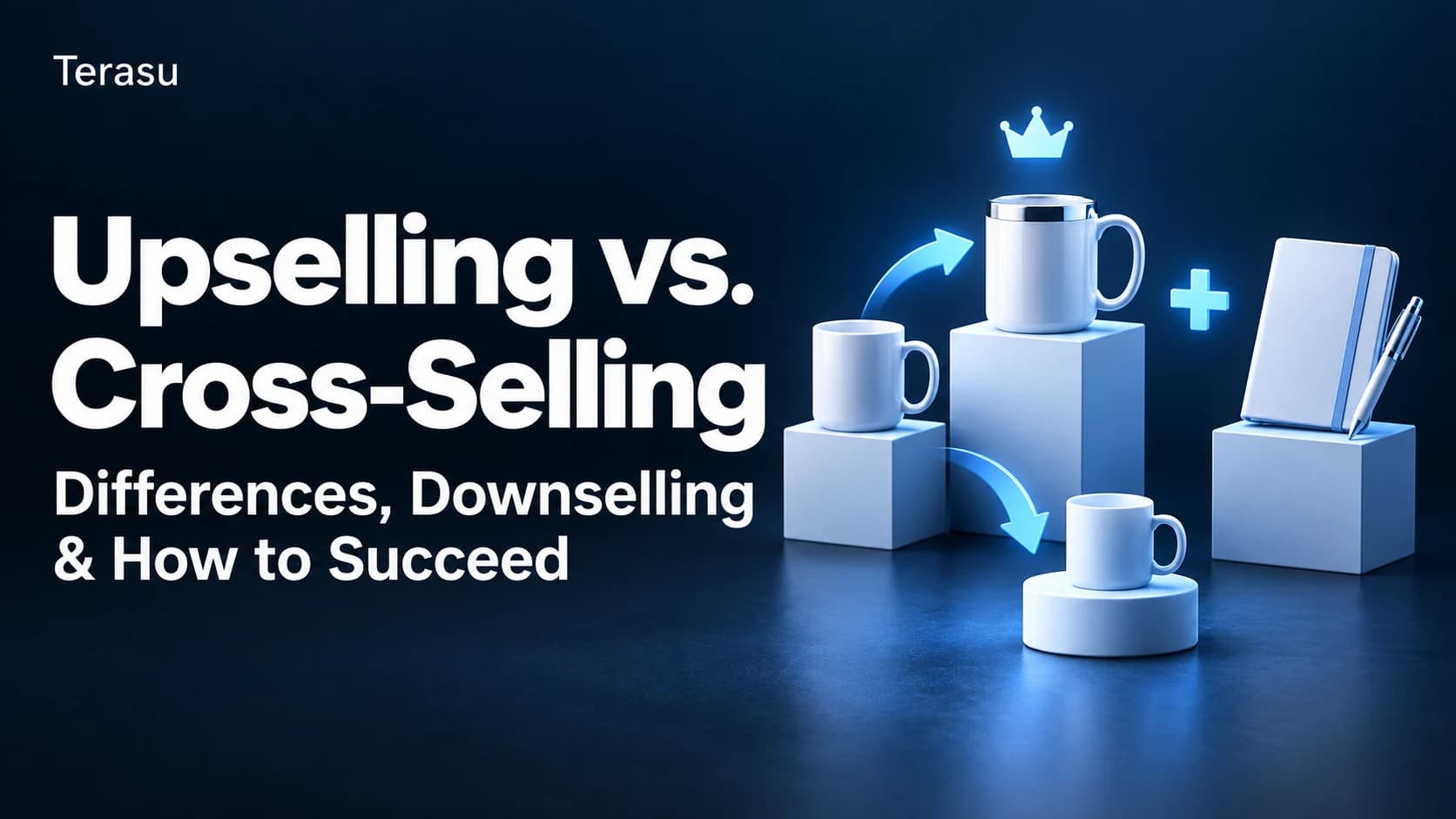
Upselling is the practice of proposing a higher-grade model or plan than the one a customer is considering or already using, in order to raise the per-customer value. Cross-selling is the practice of proposing a related, separate product alongside it to increase the number of items purchased.
Key takeaways:
- Upselling means moving a customer up to a higher grade, cross-selling means expanding into related products, and downselling means offering a lower-tier plan to prevent churn. Understanding all three together keeps you from misjudging which to use
- The shared goal is maximizing per-customer value and LTV (Lifetime Value). You can grow revenue at a lower cost than acquiring new customers (the 1:5 rule)
- In B2B SaaS, upselling and cross-selling are the primary drivers of NRR (Net Revenue Retention). Once NRR exceeds 100%, revenue grows even with zero new customers
- However, proposals that turn into hard-selling cause churn and erode trust. We cover the mistakes to avoid and how to read the right timing in concrete terms

"I want to grow revenue from existing customers," "What exactly is the difference between upselling and cross-selling?"—these are challenges sales and customer success teams face every day. As the cost of acquiring new customers keeps rising, "upselling" and "cross-selling"—delivering additional value to customers you already have and raising their value—are getting renewed attention as the royal road to revenue growth.
This article first organizes the definitions and differences between upselling, cross-selling, and downselling in a 6-dimension comparison table, then systematically explains the LTV and NRR (expansion revenue) context, industry-specific examples, the timing that makes proposals succeed, the failure patterns to avoid and their countermeasures, and the KPIs that measure effectiveness. We also introduce how to use a digital sales room (DSR) as a way to spot the right moment to make a proposal.
What Are Upselling and Cross-Selling? (The Big Picture and How the Three Relate)
Upselling and cross-selling are both sales and marketing techniques that make an additional proposal to an existing or prospective customer in order to raise the per-customer value. Together with "downselling," these three are positioned as a connected toolkit for optimizing per-customer value and LTV.
First, here is the big picture in a table so you can grasp the differences in 30 seconds.
| Technique | In one phrase | Effect on value | Typical example |
|---|---|---|---|
| Upselling | Move up to a higher grade | Raises per-deal value | Standard plan → higher plan |
| Cross-selling | Expand into related products | Raises item count / value | Core product + option / separate module |
| Downselling | Prevent churn with a lower plan | Avoids losing value to churn | Cheaper plan for a customer considering cancellation |
What all three share is that they target customers who already have a relationship with you. Unlike acquiring new customers, you have a foundation of trust and a usage track record, so with the right timing and proposal, the close rate is high and the cost efficiency is strong. The following sections dig into each one with concrete examples.
What Is Upselling? (Definition, Purpose, Examples)
Upselling is the practice of proposing that a customer move up to a higher grade, plan, or model of the product or service they are considering or already using, thereby raising the per-customer value.
Its purpose is "raising the purchase value." Within the same product category, you propose a higher-end version with expanded features, capacity, or support scope—delivering greater value to the customer while growing revenue. The key is not simply to push a more expensive item, but to get the customer to agree that the higher-end version is the more rational choice for their situation and challenges.
Examples of Upselling
Upselling happens daily in both B2C and B2B.
- B2C: When upgrading a smartphone, recommending the latest high-capacity model over a low-capacity one. Encouraging a move from a free streaming plan to an ad-free paid plan
- B2B SaaS: Proposing a higher plan (unlimited users, advanced analytics) to a customer on a standard plan capped at 5 users, as their headcount grows
- Field sales: For a quote on industrial equipment, showing a case where the higher-end model has a lower total cost once long-term maintenance is included
In every case, the more clearly grounded the proposal is in "given your current usage, the higher-end version benefits you more," the higher the success rate. The better you understand usage data and business challenges, the more persuasive your upsell can be.
What Is Cross-Selling? (Definition, Purpose, Examples)
Cross-selling is the practice of proposing a related, separate product or service in addition to what a customer is buying or using, in order to increase the number of items purchased or the deal size.
If upselling is a "vertical" proposal (grade-up), cross-selling is a "horizontal" proposal (adding related products). By anticipating the peripheral challenges a customer faces and presenting related products that solve them, you increase the deal size while improving the customer's convenience.
Examples of Cross-Selling
- B2C: Recommending a fries-and-drink set to a customer ordering a burger. Proposing a mouse or security software to someone buying a PC
- B2B SaaS: Proposing a connected business-card-management or inside-sales-support module to a customer that has already deployed sales support tools (SFA)
- Field sales: Proposing maintenance services or employee training to a customer that has deployed a core system
In cross-selling, the key is a story along the lines of "combine this with what you already use and you'll get even better results." Recommending loosely related products at random comes across as hard-selling, so a proposal that fits the customer's usage context is the prerequisite.
What Is Downselling? (Definition and When to Use It)
Downselling is the practice of proposing a lower-priced, lower-grade option to customers who hesitate to buy or continue with a higher-end product—or who are considering cancellation—in order to prevent them from leaving the relationship entirely.
At first glance it looks like an act that lowers revenue, but the essence of downselling is "preserving revenue that was about to become zero and keeping the relationship alive." If you offer a cheaper plan to a customer about to cancel over price, you avoid the value dropping to zero through churn. And as long as the relationship continues, you keep open the chance to upsell and cross-sell again in the future.
Downselling is effective in situations like these:
- Proposing a feature-limited lower plan to a customer who cites price as the reason for cancellation
- Offering an entry plan to start small for a prospect who can't get budget approval for a high-priced plan
- Proposing continuation on a minimal plan—rather than dormancy—to a customer who wants to scale down only during a slow period
The heart of downselling is the mindset of "continuing the relationship," not "selling and being done." Designed as a set with upselling and cross-selling, it makes per-customer value optimization considerably more precise.
The Difference Between Upselling, Cross-Selling, and Downselling (Comparison Table)
Here are the three organized across six dimensions: definition, purpose, direction of the proposal, typical timing, conditions for applying it, and the mistake to avoid. This is the core reference table of this article.
| Dimension | Upselling | Cross-selling | Downselling |
|---|---|---|---|
| Definition | Move up to a higher grade / plan | Add a related, separate product | Offer a lower plan to prevent churn |
| Main purpose | Raise per-deal value | Expand item count / deal size | Avoid churn and lost deals, keep the relationship |
| Direction | Vertical (grade-up) | Horizontal (related products) | Down (grade-down) |
| Typical timing | Near a usage cap / before renewal | After onboarding / after results appear | At signs of cancellation / over budget |
| Conditions to apply | Higher-end version clearly benefits the customer | Related product fits the customer's challenge | Price is the barrier and they may leave |
| What not to do | Push an unnecessary higher version | Bundle unrelated products | Erode value with careless discounting |
The three are not opposing techniques but "drawers" you open depending on the customer's situation. For a customer whose usage is expanding, upsell; for one whose challenges are broadening, cross-sell; for one about to leave, downsell—you choose according to the customer's stage.
English Terminology Notes
In practice, these terms are also commonly written as up-selling (or upsell), cross-selling (cross-sell), and down-selling (downsell). Each pairs "sell" with a prefix indicating direction—up = higher tier, cross = across, down = lower tier—and keeping that directional image in mind prevents confusion.
Why It Matters: LTV and Expansion Revenue (NRR)
The biggest reason upselling and cross-selling are valued is that they directly drive the maximization of LTV (Customer Lifetime Value). Especially in subscription-based B2B SaaS, additional revenue from existing customers (expansion revenue) becomes the engine of business growth.
How to Think About LTV and Its Formula
LTV (Lifetime Value) is the total profit a single customer (or company) brings over the entire course of the relationship. A common formula is as follows.
LTV = average customer value × profit margin × purchase frequency × retention period
Upselling and cross-selling raise the "average customer value" and "purchase frequency" in this formula. Furthermore, the more deeply a customer uses your product, the higher their switching cost—so the "retention period" also tends to lengthen. In other words, upselling and cross-selling are measures that affect multiple variables of LTV simultaneously.
What Is NRR (Net Revenue Retention)?
NRR (Net Revenue Retention) is a metric that shows how much the revenue generated by a given set of existing customers has increased or decreased after a certain period. It excludes revenue from new customers and is calculated by subtracting the decrease from churn and downgrades from the increase from upselling and cross-selling.
If NRR exceeds 100%, it means revenue grows from existing customers alone, even if you acquire zero new customers. The median NRR for SaaS companies is reported to be around 106% in ChartMogul's published 2024 data (source: ChartMogul "The SaaS Retention Report"). As a general benchmark used by investors evaluating SaaS, 100% is considered good, 110% strong, above 120% excellent, and best-in-class above 130%—a view shared as a rule of thumb (medians vary by customer size and ACV).
NRR is determined by the tug-of-war between upselling and cross-selling (positive factors) and churn and downgrades (negative factors). That is precisely why the two wheels—appropriate expansion proposals to existing customers and downselling to prevent churn—shape NRR and, by extension, the growth rate of the business.
The Benefits of Upselling and Cross-Selling (the 1:5 Rule)
Upselling and cross-selling are valued alongside new-customer acquisition because of their cost efficiency. Representative supporting ideas are the "1:5 rule" and the "5:25 rule."
The 1:5 rule is the heuristic that acquiring a new customer costs roughly five times as much as retaining an existing one. The 5:25 rule holds that improving customer churn by 5% improves profit by 25% or more. Both are widely cited heuristics supporting a focus on existing customers, and a well-known account credits them to Frederick F. Reichheld of Bain & Company (there are differing accounts of who originated them and where they came from) (source: Commune "What Are the 1:5 Rule and the 5:25 Rule?").
The main benefits of upselling and cross-selling that follow from this are:
- Lower acquisition cost: Because trust already exists, the effort from proposal to close is smaller than new-customer development
- Higher close rate: Because you understand usage and challenges, it's easier to make proposals that land
- They drive LTV and NRR: They affect value, frequency, and retention simultaneously, so revenue accumulates efficiently
- They also raise satisfaction: A proposal that anticipates and solves a challenge is welcomed as a "value proposal," not hard-selling
That said, these benefits assume "the proposal fits the customer's challenge." Step outside that condition and it backfires—a point we cover in detail in the failure patterns below.
Examples by Industry and Model
Suitable approaches to upselling and cross-selling differ by industry and business model. Here are the representative patterns.
| Model | Upselling example | Cross-selling example |
|---|---|---|
| B2C (e-commerce / retail) | Propose a higher-grade appliance | Propose consumables / accessories to a buyer |
| B2C (subscription) | Move from free/standard to a higher plan | Bundle a separate service such as video + music |
| B2B SaaS | Move to a plan with more users / features | Add a connected separate module / add-on |
| Field sales (B2B) | Move to a higher-spec model with long-term maintenance | Add operational support, training, related products |
In B2B SaaS, customer success and inside sales increasingly lead upselling and cross-selling. The typical play is to watch usage after deployment and then make a higher-plan proposal to a department whose usage has expanded (upsell), or expand horizontally to a separate department or affiliate (cross-sell). Building this proactive proposal flow for existing customers into your inside sales workflow makes it more repeatable.
How to Succeed and When to Make the Proposal
The single biggest factor in whether upselling and cross-selling succeed is "timing." The same proposal is welcomed if made the moment a customer feels value, and comes across as hard-selling if made at any other time. Here are the keys to success.
- Start from the customer's challenge: Work backward from the challenge the customer wants to solve, not the product you want to sell
- Aim for right after results appear: The moment a customer experiences the impact of deployment is when the psychological hurdle to additional investment is lowest
- Back it up with data: Show usage and outcome metrics, presenting the rationale that "the higher version / related product is more rational"
- Propose in stages: Rather than one large additional proposal, build up small successes before moving up
Here are the representative moments suited to a proposal.
| Timing | Why it's an opportunity | Suitable technique |
|---|---|---|
| After onboarding is complete | Initial value is felt and the next challenge starts to show | Cross-selling |
| When usage approaches the current plan's cap | The customer themselves feels the current plan's limits | Upselling |
| Right after results / KPI improvement | ROI is felt, so persuasiveness is high | Upselling / cross-selling |
| Before contract renewal | They've entered a contract-review mindset | Upselling |
| After a high support rating | Trust is higher, making proposals easier to accept | Cross-selling |
| At signs of cancellation / over budget | You need to prevent churn | Downselling |
How well you succeed at onboarding becomes the foundation for later expansion proposals. For accompanying customers through the early deployment phase, see customer success onboarding as well.
Upselling and Cross-Selling You Should Never Do (Failure Patterns and Countermeasures)
Upselling and cross-selling are double-edged swords. Get the timing or the content wrong and, far from raising value, you invite churn and erode trust. Here we organize the "failure patterns" that many competing articles don't address, paired with what happens and how to prevent each.
| Failure pattern | What happens | Countermeasure |
|---|---|---|
| A too-early proposal before value is felt | Seen as "nothing but sales pitches," distrust grows, churn risk rises | Wait for onboarding completion and felt results |
| Bundling unrelated to the customer's challenge | Taken as hard-selling; satisfaction and NPS drop | Propose only related products that fit the usage context |
| Quota-driven over-proposing | Dissatisfaction over "features they don't use" piles up from an unnecessary higher version | Propose from the customer's side; confirm need with usage data |
| Careless discounting / excessive downselling | Per-customer value drops permanently, hurting LTV and profitability | Respond with a feature-limited plan, not discounts |
| Insufficient follow-up after the proposal | The added purchase goes unused and churns at renewal | Design post-expansion adoption support as a set |
The common root of these failures is prioritizing "your own revenue convenience." Upselling and cross-selling should fundamentally be a "value proposal" that anticipates and solves the customer's challenge, and whether the proposal starts from the customer is the dividing line. Setting an operating rule to always ask "is this good for the customer?" before proposing prevents proposals from turning into hard-selling.
KPIs That Measure Effectiveness
To improve upselling and cross-selling continuously, you must manage them by metrics rather than gut feel. Here are the representative KPIs.
| KPI | What it measures | Guideline / approach |
|---|---|---|
| Upsell rate | Share of existing customers who moved to a higher plan | Compare the trend before and after the initiative |
| Cross-sell rate | Share of existing customers who added a related product | Track progress of departmental expansion |
| Expansion MRR | The increase in monthly recurring revenue from existing customers | Manage separately from new MRR |
| NRR | Net change in existing-customer revenue | Above 100% is the growth dividing line |
| Average revenue per account (ARPA) | Average revenue per customer | The combined effect of upselling / cross-selling |
The basic principle is to monitor these KPIs separately from new-acquisition KPIs. NRR and expansion MRR in particular are core metrics that reflect the health of the existing-customer business, and the ultimate results of upselling and cross-selling initiatives converge here. Whether to put resources into new acquisition or existing customers is best judged against the cost structure of B2B lead generation methods.
Use a DSR to Make Expansion-Proposal Timing Visible
As we've repeatedly noted, the success of upselling and cross-selling depends heavily on "when you propose." Yet in many teams, spotting the right moment relies on a rep's intuition or memory. The means to make this "timing visible" is the digital sales room (DSR).
A DSR is a mechanism that consolidates deal and customer-facing materials and information into a single online space and makes the customer's viewing and interest data visible. In the context of upselling and cross-selling, you can detect signals such as:
- Repeatedly viewing a specific higher-plan document → a sign that an upsell consideration has begun
- A contact from a new department accessing the introduction page for a related module → an opportunity for cross-selling (departmental expansion)
- Increased viewing of the adoption guide as usage deepens → just before value is felt, a state in which proposals are easy to accept
- Access has been absent for a long time → a sign of churn; downselling or follow-up should be considered
The value of a DSR is that it turns the general principle that "timing matters" into measurable engagement signals. When inside sales and customer success act on this data, expansion proposals that don't rely on intuition can be run repeatably. Understanding the difference between SFA and CRM, the foundations for managing sales data, and then combining a DSR as the layer that makes customer touchpoints visible, raises the precision of the entire existing-customer business.
Conclusion
Here are the key points of this article.
- Upselling is moving up to a higher grade, cross-selling is expanding into related products, and downselling is preventing churn with a lower plan. Using all three appropriately optimizes per-customer value
- The shared goal is maximizing LTV (Customer Lifetime Value). As the 1:5 rule shows, expansion proposals to existing customers are more cost-efficient than new-customer development
- In B2B SaaS, upselling and cross-selling are the primary drivers of NRR (Net Revenue Retention). NRR above 100% means "growth even with zero new customers"
- What separates success from failure is timing and a customer-first stance. Too-early proposals, unrelated bundling, and quota-driven over-proposing invite churn and erode trust
- Measure effectiveness with upsell rate, cross-sell rate, expansion MRR, and NRR. The right moment to propose can be made visible as customer interest data with a DSR
Upselling and cross-selling are not merely "techniques for raising prices"—they are the relationship-building that keeps anticipating and solving the customer's challenges. Building a mechanism that captures the customer's stage and signals and delivers value at the right moment is the shortcut to sustainable revenue growth.
Capture customer interest as data and propose at the right moment
With Terasu DSR, make upsell and cross-sell opportunities visible from customers' document-viewing and interest data. Maximize expansion revenue from existing customers.
Start for freeWhat is the difference between cross-selling and upselling?
Upselling proposes a higher grade or plan than the one a customer is considering or using, raising the per-deal value—a "vertical" technique. Cross-selling proposes a related, separate product alongside it to increase the number of items purchased—a "horizontal" technique. Both aim to maximize per-customer value and LTV, but upselling is a move-up within the same category while cross-selling adds a different category.
What are examples of upselling and cross-selling?
Examples of upselling include getting a customer to switch to a higher-capacity smartphone model (B2C) or moving a customer from a standard SaaS plan to a higher one (B2B). Examples of cross-selling include recommending a fries-and-drink set with a burger (B2C) or proposing a connected module to a company that has deployed an SFA (B2B).
What is the difference between upselling and downselling?
Upselling raises value by moving a customer up to a higher grade, while downselling proposes a lower plan to prevent cancellation or a lost deal. They look like opposite directions, but both share the goal of "optimizing the deal with the customer and protecting LTV." Downselling avoids zero revenue and keeps the relationship alive, preserving room for future upselling and cross-selling.
What is cross-selling?
Cross-selling is the practice of proposing a related, separate product or service in addition to what a customer is buying or using, in order to increase the number of items purchased or the deal size. Recommending a mouse or security software to a PC buyer is cross-selling. The key is presenting related products that anticipate and solve the customer's peripheral challenges.
How are upselling and cross-selling written in English?
Upselling is written as up-selling (or upsell), cross-selling as cross-selling (cross-sell), and downselling as down-selling (downsell). Each pairs "sell" with a prefix indicating direction: up = higher tier, cross = across, down = lower tier.
When is the best time to make an upsell or cross-sell proposal?
The moment the customer is feeling value is the opportunity. Specifically: after onboarding is complete, when usage approaches the current plan's cap, right after results or KPI improvements appear, and before contract renewal. Conversely, a too-early proposal before value is felt comes across as hard-selling and raises churn risk.
Why do upselling and cross-selling get disliked?
In most cases, the cause is a proposal that prioritizes "your own revenue convenience." Too-early proposals before value is felt, bundling products unrelated to the customer's challenge, and quota-driven over-proposing are taken as hard-selling and damage satisfaction and trust. You can prevent this by putting the starting point of the proposal on the customer's challenge and backing the need with usage data.
What is the relationship between NRR and upselling/cross-selling?
NRR (Net Revenue Retention) is a metric that shows how existing-customer revenue has changed on a net basis—the increase from upselling and cross-selling minus the decrease from churn and downgrades. Upselling and cross-selling are the positive factors in NRR, and once NRR exceeds 100%, revenue grows even with zero new acquisition. That's why, in B2B SaaS, upselling and cross-selling are positioned as the primary drivers of NRR.
※ Sources cited in this article:
- The 1:5 rule / 5:25 rule: Commune "What Are the 1:5 Rule and the 5:25 Rule?" (heuristics; accounts of who originated them vary)
- SaaS NRR benchmark: ChartMogul "The SaaS Retention Report" (2024)
Related articles
What Is LTV? Customer Lifetime Value Formula, LTV/CAC Benchmarks & How to Improve It
What Is Customer Loyalty? Difference from Satisfaction, Metrics, and How to Improve It