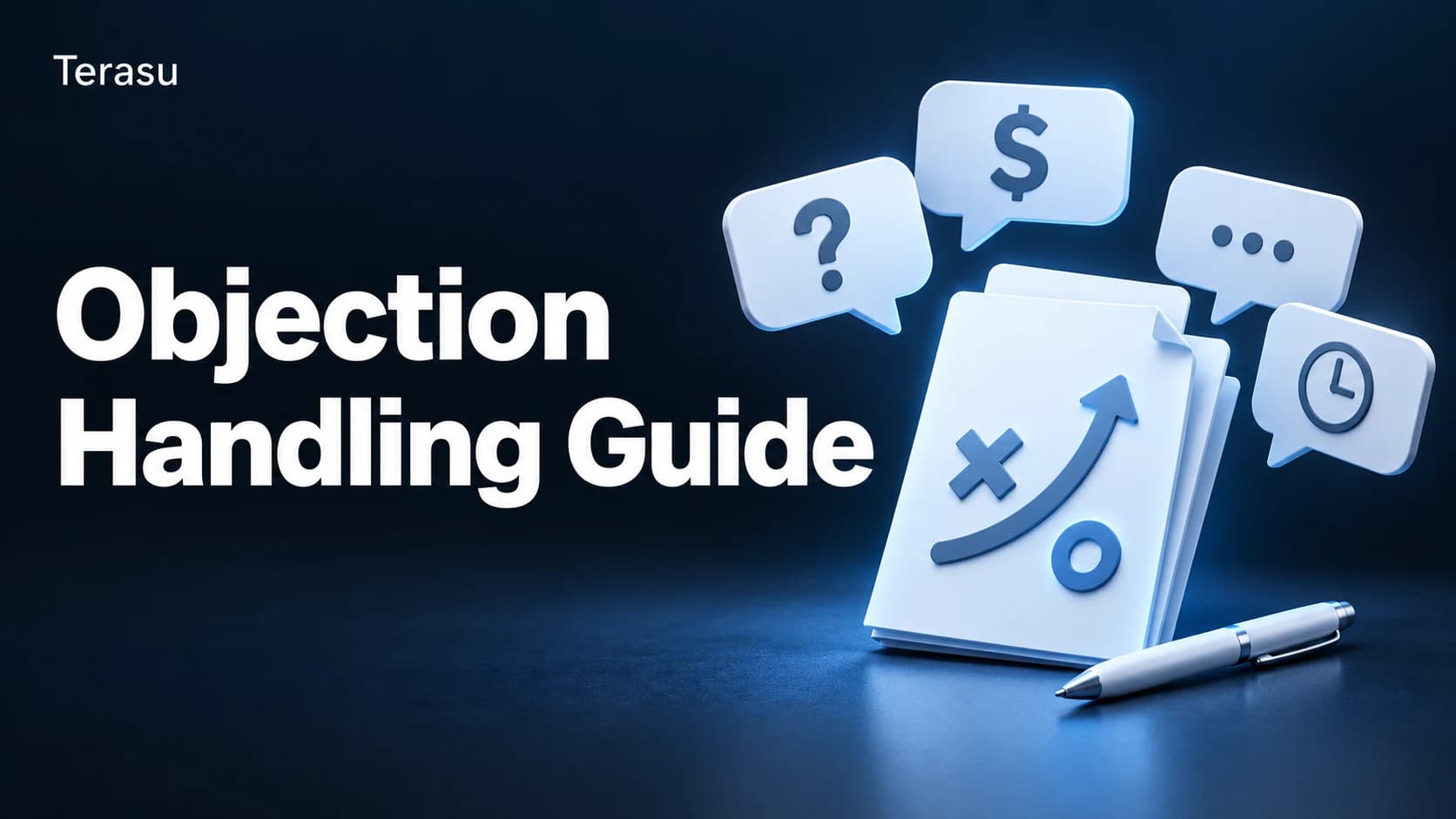
The Complete Guide to Objection Handling: 21 Proven Rebuttal Scripts for Sales Objections (2026)
Objection handling is the sales skill of responding to a prospect's concerns and pushbacks—"it's too expensive," "let me think about it"—by listening, empathizing, clarifying, and re-proposing, so that the deal moves forward. It is not a debating technique for out-arguing the customer; it is the process of surfacing the real concern and guiding both sides toward agreement.
"I see the value, but honestly, it's a bit expensive." "Let me discuss it internally and get back to you."—These moments appear at the end of almost every sales conversation. You freeze and let the deal walk out the door, or you panic and offer a discount. Most people researching objection handling and rebuttal scripts start from exactly this frustration.
Most guides out there will give you "10 rebuttal lines" and "the basic steps." What they don't cover is what actually hurts in practice: how to diagnose the real concern behind the objection, what to do after the prospect says "I need to run this by my boss," and how to keep the deal moving after the meeting ends. This guide covers all of it, written for B2B sales practitioners.
Key Takeaways
- The goal of objection handling is not to win the argument but to move the deal one step forward. The moment you out-argue a prospect, they stop sharing their real concerns—and the deal quietly dies.
- An objection is a surface-level phrase. The underlying cause falls into five categories: unproven value, budget constraints, the decision-making process, timing, and status quo bias. Diagnose before you respond.
- The framework is four steps: listen → empathize → clarify → re-propose. Don't improvise; respond from a prepared repertoire.
- This guide includes 21 rebuttal scripts (7 objections × 3 variations), each labeled by scenario (cold call / sales meeting / closing), ready to adapt to your own product (→ jump to the script library).
- "Let me think about it" and "I need to ask my boss" are usually not rejections—they are the start of the buying committee's internal process. Scripts alone won't solve this; you need a mechanism for engaging the decision maker.
What Is Objection Handling? Moving Deals Forward Without Winning Arguments
Objection handling is the sales technique of understanding and resolving the anxieties behind a prospect's concerns, questions, and pushbacks so the conversation can progress. Rebuttal scripts (talk tracks) and classic rebuttal techniques are the practical tools used to execute it.
Note that "objection handling" is also used in debate contexts, but this article is strictly about resolving concerns in B2B sales conversations. Unlike debate—where the goal is to expose contradictions and win—the goal here is the exact opposite: agreement.
Objection Handling, Rebuttal Scripts, and Rebuttal Techniques: How They Relate
The three terms fit together like this:
| Term | Meaning | Role |
|---|---|---|
| Objection handling | The overall activity of resolving concerns and moving the deal forward | Purpose / process |
| Rebuttal scripts | The specific lines you say in response to an objection | The tool |
| Rebuttal techniques | The patterns used to construct those lines (Yes-But, etc.) | The design method |
In other words: you use rebuttal techniques to build rebuttal scripts, in service of the goal called objection handling. Memorizing scripts without the goal (deal progress) and the diagnosis (the real concern) backfires.
An Objection Is a Signal of Interest, Not Rejection
The fundamental premise: a prospect's objection is, in most cases, a sign of serious consideration, not rejection. A prospect with zero interest doesn't say "it's expensive" or "I'm worried about the results." They nod politely and end the meeting.
Voicing a concern means "if this concern were resolved, I'd want to move forward." That's why the first step of objection handling is welcoming objections. A rep who treats objections as threats to crush and a rep who treats them as the doorway to agreement will get completely different results from the same script.
Why Objection Handling Decides Whether Deals Close
In B2B, the buyer always has structural reasons not to buy. Purchasing requires internal approvals and cross-team coordination, and a failed rollout reflects on the champion personally—so the status quo is always the safest choice. Left alone, every deal drifts toward "we'll think about it" and quiet death.
Objection handling is the work of resisting that drift by giving the buyer what they need to move: resolved concerns, internal-selling logic, and a nudge toward a decision.
Diagnose the Real Concern First: The Five Causes Behind Every Objection
The most common failure in objection handling is responding to the literal words of the objection. Hearing "it's expensive" and launching into a price justification; hearing "let me think about it" and sending more collateral—these miss because the stated objection rarely expresses the real concern directly.
In practice, the cause behind an objection falls into one of five categories:
- Unproven value—the prospect doesn't yet believe the value justifies the cost (the most common cause of "it's expensive")
- Budget constraints—they see the value, but the budget cycle or allocation blocks them
- Decision-making process—the contact is on board, but approvers and other stakeholders must agree
- Timing—a higher-priority initiative is consuming attention right now
- Status quo bias—psychological resistance to change itself; the risk of failure feels heavier than the benefit of change (loss aversion, in behavioral-economics terms)
The same "let me think about it" calls for completely different responses: re-presenting value if the cause is unproven value, engaging the decision maker if it's the approval process. The table below maps the major objections to their likely causes, with diagnostic questions.
| Objection | Likely causes (in order) | Diagnostic question | Response by cause |
|---|---|---|---|
| "It's expensive" / "No budget" | Unproven value / budget constraints | "Setting the budget aside for a moment—would you want to move forward?" | Value gap → re-present ROI / Budget → phased plan, timing |
| "We don't need it right now" | Status quo bias / unproven value | "If you had to name one thing about the current setup that's inconvenient, what would it be?" | Surface hidden costs → present future risk |
| "Let me think about it" | Decision process / unproven value / soft no | "What's most likely to be the sticking point as you evaluate this?" | Identify the blocker → if it's the approval process, shift to engagement |
| "Our current vendor is fine" | Status quo bias / unproven value | "Is there anything about the current service you wish worked better?" | Propose coexistence and complement, not replacement |
| "I'm not sure it will work for us" | Unproven value (lack of evidence) | "What would you need to see to feel confident moving ahead?" | Pinpoint the doubt → matching case study or trial |
| "I need to ask my boss" | Decision process | "When your manager evaluates this, what usually matters most to them?" | Not a rejection—support their internal pitch |
| "I don't have time" | Timing / low priority | "If time is the issue, could I give you just the key points in three minutes?" | Minimize burden + secure the next touchpoint |
The point of this table: always insert a diagnostic question before the rebuttal. A rebuttal without diagnosis is a prescription without an examination. Narrow down the cause first, then choose from the objection-specific scripts below. The questioning skills themselves are covered in depth in our SPIN selling guide.
The Four Steps of Objection Handling: Listen → Empathize → Clarify → Re-propose
Objection handling has a standard playbook. You'll find five-step and seven-step versions elsewhere; what matters is not the count but two ordering principles: never rebut immediately, and never skip clarification. The four-step version is the easiest to run in live conversations.
Step 1: Listen—Let Them Finish, Without Interrupting
When a prospect starts voicing a concern, let them finish completely. Obvious, yet the single most common failure: the rep cuts in with "well, actually—" the moment an objection appears. A prospect who gets interrupted stops sharing real concerns for the rest of the relationship.
Template lines:
- "Thank you for being candid. Could you tell me a bit more about that?"
- "That's an important point. Which part concerns you most specifically?"
The purpose of this step is information gathering. The more the prospect talks, the more material you have for diagnosis.
Step 2: Empathize—Validate the Concern's Legitimacy
After listening, show empathy for the concern itself. Note that empathy is not agreement. You're not conceding "you're right, it is expensive"—you're acknowledging that having the concern is reasonable.
Template lines:
- "Given your position, being careful here makes complete sense."
- "It's entirely fair to weigh the upfront cost. Most of our customers checked the same thing."
That last phrase—"other customers had the same concern"—transforms the prospect's anxiety from "an exceptional doubt only I have" into "a checkpoint everyone passes through."
Step 3: Clarify—Identify the Real Concern and Its Priority
After empathy, use the diagnostic questions from the previous section to identify what the concern actually is. This step is the heart of the framework—and the one most often skipped.
Template lines:
- "Hypothetically, if that point were resolved, would you be ready to move forward?" (tests whether this is the real blocker)
- "You mentioned cost—is it the amount itself, or whether the results will justify it?" (raises the resolution of the concern)
- "Is there anything else on your mind?" (surfaces hidden concerns)
The first one—the hypothetical question—is especially important. If the answer is "hmm, even then…," the stated concern is not the real one, and something else (usually the approval process or status quo bias) is hiding underneath.
Step 4: Re-propose—Address Only the Identified Concern
Only after the concern is identified do you present a solution. The key: don't restart the product pitch. Answer only the specific concern, pinpointed.
Template lines:
- "If that's the concern, we can resolve it with ◯◯. Specifically—"
- "A customer in your exact industry had the same worry; their result answers it better than I could. May I take one minute to share it?"
After re-proposing, always confirm—"does that resolve the concern we discussed?"—and if yes, move to the next action: the next meeting, a trial, or a proposal for the decision maker.
The Four Steps in One Conversation
To see the flow end to end, here's a full exchange (all company names and figures are fictional samples):
Prospect: "Honestly, this is pricier than I expected."
Rep (listen): "Thanks for being upfront. If you don't mind—pricier compared to what, exactly?"
Prospect: "It's nearly double our current tool. That's hard to explain internally."
Rep (empathize): "Right—if you have to justify it internally, you need a solid rationale for the price difference. Most buyers we work with face the same thing."
Rep (clarify): "Hypothetically—if you had material that clearly justified the difference, would you be inclined to move forward?"
Prospect: "Then yes, probably. In the end it comes down to whether I can convince my boss."
Rep (re-propose): "Understood. Then let me prepare a comparison document using a customer of your size, laying out the delta versus your current tool—formatted so you can hand it directly to your manager. Can we reconnect after you've seen it?"
Notice how, at the clarify step, the real concern shifted from "price" to "internal persuasion." A literal response to price would have turned this into a discount negotiation.
The Rebuttal Script Library: 21 Scripts by Objection, Labeled by Scenario
This is the core of the guide. For each of the seven most frequent B2B objections, here are three rebuttal scripts. Each is labeled with its intended scenario: [Cold call] [Sales meeting] [Closing]. As covered later, cold-call rebuttals and meeting rebuttals serve different goals—adjust before reusing across scenarios.
All figures and company names in the scripts are fictional samples. Replace them with your own results and case studies.
First, a navigation table from objection to section:
| Objection | Typical cause | Direction of response |
|---|---|---|
| "It's expensive" / "No budget" | Unproven value or budget constraints | Change the cost-value comparison axis |
| "We don't need it" / "We're covered" | Status quo bias | Make hidden costs of the status quo visible |
| "Let me think about it" | Unresolved concern or decision process | Identify the blocker, accompany the evaluation |
| "Our current vendor is fine" | Status quo bias | Enter via complement, never attack the competitor |
| "Not sure it will work for us" | Lack of evidence | Pinpoint the doubt, apply matching proof |
| "I need to ask my boss" | Decision process | Become the internal champion's support |
| "I don't have time" | Priority / burden | Minimize burden, keep the touchpoint |
"It's Expensive" / "We Have No Budget"
Whatever the phrasing—"too expensive," "no budget," "no money for this"—diagnose first whether it's unproven value (results don't seem worth the price) or a budget constraint (value is clear, but no allocation). Discounting in response to unproven value is the worst possible move: cutting price without establishing value ends in "cheaper, but still unnecessary."
Script 1 [Sales meeting / unproven value]
"Thanks for the candor. Let me check one thing: is it the amount itself, or more the question of whether the results will justify the amount? —If it's the latter, rather than explaining the price, it'll be faster to show you the before-and-after from a company with your exact challenge. Could I take two minutes?"
Script 2 [Closing / budget constraint]
"Understood on the budget ceiling. One question—if budget weren't the issue, would you want to move forward? —Great. In that case, we can scope year one to just the ◯◯ module to fit your allocation, confirm results, and expand next fiscal year. Would that be easier to take through internally?"
Script 3 [Cold call]
"The cost concern is completely fair. Honestly, when people only hear the price on a call, it almost always sounds high. But fifteen minutes on what it actually does usually changes the picture entirely. Could I get fifteen minutes online next week?"
Key point: "expensive" is usually uttered without a clear comparison object. Identify what it's being compared to—the current tool, headcount cost, a competitor, expected returns—and you can reframe the comparison axis. Capturing budget, authority, need, and timing early in the deal makes this moment far easier; see our BANT framework guide.
"We Don't Need It Right Now" / "We're Covered"
The typical cause is status quo bias: no acute pain, so the cost of change (evaluation effort, rollout risk) outweighs the benefit. Arguing "you do need it" head-on is a non-starter. The standard play is to have the prospect voice the small dissatisfactions and hidden costs in their current setup themselves.
Script 4 [Cold call]
"Glad to hear things are running smoothly. The reason I'm calling is that many companies in your industry tell us they're 'not struggling, but month-end ◯◯ work takes forever'—and we help cut that time in half. Who handles month-end ◯◯ at your company?"
Script 5 [Sales meeting]
"So the current setup is working. Out of curiosity—if you had to name one thing that could be a little easier, what would it be? —That ◯◯ part is exactly what this proposal addresses. Rather than changing everything, could you look at it as fixing just that one point?"
Script 6 [Sales meeting / future risk]
"Understood—no problems today. Let me share one thing: in your industry, ◯◯ is accelerating, and we often hear that companies who start searching after it becomes urgent can't move fast enough. You don't need to buy anything now—may I simply send the material you'd want on hand when that day comes?"
Key point: preaching necessity to someone who said "we don't need it" triggers psychological reactance. Either draw out a small dissatisfaction with questions, or lower the sales pressure explicitly ("you don't need to buy now") and secure a future touchpoint.
"Let Me Think About It"
The most common—and most ambiguous—objection in B2B. The cause is one of three: (a) an unresolved concern, (b) the contact can't decide alone, or (c) a polite way to decline. Retreating with "I'll wait to hear from you" without identifying which one means accepting the deal's quiet death.
Script 7 [Closing / identify the blocker]
"Thank you—glad you're considering it seriously. To make the evaluation easier on your side: what's most likely to be the sticking point—cost, functionality, or internal coordination?"
Script 8 [Closing / hypothetical to find the real concern]
"Of course. One quick check: if the ◯◯ concern you raised earlier were fully resolved, would you be ready to proceed? —If it would still be difficult, something else may be in the way; please feel free to tell me candidly."
Script 9 [Closing / accompany the evaluation]
"Please do take your time. One question—will you be evaluating this on your own, or together with your manager and other teams? —In that case, I'll prepare a comparison document everyone can review, plus answers to the questions we hear most. Rather than making you contact me each time something comes up, I'll keep everything in one place you can access anytime."
Key point: the essence of handling "let me think about it" is not the line you say in the room—it's building the structure to accompany their evaluation process. When the evaluation moves inside the buyer's organization (approvers, adjacent teams), see the decision-maker section below.
"Our Current Vendor Is Fine"
The cause is satisfaction with the incumbent or resistance to switching costs. The one absolute prohibition: badmouthing the competitor. People defend what they chose, because criticizing the choice criticizes the chooser.
Script 10 [Cold call]
"Good to hear you have a partner in place. To be clear, I'm not calling to propose a switch—this works alongside your current service and reinforces just the ◯◯ part. Does your current setup cover ◯◯?"
Script 11 [Sales meeting]
"You're using ◯◯—a solid choice. Let me ask this: would you give it a perfect score? If there's even one 'I wish it did this better,' that one point alone may be worth comparing."
Script 12 [Sales meeting / switch to information mode]
"Fully satisfied—understood, and I won't push the proposal. That said, when your renewal or re-evaluation window comes around, having comparison material on hand tends to be useful. May I send you a one-pager of evaluation criteria? When is your renewal, roughly?"
Key point: a replacement pitch asks the buyer to bear a double burden—repudiating their past choice plus migration cost. Entering through coexistence, partial reinforcement, or "next renewal comparison" lowers the bar dramatically. Asking for the renewal date is also a way of booking a future opportunity.
"I'm Not Sure It Will Work for Us"
The value hypothesis has landed, but the prospect lacks evidence it will reproduce in their environment. Don't pile on more general explanation; pinpoint where the doubt lives and apply targeted proof—a matching case study, data, or a trial.
Script 13 [Sales meeting / pinpoint the doubt]
"A completely natural concern. Let me clarify: is the doubt closer to 'will the product itself perform' or 'can our team actually operate it'? —If it's adoption, then walking through our onboarding and enablement process will answer it better."
Script 14 [Sales meeting / matching case study]
"A customer in your industry, at your scale, raised the same concern. They started with a single department, verified the numbers, then expanded company-wide. If you want to cap the risk, that's the path I'd suggest for you as well—what do you think?"
Script 15 [Closing / propose verification]
"I'd never ask you to decide with doubts unresolved—that serves neither of us. How about a ◯-week trial using your real data, and you decide after seeing the results? We'll design the verification checklist, so the burden on your team stays minimal."
Key point: "not sure it will work" is the most honest signal among all objections—and the closest to a close if resolved. Deals lost after pushing past unresolved doubt are a classic post-mortem pattern.
"I Need to Ask My Boss" / "It's Not My Decision"
Strictly speaking, this is not an objection—it's the announcement that the B2B decision process has begun. Yet most rebuttal articles treat it as stalling and advise nothing beyond "lock the next meeting." The real answer: stop trying to persuade the person in front of you, and become the person who helps them sell it internally.
Script 16 [Sales meeting / map the decision structure]
"Absolutely—please do. If I may ask, would that be ◯◯, your department head? When they evaluate proposals like this, what tends to matter most—ROI, references, or risk? I'll tailor the material accordingly."
Script 17 [Sales meeting / propose joining]
"Considering the effort of re-explaining everything internally, some parts may be faster if I present them directly. Could we get fifteen minutes with your manager in the room? It would also lighten the load on you."
Script 18 [Closing / provide an internal pitch kit]
"Then let me build something you can forward as-is: the proposal summary, the ROI case, and answers to the questions likely to come up. What questions do you expect internally? Let's preempt them now."
Key point: confirm three things in this moment—who decides, by what criteria, and when. Internal selling that relies on the champion's memory is a game of telephone; the proposal's value decays at every hop. How to engage the decision maker directly—and how to share information asynchronously when you can't—is covered in the next section on the decision-maker problem.
"I Don't Have Time" / "I'm Busy"
The cause is low priority or unpredictable burden. Most common on cold calls, where the goal of the rebuttal is not persuasion—it's minimizing the prospect's burden while securing the next touchpoint.
Script 19 [Cold call / state the time cost]
"Apologies for catching you mid-day—thirty seconds, then. We help companies cut ◯◯ costs. For the full picture, could I get just fifteen minutes next week? Would Tuesday or Thursday work better?"
Script 20 [Cold call / switch to async]
"Understood—I'll skip the phone pitch. May I simply send a three-minute read instead? If anything catches your eye, reply at your convenience. Is ◯◯ the best address?"
Script 21 [Sales meeting / narrow the agenda]
"Since time is tight, let's cut today to a single topic. I'll cover the ◯◯ part—the one that matters most to you—in ten minutes, and leave the rest as material you can review later. Does that work?"
Key point: a long rebuttal to "I'm busy" is self-contradicting. Keep lines short and offer choices ("Tuesday or Thursday?")—this quietly moves the ground from yes/no to picking a date.
The 6 Classic Rebuttal Techniques That Power Every Script
Rebuttal techniques are the reusable patterns for constructing responses to a prospect's reactions. Every script above is built from combinations of the following six. Know the patterns, and you can design your own rebuttals when an unexpected objection appears.
| Technique | What it is | Best for | Misuse to avoid |
|---|---|---|---|
| Yes-But | Accept first, then offer a different view | Correcting a clear misunderstanding | Overusing "but" until it reads as reflexive contradiction |
| Yes-And | Accept, then add information on top | When the objection is factually true | Fake agreement that smuggles in a topic change |
| Question reversal | Answer the objection with a question that digs for the real concern | Vague objections | Interrogation tone that corners the prospect |
| Story / example | Answer the concern through a third party's experience | Doubts about results and reproducibility | Fabricating case studies |
| Boomerang | Turn the reason for refusing into the reason for buying | "I'm busy," "no budget" | Overuse—it borders on sophistry |
| Pivot to evidence | End the verbal back-and-forth; shift attention to data or materials | When the discussion stalls | Dumping a document instead of explaining |
How to Use Each Technique
Yes-But is the basic form: "You're absolutely right. May I add one thing?" Modern usage softens the "but" with bridges like "actually," "that said," or "at the same time." The harder the pivot, the more it erases the acceptance that preceded it.
Yes-And adds rather than reverses: "You're right, the upfront cost is real. And when you look at the savings from month six onward—". When the prospect's claim is factually correct (your price really is higher), Yes-And is more honest than trying to negate it with Yes-But, and it preserves trust.
Question reversal is the "clarify" step itself: "Could you say more about that?" "Which part specifically?" The prospect articulates their own concern for you. It's the most versatile technique, but chained questions become an interrogation—make it a habit to insert one beat of empathy before each question.
Story / example answers through a third party's narrative: "A customer in your industry had the same hesitation. Once they rolled it out—". A third party's experience often persuades where the rep's own claims can't. Cases must be real, full stop.
Boomerang flips the refusal into the reason: "It's precisely because you're busy that automating this pays off." Powerful when it lands, but it lives one step from sophistry—skip it when the prospect's expression is cold.
Pivot to evidence exits a stalled verbal exchange: "Rather than debate this in words, let me show you the actual data." Objection handling is lost the moment it becomes an argument; this is the escape hatch that swaps the arena from words to proof.
7 Objection Handling Mistakes That Quietly Kill Deals
Used badly, rebuttals don't move deals forward—they quietly destroy them. Here are the classic failure patterns, paired with the damage that follows. Knowing the damage is what stops you in the moment.
| Mistake | Typical form | Resulting damage |
|---|---|---|
| Out-arguing | "That's a misconception. The data clearly shows—" | You win the moment; the prospect never shares a real concern again, and the deal dies of superficial politeness |
| Instant discounting | "We can lower the price, then" | The value conversation ends; every future negotiation starts from price; "cheap" suspicion lingers post-discount |
| Interrupting | Cutting in mid-sentence: "no, actually—" | Branded as "the rep who doesn't listen"; the listen step never functions again |
| Over-empathizing | "You're right, it is expensive…" and stopping there | Agreement without progress; you become "nice but useless" and lose the deal |
| Re-pitching | Restarting the full product pitch at every concern | The conversation diverges from what the prospect asked; meeting time evaporates |
| Fear-mongering | "Companies that wait get left behind" | Reactance opens psychological distance; even if it closes, the relationship starts damaged |
| Reciting from memory | Replaying a template regardless of context | Recognized as scripted; exposes that you haven't heard this company's specifics |
The root cause shared by all seven: the goal has silently shifted from "move the deal forward" to "survive this objection." When in doubt, apply one test to the line you're about to say: does it reduce the prospect's concern, or add to it?
Discounting deserves one clarification. The discount itself isn't the sin—discounting without diagnosing the value gap is. Once you've confirmed the cause is a genuine budget constraint, adjusting scope, term, or timing in exchange for conditions is legitimate negotiation. "They said expensive, so I cut the price" and "I restructured the package to fit their budget" only look similar.
Cold-Call Rebuttals vs. In-Meeting Objection Handling: Know Which Game You're Playing
"Rebuttal scripts" get lumped together, but cold-call rebuttals and in-meeting (or closing-stage) objection handling differ in both purpose and technique. Mixing them up makes scripts ring false, so here is the distinction:
| Aspect | Cold-call rebuttal | In-meeting / closing objection handling |
|---|---|---|
| Goal | Don't persuade. Secure the next touchpoint (meeting, materials) | Actually resolve concerns, build agreement |
| Time | Seconds. Longer means hang-up | As long as needed; real listening is possible |
| Prospect's state | Guarded; you interrupted them; no premise of conversation | Time reserved; premise of listening exists |
| Main techniques | State the time cost, offer choices, boomerang | Four steps + question reversal, story, pivot to evidence |
| Success means | One reason to meet lands, and a date is set | Concerns get crossed off one by one; the next action is agreed |
On a cold call, "I'm busy" and "we're covered" are not objections to your content—they're defense reactions to an interruption. Pitching value there mistakes the scenario; the answer is pure burden-minimization plus touchpoint-securing. Conversely, brushing off an in-meeting "I'm not sure it will work" with a quick cold-call-style line throws away the most honest buying signal you'll get.
This is why every script in this guide carries a scenario label. When you build your own team's script library, organize it as objection × scenario.
Beyond "Let Me Think About It": The Decision-Maker Problem and the Invisible Internal Evaluation
The scripts above handle objections raised in the room. But B2B has one wall that no script can climb: the decision is made outside the room—in internal evaluations and approval processes you never see.
What Actually Happens After "I'll Run It by My Boss"
After your champion takes the proposal back inside, here is what typically unfolds:
- The champion explains the proposal to their manager from memory (most of the value gets lost in transmission)
- The manager asks a question the champion can't answer, and the evaluation stalls
- Other work crowds it out; the evaluation's priority sinks; it gets forgotten
- A competitor's rep reaches the decision maker directly, and the comparison shifts ground
In other words, most "went dark after the meeting" outcomes are not rejections—the internal evaluation simply decayed before completing. Because the sales side can't see the evaluation, it can't even time a useful nudge. The invisibility itself is the final enemy of objection handling.
The Principle: Shift Persuasion from the Champion's Memory to Shared Material
The fix here isn't better talking—it's structure. Three principles:
- Put concerns and answers on the record—document every objection raised and its resolution in a form the buyer's organization can circulate, instead of leaving it verbal
- Create a direct channel to the decision maker—joining the meeting is ideal; failing that, prepare materials, video, and an FAQ the decision maker can consume on their own schedule
- Observe the evaluation's movement—track whether materials are viewed and shared, and time your follow-up to the signals
A digital sales room (DSR) is the practical vehicle for all three. A DSR is a dedicated online space per deal, where proposals, meeting notes, FAQs, and videos live in one shared place. In the objection handling context, it works like this:
- Concern log in one place: objections raised in meetings and their answers are recorded in the room—discovery notes stop dying in the rep's private files and become the buyer's official evaluation material
- Decision-maker engagement: the champion forwards one link, and the decision maker reads the primary material with nothing lost in translation
- Visible internal evaluation: you see who viewed which material and when—"the VP has been reading the pricing page" becomes the trigger to send ROI reinforcement at exactly the right moment
- Team-wide win patterns: which rebuttal and which material resolved which concern persists as deal history, turning your top rep's objection handling from individual art into a reproducible team asset
If sharpening your rebuttals hasn't moved your win rate, the bottleneck is often not the meeting—it's what happens after it. For the full picture of how DSRs work, see what is a digital sales room.
Manage client projects more efficiently. Try it free.
Start for FreeTurning Objection Handling into a Team Asset: Practice and Shared Playbooks
Objection handling is a skill, not knowledge—reading about it changes nothing. And one rep mastering it changes nothing for the team's win rate. Here is how to practice individually and how to institutionalize it.
Individual Practice: How to Run Role-Plays
The most effective practice format is the short, single-objection role-play. As a general guideline:
- Pick one objection (this week is only "let me think about it")
- The customer role pushes that objection for three minutes. The rep role must hold the four steps—listen → empathize → clarify → re-propose—without breaking
- Debrief on exactly three questions—Did you listen without interrupting? Did you insert a clarifying question? Was the re-proposal scoped to the concern?
- Swap roles. Playing the customer teaches you the psychology of being rebutted—and accelerates learning
Single-objection repetition beats full-meeting role-plays for objection handling, rep for rep. Having a generative AI play the customer role for solo reps is now genuinely practical.
The Team Asset: Building and Maintaining a Script Library
A team's objection handling capability is built on a shared script library. The essentials:
- Organize by objection × scenario—"expensive [meeting]" and "expensive [cold call]" are separate entries, exactly as in this guide
- Keep multiple variations per objection—a script that doesn't fit a rep's voice never gets used; three variations means one fits someone
- Record what worked and what didn't—add a field for real-deal outcomes. A library nobody writes back to is a dead document within months
- Prune on a schedule—as a general guideline, quarterly: delete unused entries, add newly emerging objections
An operating checklist:
- Scripts organized by objection and scenario
- Each script lists the likely underlying cause (prevents line-memorization without diagnosis)
- Real-deal outcomes get written back
- New reps have a pre-meeting path to it (not buried in onboarding decks)
- Connected to deal history (which concern was resolved by which material)
That last item is where the script library connects to the DSR from the previous section. The library is the asset of what to say; deal history is the asset of which proof resolved which concern. Objection handling becomes an organizational capability only when both exist.
Frequently Asked Questions
What is objection handling in sales?
Objection handling is the sales technique of responding to a prospect's concerns and pushbacks—such as "it's too expensive" or "let me think about it"—through the steps of listening, empathizing, clarifying, and re-proposing, so that anxiety is resolved and the deal moves forward. The goal is not to out-argue the customer but to surface the real concern behind the objection and guide both sides toward agreement.
What are examples of rebuttal scripts for sales objections?
For "let me think about it," respond with a blocker-identifying question: "What's most likely to be the sticking point—cost, functionality, or internal coordination?" For "it's expensive," separate the concern: "Is it the amount itself, or whether the results will justify the amount?" This guide includes 21 scripts—seven objections, three variations each—labeled by scenario (cold call, sales meeting, closing).
How do you respond when a prospect says it's too expensive?
First diagnose whether the cause is unproven value (results don't seem worth the price) or a budget constraint (value is clear, but no allocation). For unproven value, confirm with "setting budget aside, would you want to move forward?" and then present ROI evidence or matching case studies. For a true budget constraint, propose a reduced scope or adjusted timing. Discounting without this diagnosis abandons the value conversation and anchors every future negotiation to price.
How do you handle 'let me think about it'?
The cause is one of three: an unresolved concern, a decision the contact can't make alone, or a polite refusal. Distinguish them with questions like "What's most likely to be the sticking point?" and "If that point were resolved, would you be ready to proceed?" When the cause is the decision process, the real response is not a clever line—it's accompanying the buyer's internal evaluation: providing materials built for internal presentation and creating a channel to the decision maker.
What are the classic rebuttal techniques?
Six patterns cover most situations: Yes-But (accept, then offer another view), Yes-And (accept, then add information), question reversal (dig for the real concern with a question), story/example (answer through a third party's experience), boomerang (turn the refusal reason into the buying reason), and pivot to evidence (end the verbal exchange and shift to data or materials). Rebuttal scripts are built by combining these patterns to fit each objection.
What should you never do when handling objections?
Seven classic mistakes: out-arguing the prospect (they stop sharing real concerns), instant discounting (negotiations become price-anchored), interrupting (listening never functions again), over-empathizing without progress, restarting the product pitch at every concern, fear-mongering (triggers reactance), and reciting templates regardless of context. The shared root cause is that the goal has shifted from "move the deal forward" to "survive this objection."
Are cold-call rebuttals different from in-meeting objection handling?
Substantially. A cold-call rebuttal addresses a guarded prospect in seconds, and its only goals are minimizing the prospect's burden and securing the next touchpoint—stating the time cost and offering scheduling choices, without attempting persuasion. In-meeting and closing-stage objection handling resolves concerns in depth using the four steps plus techniques like story and pivot-to-evidence. Organize your script library by objection × scenario so scripts aren't reused across the wrong context.
How do you handle objections when the decision maker isn't in the room?
"I need to ask my boss" is not a rejection—it signals the start of the buyer's internal decision process. Three moves: confirm who decides, by what criteria, and when; shift from persuading your contact to supporting their internal pitch; and build a channel that delivers information to the decision maker without loss—joining the next meeting, an internal pitch kit, or a digital sales room where materials, concerns, and answers are shared in one place. Relying on the champion's memory means the proposal's value decays at every retelling.
How do you practice and improve objection handling?
Run short, single-objection role-plays: the customer role pushes one objection for three minutes, the rep role holds the four steps (listen → empathize → clarify → re-propose), and the debrief covers exactly three points—did you listen without interrupting, did you ask a clarifying question, was the re-proposal scoped to the concern. Swapping roles teaches the psychology of being rebutted. Single-objection repetition outperforms full-meeting role-plays, and using a generative AI as the customer makes solo practice viable.
Conclusion: Don't Stop at the Script—Build the System Around It
Objection handling is not the art of defeating a prospect's pushback; it is the craft of resolving concerns so deals keep moving. The essentials:
- Diagnosis first: the cause behind any objection is one of five—unproven value, budget constraints, decision process, timing, status quo bias. Insert a diagnostic question before any rebuttal.
- Respond with the framework: listen → empathize → clarify → re-propose. The hypothetical question—"if that were resolved, would you proceed?"—is what exposes the real blocker.
- Scripts travel with scenarios: the same objection demands different responses on a cold call (goal: the next touchpoint) versus in a meeting (goal: resolved concerns). Use the 21 scripts' scenario labels as your adaptation guide.
- The common root of every mistake: out-arguing, instant discounts, interrupting—all happen when the goal shifts to "surviving the objection." The test for every line: does it reduce the prospect's concern?
- Beyond the script, the system: the invisible internal evaluation behind "let me think about it" is not solvable by talking. Record concerns and answers, open a direct channel to the decision maker, and make the evaluation visible—with a structure like a digital sales room.
The scripts work today. But what changes your win rate durably is a team where effective rebuttals accumulate and the buyer's evaluation stays visible after the meeting ends. Pick your team's single most common objection, take the matching scripts from this guide, and write the first page of your team's library.
Run client projects more intelligently.
Manage client projects more efficiently. Try it free.
Start for FreeRelated articles
How to Write a Sales Script: Complete Guide with Ready-to-Use Examples and Templates (2026)
Proposal & Quote Follow-Up Emails: 15 Templates, Subject Lines & a Day-by-Day Cadence (2026)