SPIN Selling: The 4 Questions, 50 Industry Examples & Buyer-Led Update (2026)
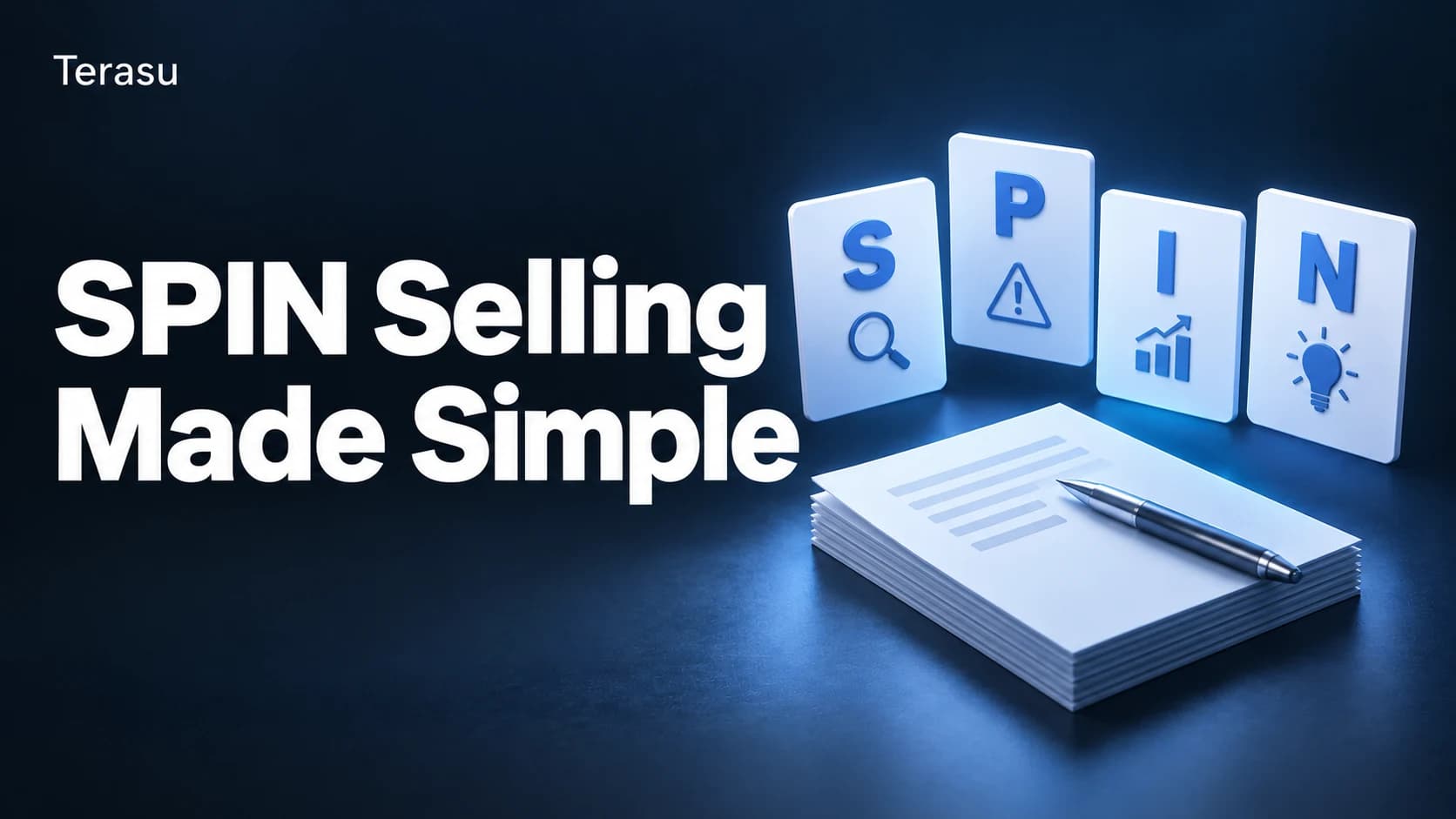
SPIN Selling is a consultative sales methodology built on four sequenced question types—Situation, Problem, Implication, and Need-payoff. Developed by Neil Rackham and Huthwaite from a 12-year study of roughly 35,000 sales calls, it remains the foundational discovery framework for complex, high-value B2B deals where building buyer-recognized need beats pitching features.

TL;DR
- What SPIN is: A four-stage questioning sequence (Situation → Problem → Implication → Need-payoff) that helps buyers articulate and quantify their own need before you ever propose a solution.
- Why it still works: Rackham's research found that top performers in large, complex sales ask far more Implication and Need-payoff questions than average reps—the opposite of feature-led "product dumping."
- 50 industry examples: This guide includes 50 ready-to-use SPIN questions across SaaS/Tech, Manufacturing, Finance, and Healthcare, organized by question type.
- SPIN vs other frameworks: SPIN governs how you ask; MEDDIC and BANT govern what you qualify. They are complementary, not competing—a comparison table is included.
- Buyer-led update for 2026: With Gartner reporting 67% of B2B buyers prefer a rep-free experience, Implication and Need-payoff must now happen asynchronously, inside content and Digital Sales Rooms—not only in live calls.
According to Salesforce State of Sales 2026 (n=4,050), 87% of sales organizations now use AI, yet the hardest skill to automate remains the one SPIN was built for: helping a buyer discover and own the cost of their problem. The methodology that has anchored consultative B2B selling for nearly four decades is SPIN Selling.
This article covers SPIN from definition to field application: the four question types with technique notes, 50 industry-specific question examples (SaaS / Manufacturing / Finance / Healthcare), a SPIN vs MEDDIC / BANT / Challenger / SNAP comparison and decision guide, a buyer-led modernization for the rep-free era, a SPIN × Digital Sales Room (DSR) signal map, common mistakes, and a four-step rollout plan.
You will learn:
- The four SPIN question types and the order that makes them work
- 50 natural, industry-specific SPIN questions you can copy into call plans
- When to use SPIN versus MEDDIC, BANT, Challenger, or SNAP—and how to combine them
- How to run Implication and Need-payoff asynchronously when buyers go rep-free
- A SPIN × DSR map that turns engagement signals into discovery follow-ups
What SPIN Selling Is — Origin and Core Logic
SPIN Selling was introduced by Neil Rackham in his 1988 book of the same name, built on research conducted by his firm Huthwaite. The study analyzed roughly 35,000 sales calls across 12 years and more than 20 countries, making it one of the largest empirical investigations of sales behavior ever published. Its central finding overturned conventional wisdom: the techniques that close small, transactional sales actively hurt performance in large, complex sales.
In high-value B2B deals, Rackham found, success correlates not with how well a rep pitches, but with how skillfully they ask questions that lead the buyer to articulate—and quantify—their own need. SPIN is the acronym for the four question types, asked in sequence.
| Type | Question type | Purpose |
|---|---|---|
| S | Situation | Establish factual context about the buyer's current state |
| P | Problem | Surface difficulties, dissatisfactions, and pains |
| I | Implication | Develop the consequences and ripple effects of those problems |
| N | Need-payoff | Lead the buyer to state the value of solving the problem |
The sequence matters. Situation and Problem questions uncover need; Implication and Need-payoff questions develop and amplify it until the buyer—not the seller—makes the case for change. Rackham's data showed that successful reps in large sales ask disproportionately more Implication and Need-payoff questions than their average peers, who tend to over-index on Situation questions and jump prematurely to features.
Why SPIN Endures
SPIN remains relevant because the structural problem it solves has only intensified. Forrester's State of Business Buying 2024 reports that B2B purchases now involve an average of 13 people and span two or more departments 89% of the time. When a deal has 13 stakeholders, no feature pitch survives contact with the buying committee—but a buyer who can articulate the quantified cost of inaction (the output of good Implication and Need-payoff questioning) becomes an internal champion who sells on your behalf.
SPIN is not a script. It is a discipline for sequencing curiosity so that need is built, not assumed.
The Four SPIN Question Types Explained
Situation Questions
Situation questions gather facts and background about the buyer's current state—tools, team size, process, volumes. They are essential for context but low-value if overused. Rackham's key warning: inexperienced reps ask too many Situation questions, which bores buyers (who already know their own situation) and feels like an interrogation.
Technique: Do your homework first. Replace generic Situation questions ("How big is your team?") with research-informed ones ("I saw you've grown headcount 40% this year—how is your current onboarding process keeping up?"). Every Situation question you can answer from public data is one you should not ask.
Problem Questions
Problem questions probe for difficulties, dissatisfactions, and unmet needs. They convert a neutral situation into a recognized problem—the seed of an "implied need."
Technique: Frame around friction, not your product. "Where does the current process slow down?" outperforms "Are you unhappy with your current vendor?" because it invites a story rather than a yes/no.
Implication Questions
Implication questions are the engine of SPIN. They take a stated problem and develop its consequences—cost, risk, knock-on effects, and impact on other people and goals. This is where an implied need ("our handoffs are messy") becomes an explicit, urgent need ("messy handoffs are costing us deals and burning out the team").
Technique: Chain consequences. "When a handoff breaks, what happens downstream?" → "How often does that lead to a slipped deal?" → "What does a slipped enterprise deal cost you?" Each link raises the perceived cost of the status quo. This is the single highest-leverage skill in complex selling—and the hardest to do without sounding leading.
Need-payoff Questions
Need-payoff questions invite the buyer to state the value of solving the problem. Where Implication questions amplify pain, Need-payoff questions pivot to a positive vision—and crucially, they get the buyer to articulate the benefits in their own words.
Technique: Ask about the upside the buyer cares about. "If handoffs were seamless, what would that free your team to do?" or "How would faster cycle times change your quarter?" When the buyer answers, they are pre-selling the solution internally—and you can quote them later to the wider committee.
50 SPIN Question Examples by Industry
The four question types are universal, but their content must be tailored. Below are 50 field-ready SPIN questions across four industries, grouped by type. Adapt the specifics to your buyer's role and your discovery stage.
SaaS / Tech (13 questions)
Situation
- "Which tools make up your current sales or product stack today?"
- "How is your team structured across product, engineering, and revenue functions?"
Problem 3. "Where in your release cycle do bottlenecks show up most often?" 4. "How reliable is the data flowing between your CRM and your product analytics?" 5. "Which manual steps in your current workflow do engineers complain about most?"
Implication 6. "When deploys slow down, how does that affect your ability to hit quarterly OKRs?" 7. "If onboarding friction increases churn, what does that do to net revenue retention?" 8. "How much engineering time gets pulled into firefighting instead of roadmap work?" 9. "When data is inconsistent across tools, how does that affect leadership's trust in the numbers?"
Need-payoff 10. "If you could cut lead time by half, what would that unlock for the roadmap?" 11. "How valuable would it be to have one source of truth your whole GTM team trusts?" 12. "If churn dropped two points, how would that change your fundraising or board story?" 13. "What would it mean for retention if customers reached first value a week sooner?"
Manufacturing (13 questions)
Situation 14. "What does your current equipment maintenance and refresh cycle look like?" 15. "How are decisions split between plant-floor managers, corporate IT, and executives?"
Problem 16. "Where do you see the most unplanned downtime across the line?" 17. "How visible is inventory and utilization data across your facilities today?" 18. "Which quality or safety issues recur despite existing controls?"
Implication 19. "When a line goes down unexpectedly, what's the knock-on cost to delivery commitments?" 20. "If yield slips even a few percent, how does that flow through to COGS and margin?" 21. "How does poor cross-plant visibility affect your ability to balance capacity?" 22. "When a safety incident occurs, what's the full impact—downtime, audit, morale?"
Need-payoff 23. "If you could predict downtime before it happens, what would that save annually?" 24. "How valuable would real-time utilization data be when you plan the next capex cycle?" 25. "If defect rates dropped, how would that change your standing with key OEM customers?" 26. "What would consistent cross-plant reporting do for your annual budget planning?"
Finance (12 questions)
Situation 27. "How is your compliance and risk function structured relative to IT and operations?" 28. "Which regulatory frameworks (SOX, GDPR, PCI DSS) shape your current controls?"
Problem 29. "Where do gaps appear when you assemble evidence for an audit?" 30. "How much manual effort goes into producing audit logs and access reports today?" 31. "Which controls are hardest to demonstrate to external auditors?"
Implication 32. "If an audit finding surfaced, what's the exposure—remediation cost, reputation, regulatory?" 33. "When evidence-gathering is manual, how does that pull your team off higher-value risk work?" 34. "How does incomplete data residency control affect your ability to expand into new regions?" 35. "If a control failed before the next external audit, what would the downstream impact be?"
Need-payoff 36. "How valuable would automated, audit-ready logs be at your next review cycle?" 37. "If you could prove controls in hours instead of weeks, what would that free the team to do?" 38. "What would stronger data residency controls mean for entering regulated markets?"
Healthcare (12 questions)
Situation 39. "How are technology decisions made across hospital administration, clinical, and pharmacy?" 40. "Which reimbursement cycles most affect your budgeting and project timing?"
Problem 41. "Where does documentation for billing claims most often break down?" 42. "Which manual steps in charting or medication workflows create the most risk?" 43. "How consistent is patient-safety reporting across departments?"
Implication 44. "When billing documentation is incomplete, what's the impact on claim rejections and revenue?" 45. "If a medication error slips through, what's the full clinical and compliance consequence?" 46. "How does fragmented reporting affect your readiness for an accreditation review?" 47. "When staff spend time on manual charting, how does that affect patient face-time and burnout?"
Need-payoff 48. "If billing documentation were automatic and complete, what would that recover in claim revenue?" 49. "How valuable would error-proof medication workflows be for patient safety scores?" 50. "If clinicians got an hour back per shift, how would that change care quality and retention?"

Run sharper discovery with Terasu
Terasu's Digital Sales Room captures which content each stakeholder engages with—so your Implication and Need-payoff questions land on real buying signals. Try free.
Start freeSPIN vs Other Frameworks — When to Use Which
A common mistake is treating SPIN as a competitor to MEDDIC or BANT. They operate on different axes. SPIN governs how you draw out and develop need through questioning; qualification frameworks govern what you must verify to forecast a deal. The best teams run both: SPIN inside the conversation, a qualification framework inside the CRM.
| Framework | What it is | Primary job | Best fit |
|---|---|---|---|
| SPIN | A questioning sequence (Situation · Problem · Implication · Need-payoff) | Build and amplify buyer-recognized need during discovery | Complex, consultative deals where need must be developed |
| MEDDIC | A qualification checklist (Metrics · Economic Buyer · Decision Criteria · Decision Process · Identify Pain · Champion) | Verify deal health and forecast accuracy | Enterprise deals with multi-stakeholder decisions |
| BANT | A qualification checklist (Budget · Authority · Need · Timeline) | Fast initial screening of fit | SMB / mid-market, sub-45-day cycles |
| Challenger | A sales stance (Teach · Tailor · Take control) | Reframe the buyer's thinking with commercial insight | Mature markets where buyers think they already know the answer |
| SNAP | A buyer-centric selling model (Simple · iNvaluable · Aligned · Priorities) | Win time-starved, overwhelmed buyers | Fast, frazzled buyers facing decision overload |
Decision Guide — Pick by Situation
| Your situation | Use | Why |
|---|---|---|
| Buyer doesn't yet recognize the problem | SPIN | Implication/Need-payoff build need from scratch |
| Need is clear; you must qualify and forecast | MEDDIC or BANT | Checklists verify viability, not curiosity |
| Buyer is locked into a flawed mental model | Challenger | Insight-led reframing breaks the status quo |
| Buyer is overwhelmed and time-poor | SNAP | Simplicity and alignment win attention |
| Complex enterprise deal, full cycle | SPIN for discovery → MEDDIC for qualification | Develop need, then verify decision structure |
For a fuller map of how qualification methods fit together, see the sales qualification frameworks guide. To layer insight-led reframing on top of SPIN discovery, see the Challenger Sale guide.
Modernizing SPIN for Buyer-Led B2B (2026 Update)
SPIN was designed for an era when discovery happened almost entirely in live, rep-controlled meetings. That world is gone. Gartner's 2026 buying survey (n=646) found that 67% of B2B buyers prefer a rep-free buying experience—yet hybrid buying that combines a rep with digital tools produces 1.8× higher-quality deals than pure self-service.
The implication for SPIN is profound: buyers now move through much of Situation and Problem before they ever speak to you, using your website, content, and peer reviews. The classic sequence breaks if you assume you'll be in the room for all four stages.
How Each Question Type Shifts
| SPIN type | Old model (rep-led) | 2026 model (buyer-led) |
|---|---|---|
| Situation | Asked live in the first meeting | Largely pre-answered by research; never waste a meeting on it |
| Problem | Surfaced through dialogue | Buyer often arrives already aware; confirm and deepen, don't re-discover |
| Implication | Developed verbally over a call | Must also live in content—ROI calculators, cost-of-inaction stories, case studies |
| Need-payoff | Buyer states value to the rep | Buyer must be able to restate value to their committee without you present |
The modern SPIN rep front-loads research so live time is spent almost entirely on Implication and Need-payoff—the two stages that can't be self-served and that turn a contact into an internal champion. And because the buying committee averages 13 people, your champion needs assets that carry the Implication and Need-payoff logic into rooms you'll never enter.
This is exactly where a Digital Sales Room changes the game.
SPIN × Digital Sales Room — Turning Signals Into Discovery
A Digital Sales Room (DSR) is a shared, trackable space where you publish proposals, cases, and ROI material for a specific buyer. Because engagement is observable, a DSR lets you run SPIN asynchronously—reading which problems resonate and which value cases land, then sharpening your live questions accordingly.
SPIN × DSR Signal Map
| SPIN type | DSR signal | Discovery follow-up |
|---|---|---|
| Situation | Which solution/overview pages the buyer views | Skip basics—open with what their behavior already tells you |
| Problem | Long dwell on a specific problem/use-case page | "I noticed your team spent time on the handoff page—is that the friction point today?" |
| Implication | Repeat views of an ROI calculator or cost-of-inaction story | "When you ran the ROI numbers, did the cost of the status quo match what you're seeing internally?" |
| Need-payoff | A new senior stakeholder opens the value summary | "Your VP reviewed the outcome summary—what outcomes matter most to them?" |
Why This Matters for the 13-Person Committee
When your champion shares the DSR internally, the Implication and Need-payoff logic travels with it. A well-built outcome summary lets the buyer restate the value to stakeholders you never meet—the asynchronous equivalent of a Need-payoff answer. DSR engagement also flags when a new decision-maker enters, so you can re-run targeted Problem and Implication questions for that person's priorities.
Caveat: DSR signals indicate interest, not confirmed need. A pricing-page view is a prompt to ask a better question—not proof the buyer has budget. Treat signals as the starting point for SPIN, never a substitute for it.
Make every SPIN question land
Terasu shows you which stakeholders engage with which proof points, so your Implication and Need-payoff questions follow real buying signals—and your champion can sell internally without you in the room.
Start freeCommon SPIN Selling Mistakes
| Mistake | Why it hurts | Fix |
|---|---|---|
| Over-asking Situation questions | Bores buyers who know their own facts; feels like interrogation | Research first; replace with informed Problem questions |
| Jumping to features after a Problem question | Skips Implication, so need stays "nice-to-have" | Chain 2–3 Implication questions before any solution talk |
| Leading Implication questions that feel manipulative | Buyer senses the setup and disengages | Ask open consequence questions, not rhetorical traps |
| Skipping Need-payoff because the problem seems obvious | The buyer never articulates value, so can't sell it internally | Always let the buyer state the upside in their own words |
| Treating SPIN as a rigid script | Conversation feels robotic | Use the sequence as a guide, follow the buyer's thread |
How to Roll Out SPIN Across a Team
- Build call plans, not scripts — For each segment, pre-write 3–5 candidate questions per SPIN type (use the 50 examples above as a starting bank). Reps adapt, not recite.
- Coach to the ratio — In call reviews, count Implication and Need-payoff questions. Rackham's finding holds: more of these two correlates with won complex deals. Make the ratio a coaching metric.
- Pair SPIN with a qualification framework — Run SPIN in the conversation, capture MEDDIC or BANT fields in the CRM afterward. Discovery and qualification are different jobs.
- Equip discovery with DSR assets — Build ROI calculators and cost-of-inaction stories so Implication and Need-payoff can run asynchronously and travel to the full buying committee.
Frequently Asked Questions
What does SPIN stand for in SPIN Selling?
SPIN is an acronym for four question types asked in sequence: Situation (facts about the current state), Problem (difficulties and dissatisfactions), Implication (the consequences and cost of those problems), and Need-payoff (the value of solving them). The methodology was developed by Neil Rackham and Huthwaite from a study of roughly 35,000 sales calls.
Who created SPIN Selling and what is the research behind it?
Neil Rackham introduced SPIN Selling in his 1988 book, based on research by his firm Huthwaite that analyzed about 35,000 sales calls over 12 years across more than 20 countries. The central finding was that techniques effective in small, transactional sales actually reduce success in large, complex B2B deals—where developing buyer-recognized need through questioning matters most.
Is SPIN Selling still relevant in 2026?
Yes. The structural problem SPIN solves has intensified: Forrester 2024 reports B2B purchases average 13 stakeholders across 2+ departments, and Gartner 2026 finds 67% of buyers prefer a rep-free experience. SPIN's Implication and Need-payoff questions remain the hardest skills to self-serve or automate, and they are what turn a contact into an internal champion. SPIN must be modernized—run partly asynchronously through content and Digital Sales Rooms—but its core logic is more relevant, not less.
Which SPIN questions matter most?
Implication and Need-payoff questions. Rackham's research showed that top performers in complex sales ask far more of these two types than average reps, who over-index on Situation questions. Implication questions amplify the cost of the problem; Need-payoff questions get the buyer to articulate the value of solving it. Situation and Problem questions are necessary setup, but the deal is built in the second half of the sequence.
What is the difference between Implication and Need-payoff questions?
Implication questions develop the negative consequences of a problem ("When handoffs break, how often does that cost you a deal?")—amplifying pain and urgency. Need-payoff questions pivot to the positive value of a solution ("If handoffs were seamless, what would that free your team to do?")—getting the buyer to state benefits in their own words. Implication builds the case for change; Need-payoff builds the case for your solution, voiced by the buyer.
SPIN Selling vs MEDDIC vs BANT—which should I use?
They do different jobs and work best together. SPIN governs how you draw out and develop need through questioning during discovery; MEDDIC and BANT are qualification checklists that verify deal health and forecast accuracy rather than build need. MEDDIC suits enterprise deals with multi-stakeholder decisions; BANT suits faster SMB or mid-market screening. A strong enterprise motion uses SPIN in the conversation to build need, then captures MEDDIC or BANT fields in the CRM to qualify and forecast. See the MEDDIC and BANT framework guides for the qualification side.
Can SPIN Selling work for SMB or transactional sales?
SPIN was specifically designed for large, complex sales and is overkill for small, transactional deals—where Rackham found that heavy questioning can even hurt. For short-cycle SMB deals, a lighter qualification approach like BANT is usually more efficient. Reserve full SPIN discipline for deals where the need must be developed and multiple stakeholders are involved.
How do I use SPIN when buyers prefer a rep-free experience?
Front-load Situation and Problem stages into research and content so buyers can self-serve them, and reserve live time for Implication and Need-payoff—the stages that can't be automated. Build ROI calculators, cost-of-inaction stories, and outcome summaries inside a Digital Sales Room so the Implication and Need-payoff logic travels to the full buying committee even when you're not present. Use DSR engagement signals (which pages each stakeholder views) to target your follow-up questions.
How is a Digital Sales Room used with SPIN Selling?
A DSR makes buyer engagement observable, letting you run SPIN asynchronously. Dwell time on a problem page signals which difficulty resonates (Problem), repeat views of an ROI calculator signal the buyer is weighing the cost of inaction (Implication), and a new senior stakeholder opening the value summary signals committee expansion (Need-payoff). Each signal becomes a sharper live question. Treat signals as prompts for better discovery, not as confirmation of need.
Conclusion
SPIN Selling has lasted nearly four decades because it solves a problem that grows harder every year: in complex B2B deals, you win not by pitching well but by helping buyers discover and quantify their own need. The four question types—Situation, Problem, Implication, Need-payoff—remain the most reliable structure for that work.
Article highlights:
- The sequence is the method: Situation and Problem uncover need; Implication and Need-payoff develop and amplify it until the buyer makes the case for change.
- The 50 industry examples give you a starting question bank for SaaS, Manufacturing, Finance, and Healthcare—adapt, don't recite.
- SPIN and qualification frameworks are complementary: SPIN governs how you ask; MEDDIC and BANT govern what you verify. Run both.
- The buyer-led update is non-negotiable: with 67% of buyers preferring rep-free and committees averaging 13 people, Implication and Need-payoff must also live in content and Digital Sales Rooms—so your champion can carry the logic into rooms you'll never enter.
- DSR signals sharpen discovery: engagement data tells you which problems resonate and which value cases land, turning every signal into a better SPIN question.
Next step: Build your first SPIN call plan from the 50 examples above, then equip discovery with a Digital Sales Room so your Implication and Need-payoff logic follows real buyer signals—and sells for you when you're not in the room.