Sales Deal Stages: The Standard 7-Stage Model, Exit Criteria & Checklists (2026)
Sales deal stages are the discrete, sequential steps an opportunity moves through from first contact to closed-won, each defined by a customer-side event rather than a rep action. Well-designed deal stages carry explicit "exit criteria"—the conditions that must be true before a deal can advance—so that every rep judges progress by the same objective standard, and forecasts reflect reality instead of optimism.
Key takeaways
- Deal stages are buyer milestones, not rep tasks. Define each stage by what the customer has done ("confirmed budget allocation"), never by what the rep just sent ("emailed the quote"). Rep-centric stages inflate pipelines; customer-centric stages can't be faked.
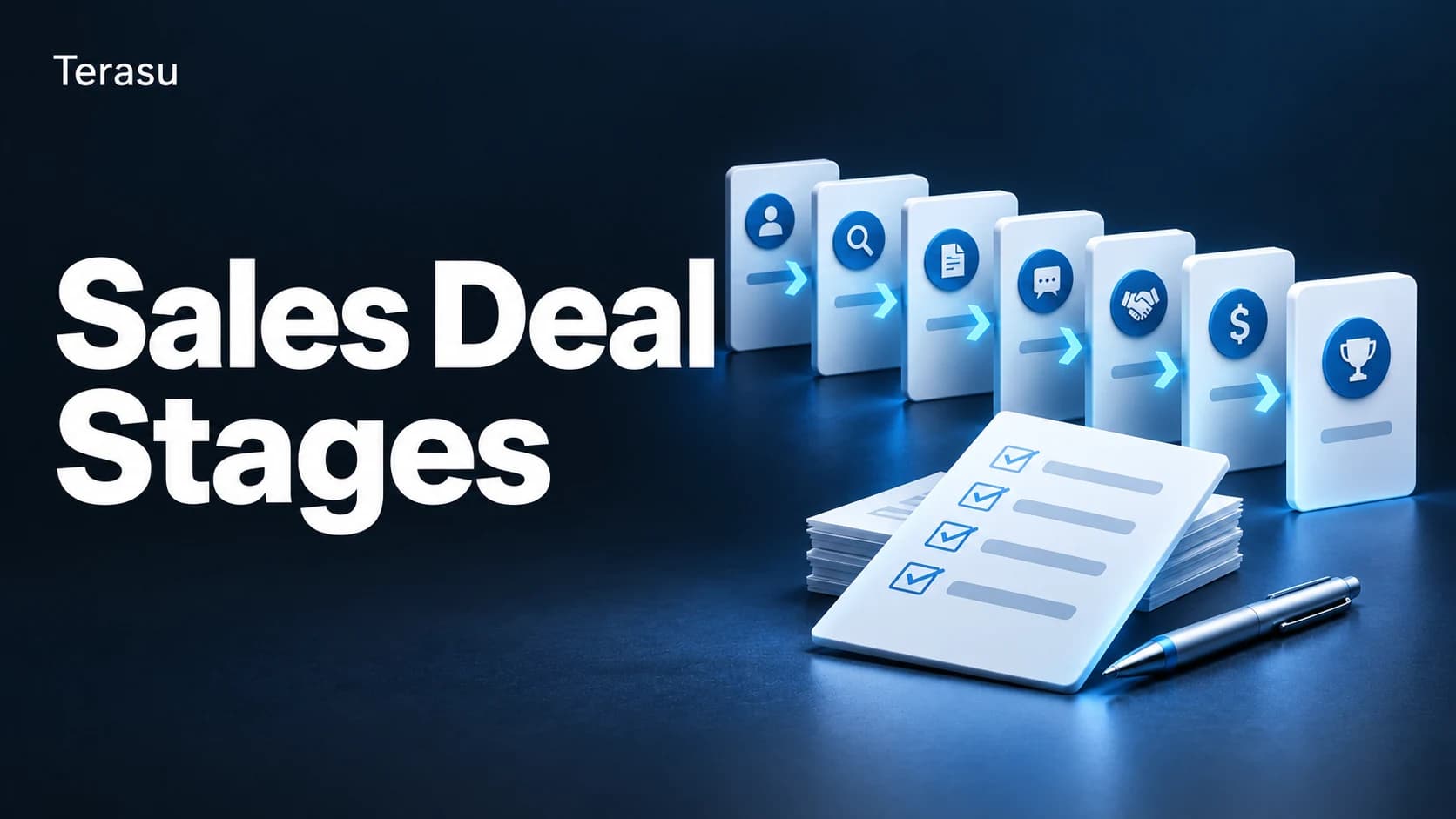
- The standard model is 7 stages: Lead → Qualification → Discovery → Proposal → Negotiation → Final Approval → Closed-Won. SMB teams compress to 5; enterprise teams expand to 7–8 with security and legal as their own stages.
- Exit criteria are what make stages work. Without documented exit criteria, "Proposal" means something different to every rep. This guide includes copy-paste checklists for all 7 stages.
- Engagement data is the 2026 upgrade. With 67% of B2B buyers preferring to buy rep-free (Gartner, 2026), Digital Sales Room (DSR) signals and a Mutual Action Plan tell you whether a stage is genuinely advancing when the rep can't see inside the account.
"What stage is this deal really in?" is the question that quietly breaks most B2B forecasts. One rep calls a deal "Proposal" the moment they email a PDF; another waits until the economic buyer has read it and asked a pricing question. Same word, two completely different probabilities—and a weighted pipeline that no executive can trust.
This guide fixes that by treating deal stages as a system: a standard 7-stage model, an exit-criteria table that defines each stage by customer behavior, copy-paste checklists you can drop into your CRM today, and a stage-by-stage playbook for using DSR engagement signals and a Mutual Action Plan to keep deals honest. For how stages roll up into volume, velocity, and forecasting metrics, pair this with our sales pipeline management guide.
What Are Sales Deal Stages?
A deal stage (also called an opportunity stage or sales stage) is one step in the sequence an opportunity travels from creation to close. Stages are the backbone of your CRM's opportunity object: each one carries a name, a win-probability weight, and—if designed well—a set of exit criteria.
Two distinctions matter before we go further:
- Deal stages vs. the funnel. A funnel is a static, aggregate view of how prospects narrow (Visitor → Lead → MQL → SQL). Deal stages track an individual opportunity moving through time. The funnel is marketing's snapshot; deal stages are the sales team's running film.
- Deal stages vs. a sales methodology. Stages describe where a deal is; a methodology like MEDDIC describes what to verify to move it forward. Stages and methodology are complementary—you anchor MEDDIC checks onto your stage exit criteria.
Why this matters now: according to the Ebsta × Pavilion 2025 GTM Benchmarks (4,000+ SaaS opportunities), average win rates fell from 29% in 2024 to 19% in 2025, while the average B2B sales cycle stretched to 6.5 months. When deals are this hard to win and this slow to close, ambiguous stages are no longer a cosmetic problem—they directly corrupt the forecast leadership uses to plan hiring and spend.
Key takeaway: Deal stages track a single opportunity through sequential, customer-defined steps. They are distinct from the funnel (aggregate) and from methodology (what to verify). In a 19%-win-rate market, stage clarity is a forecasting necessity.
The Standard 7-Stage Deal Model + Exit Criteria
Below is the standard 7-stage model most B2B SaaS teams converge on, with each stage defined by the customer-side event that signals it has truly begun, the exit criteria that must be met to advance, and a starting probability weight. Treat the probabilities as defaults to recalibrate against your own win-rate data every six months.
| # | Stage | Customer-side event (it has begun when…) | Exit criteria (advance only when…) | Default weight |
|---|---|---|---|---|
| 1 | Lead | A potential buyer is identified or inbounds | Contact confirmed as a real person at a fit account with a plausible need | 10% |
| 2 | Qualification | The prospect agrees to an exploratory conversation | Budget, authority, need, and timeline are directionally confirmed (see BANT) | 20% |
| 3 | Discovery | The buyer shares their real problem and current process | Pain quantified, decision process mapped, champion identified | 35% |
| 4 | Proposal | The buyer requests or accepts a formal proposal | Proposal delivered to the decision-maker; a substantive question raised on price, scope, or timeline | 50% |
| 5 | Negotiation | The buyer engages on terms, pricing, or contract | Open points itemized; mutual close plan agreed; security/legal review underway | 70% |
| 6 | Final Approval | The deal enters the buyer's internal sign-off | Verbal commit secured; only procurement/signature steps remain | 90% |
| 7 | Closed-Won | Contract signed | Signed agreement received; handoff to onboarding scheduled | 100% |
A few design notes:
- Stages 5–6 are where enterprise deals expand. In enterprise SaaS, "Security review," "Legal," and "Procurement" often deserve their own stages because they each carry distinct KPIs and dwell times. SMB teams typically collapse Discovery+Qualification and Final Approval+Closed, landing on a leaner 5-stage model.
- Always carry a parallel Closed-Lost. Every stage should be able to exit sideways to Closed-Lost so your loss analysis captures where deals die, not just that they died.
- The customer-side column is the discipline. If you can only describe a stage by what the rep did, the definition is broken. Rewrite it around buyer behavior.
Key takeaway: The standard model is Lead → Qualification → Discovery → Proposal → Negotiation → Final Approval → Closed-Won, each defined by a customer event and gated by explicit exit criteria. Enterprise teams split stages 5–6; SMB teams compress to five.
Exit Criteria Checklists for Every Stage
Exit criteria are the difference between a stage label and a real gate. The checklists below are written to be copied straight into your CRM stage descriptions or a shared wiki—every box must be checked before the deal advances.
# Stage 1 → 2: Lead → Qualification
- [ ] Contact is a verified real person (not a generic inbox)
- [ ] Account fits ICP (size, industry, geography)
- [ ] A plausible need or trigger event exists
- [ ] Prospect agreed to an exploratory call

# Stage 2 → 3: Qualification → Discovery
- [ ] Budget range directionally confirmed
- [ ] At least one decision-maker or influencer identified
- [ ] A concrete business need articulated by the buyer
- [ ] Rough timeline / compelling event surfaced

# Stage 3 → 4: Discovery → Proposal
- [ ] Pain quantified in the customer's own metrics (cost, time, risk)
- [ ] Decision process and approval steps mapped
- [ ] Champion identified and willing to advocate internally
- [ ] Success criteria the buyer will judge the proposal against are known
# Stage 4 → 5: Proposal → Negotiation
- [ ] Proposal delivered directly to the decision-maker (not only the champion)
- [ ] Buyer asked at least one substantive question (price / scope / timeline)
- [ ] Competitive landscape mapped
- [ ] Next concrete step scheduled (revised quote, exec meeting, security review)

# Stage 5 → 6: Negotiation → Final Approval
- [ ] All open commercial points itemized and owned
- [ ] Mutual close plan (dates + responsibilities) agreed with the buyer
- [ ] Security / legal / procurement review initiated
- [ ] Economic buyer has signaled intent to proceed

# Stage 6 → 7: Final Approval → Closed-Won
- [ ] Verbal commit secured from the economic buyer
- [ ] Final paperwork and signatory confirmed
- [ ] Start date / onboarding owner agreed
- [ ] Only signature remains—no open business questions
The most common failure is checking boxes on the rep's behalf ("I think they have budget"). Exit criteria only work when each item is verified with the buyer, not assumed. This is precisely where a methodology earns its keep—use MEDDIC to pressure-test the Discovery→Proposal gate (Is the economic buyer real? Is the decision process mapped?) so a deal can't slip forward on optimism.
Key takeaway: Document exit criteria as copy-paste checklists per stage transition, and require every box to be buyer-verified—not rep-assumed—before advancing. Anchor MEDDIC checks onto the Discovery→Proposal and Negotiation→Approval gates.
Using DSR & a Mutual Action Plan at Each Stage
Exit criteria tell you what must be true; the problem in 2026 is seeing whether it's true. With 67% of B2B buyers preferring to purchase without talking to a rep (Gartner, 2026 Sales Survey) and the average buying committee now 13 people, with 89% of purchases spanning two or more departments (Forrester, State of Business Buying 2024), much of a deal's progress happens where the rep can't observe it.
A Digital Sales Room (DSR)—a shared, per-deal space holding the proposal, collateral, and a Mutual Action Plan (MAP)—closes that visibility gap. Engagement signals reveal whether a stage is genuinely advancing, and the MAP turns exit criteria into a shared, dated plan the buyer co-owns.
| Stage | DSR engagement signal to watch | Mutual Action Plan action |
|---|---|---|
| Qualification | Did the prospect open the intro materials at all? | Draft a lightweight MAP outlining the evaluation steps |
| Discovery | Which pages are viewed, and by whom (roles)? | Add success criteria and a co-owned discovery agenda |
| Proposal | Repeat views of the proposal; pricing-page dwell time | Attach the proposal to the MAP with a review-by date |
| Negotiation | New viewers from finance, legal, or IT appearing | Map security/legal/procurement tasks with owners + dates |
| Final Approval | Decision-maker access; sustained engagement | MAP shows only signature/onboarding tasks remaining |
| Closed-Won | Onboarding materials accessed | Convert MAP into an onboarding plan |
Two signals deserve special attention:
- The cross-department signal. When someone outside your buying contact—finance, legal, IT—opens the room, the deal has likely entered the buyer's internal approval step. That's a strong, buyer-verified indicator for the Negotiation→Approval gate, far more reliable than the rep's gut.
- The silence signal. Zero access for 14 days, especially in late stages, is the most dangerous pattern in B2B: a "Late stage, low engagement" deal that SFA-only managers miss until it's lost. Surface it in every weekly review.
The MAP does the opposite job: instead of passively reading signals, it makes the buyer an active co-owner of the next milestone. When a deal stalls, refreshing the MAP with the customer to re-anchor the next dated step is the single highest-leverage recovery move—and it doubles as living documentation of your exit criteria.
Key takeaway: DSR signals make exit criteria observable when 67% of buyers buy rep-free; a Mutual Action Plan makes them co-owned. Watch the cross-department signal to confirm internal approval, and the 14-day silence signal to catch late-stage deals before they die.
Common Mistakes in Deal Stage Design
Even a well-chosen model fails in practice through a handful of recurring errors:
- Rep-action stage names. "Demo sent," "Quote submitted"—these let reps advance deals by their own activity. Always rewrite around buyer events.
- No exit criteria. Stages without gates collapse into rep opinion. The fix is the checklists above.
- Too many stages. Beyond 7–8, input burden rises and reps stop updating the CRM accurately. Resolution gained is lost to data decay.
- Static probabilities. Default weights that are never recalibrated drift from reality. Update them from your own win-rate data each half-year QBR.
- No sideways exit. If deals can only move forward, your loss analysis can't tell you which stage leaks. Wire a Closed-Lost exit from every stage.
For how these errors compound into forecast damage—and a 90-day sequence to fix them—see the failure-pattern analysis in our pipeline management guide.
Key takeaway: The five recurring mistakes are rep-action naming, missing exit criteria, too many stages, static probabilities, and no sideways exit. Each has a direct, documented fix.
How Many Deal Stages Should You Have?
There's no universal number, but there is a defensible range: 5 to 7 stages for most B2B teams. Fewer than 4 loses the resolution you need to spot bottlenecks; more than 8 collapses under rep input load and degrades data quality.
- SMB / transactional SaaS (5 stages): Lead → Qualification → Demo → Proposal → Closed. Short cycles reward simplicity.
- Mid-market (6–7 stages): the standard model above, sometimes splitting Proposal and Negotiation.
- Enterprise (7–8 stages): add "Security review," "Legal," and/or "Procurement" as discrete stages, each with its own KPI and dwell-time benchmark—these are where enterprise deals actually stall.
If you run multiple products with materially different sales motions, run separate stage sets per product even on a shared CRM, rather than forcing one model to fit all. Industries with especially long, multi-stakeholder cycles need even more stage granularity — see how this plays out in medical device sales (hospital committee consensus) and homebuilder sales (family decision-making units).
Key takeaway: Target 5–7 stages—5 for SMB, 6–7 for mid-market, 7–8 for enterprise (splitting out security, legal, procurement). Run separate stage sets per distinct product motion.
Frequently Asked Questions
What are sales deal stages?
Sales deal stages are the sequential steps an opportunity moves through from first contact to closed-won—typically Lead, Qualification, Discovery, Proposal, Negotiation, Final Approval, and Closed-Won. Each stage should be defined by a customer-side event (what the buyer has done) and gated by explicit exit criteria, so every rep judges progress by the same objective standard.
What are the standard 7 deal stages?
The standard 7-stage B2B model is: (1) Lead, (2) Qualification, (3) Discovery, (4) Proposal, (5) Negotiation, (6) Final Approval, and (7) Closed-Won. Default probability weights run roughly 10% / 20% / 35% / 50% / 70% / 90% / 100%, which you should recalibrate from your own win-rate data every six months.
What are exit criteria in deal stages?
Exit criteria are the specific, buyer-verified conditions that must all be true before a deal can advance to the next stage—for example, "proposal delivered to the decision-maker" and "a substantive pricing question raised." They turn a stage label into a real gate, preventing reps from advancing deals on optimism. Document them as copy-paste checklists in your CRM.
What is the difference between deal stages and a sales pipeline?
A deal stage is one step a single opportunity occupies; a sales pipeline is the full set of opportunities across all stages, viewed and managed together. Stages are the building blocks; the pipeline is the aggregate you forecast and analyze. See our pipeline management guide for the metrics and review cadences built on top of stages.
What is the difference between sales stages and a sales funnel?
A sales funnel is a static, aggregate view of how prospects narrow over time (Visitor → Lead → MQL → SQL)—it's marketing's snapshot of volume at each level. Deal stages track an individual opportunity moving through time within a single deal record. The funnel tells you how many prospects reach each level; deal stages tell you where one specific deal is right now and what has to happen for it to advance.
How many deal stages should a B2B team have?
Five to seven for most teams. SMB and transactional motions use around five; mid-market uses six to seven; enterprise uses seven to eight, splitting out security review, legal, and procurement as their own stages. Fewer than four loses resolution; more than eight degrades CRM data quality through input burden.
Should deal stages be based on rep actions or customer behavior?
Always customer behavior. Rep-action stages like "sent the quote" let reps inflate the pipeline through their own activity. Customer-centric definitions like "customer confirmed budget allocation" cannot be moved by rep willpower, so the forecast stays honest. This single principle is the foundation of trustworthy stage design.
How do DSR signals and a Mutual Action Plan help with deal stages?
DSR engagement signals make exit criteria observable when buyers research rep-free—cross-department views indicate internal approval has begun, and 14-day silence flags late-stage deals at risk. A Mutual Action Plan turns exit criteria into a dated, buyer-co-owned plan, so refreshing it is the highest-leverage way to re-anchor a stalled deal's next milestone.
How do MEDDIC and deal stages work together?
Deal stages describe where a deal is; MEDDIC describes what to verify to move it. You anchor MEDDIC checks onto your stage exit criteria—using it to pressure-test the Discovery→Proposal gate (Is the economic buyer real? Is the decision process mapped?) so deals can't slip forward on assumptions rather than verified facts.
Conclusion
Deal stages are only as useful as their definitions are honest. The three moves that separate a trustworthy pipeline from a hopeful one are: define every stage by a customer event, gate every transition with buyer-verified exit criteria, and make progress observable through DSR signals and a co-owned Mutual Action Plan. Adopt the standard 7-stage model, drop the exit-criteria checklists into your CRM, and recalibrate weights from real data twice a year—and "what stage is this deal really in?" stops being a guess.
Start with one stage: rewrite your "Proposal" definition around buyer behavior, add its exit-criteria checklist, and watch how quickly forecast conversations get more honest.
Run client projects more intelligently.
Manage client projects more efficiently. Try it free.
Start for free