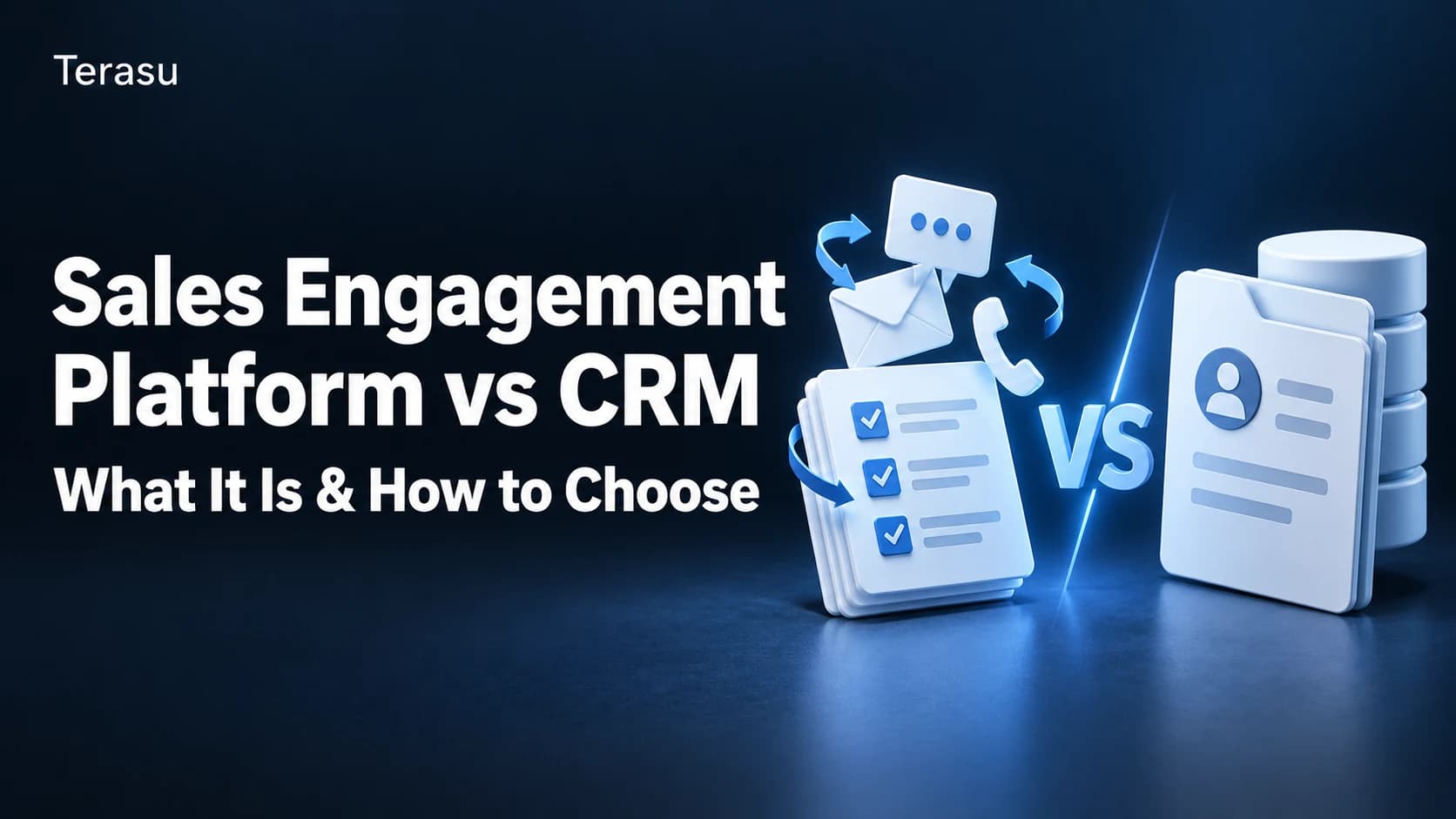
Sales Engagement Platform vs CRM: What It Is & How to Choose
Key takeaways:
- A sales engagement platform (SEP) orchestrates and automates seller outreach—sequences, calls, emails, and follow-up cadences—so reps spend more time selling and less time on manual admin.
- An SEP is not a CRM. The CRM is your system of record; the SEP is your system of action that runs on top of it. Most teams need both, plus a buyer-facing layer.
- Choosing one comes down to five things: CRM fit, multichannel depth, analytics, admin overhead, and how it hands off to the buyer-facing stage of the deal.
If you manage a B2B sales team, you have almost certainly heard the term "sales engagement platform"—and just as likely wondered how it differs from the CRM you already pay for, or from the dozen other "sales tech" categories competing for budget. The naming doesn't help: CRM, sales engagement, sales enablement, and digital sales room all sound adjacent, and vendors blur the lines on purpose.
This guide draws the lines clearly. We define what a sales engagement platform actually does, contrast it side by side with a CRM and a digital sales room so you can see where each one starts and stops, give you a concrete set of selection criteria, and lay out a reference stack you can adapt to your own team. By the end you'll know not just what an SEP is, but whether your team needs one—and what to put around it.
What Is a Sales Engagement Platform?
A sales engagement platform is software that helps sales reps execute and automate their outreach to prospects and customers across multiple channels—email, phone, LinkedIn, SMS—from a single workflow. Where a CRM stores what happened, an SEP drives what happens next: it tells a rep who to contact, on which channel, with what message, and when.
The category emerged to solve a specific problem. Reps were spending a large share of their week on non-selling work—logging activity, building task lists, copying email templates, remembering to follow up. According to Salesforce's State of Sales research, sellers spend only around 30% of their week actually selling, with the rest consumed by admin, prospecting logistics, and tool-switching (Source: Salesforce, State of Sales report). An SEP automates the connective tissue around the sale so that 30% can grow.
Core Capabilities of an SEP
Most sales engagement platforms converge on the same core feature set:
1. Sequences (cadences) The defining feature. A sequence is a predefined series of touches—e.g., Day 1 email, Day 2 LinkedIn connect, Day 4 call, Day 6 follow-up email—that the platform schedules and surfaces automatically. Reps work a prioritized task queue instead of remembering each step.
2. Multichannel outreach Email, dialer, social, and SMS in one interface, so a rep never leaves the tool to switch channels. Calls are logged automatically; emails are tracked for opens and replies.
3. Templates and snippets Reusable, version-controlled messaging that keeps the team on-brand and lets you A/B test what actually books meetings.
4. Activity capture and CRM sync Every email, call, and task writes back to the CRM automatically—removing the manual logging that erodes data quality (and rep goodwill).
5. Engagement analytics Open rates, reply rates, connect rates, sequence performance, and rep activity dashboards. This is the data that tells you which cadence converts and which rep needs coaching.
The common thread: an SEP is a system of action for the seller's side of the funnel, heavily weighted toward the top and middle—prospecting, qualification, and the working of active opportunities. For how this fits the broader discipline of equipping sellers, see our guide to sales enablement.
Sales Engagement Platform vs CRM: The Core Difference
This is the comparison that matters most, because nearly every team evaluating an SEP already owns a CRM and reasonably asks: don't they overlap?
They overlap a little and complement a lot. The cleanest way to hold the distinction:
The CRM is your system of record. The sales engagement platform is your system of action.
A CRM is the authoritative database of accounts, contacts, opportunities, and history. It answers "what is the state of this deal and this relationship?" It is built for durability, reporting, and forecasting. An SEP, by contrast, is built for doing—it sits on top of the CRM, reads from it, drives the rep's daily execution, and writes activity back. You forecast in the CRM; you work the day in the SEP.
| Dimension | CRM | Sales Engagement Platform |
|---|---|---|
| Primary purpose | System of record | System of action |
| Core question answered | "What is the state of the deal?" | "What should I do next, and when?" |
| Main user | Whole revenue org (sales, ops, leadership) | Front-line reps (SDRs, AEs) |
| Owns | Accounts, contacts, opportunities, history | Sequences, outreach execution, activity capture |
| Strength | Reporting, forecasting, single source of truth | Automation, multichannel cadence, rep productivity |
| Weakness | Manual logging, no built-in execution layer | Not a database of record; depends on the CRM |
| Typical tools | Salesforce, HubSpot, Microsoft Dynamics | Outreach, Salesloft, Apollo, HubSpot Sales Hub |
A useful analogy: the CRM is the map; the SEP is the GPS that routes the rep turn by turn. The map is essential, but on its own it won't tell a rep to call this account today because the prospect just opened the proposal twice.
That last point exposes a gap neither tool fully closes—what happens once a buyer is actively evaluating you. Which brings in a third category.
Where the Digital Sales Room Fits: SEP vs CRM vs DSR
An SEP and a CRM share one blind spot: both are seller-side, internal tools. The CRM records the deal internally; the SEP automates the seller's outbound activity. Neither gives the buyer a place to engage. Yet modern B2B deals involve an average of 6–10 stakeholders on the buying side (Source: Gartner, B2B buying research), most of whom the rep never directly emails. Once a deal is active, the work shifts from "reach the prospect" to "help a buying committee build internal consensus."
That's the job of a digital sales room (DSR): a shared, buyer-facing space where seller and customer collaborate on a live deal—proposals, pricing, mutual action plans, recordings, and documents in one link, with engagement tracked so the rep sees who viewed what.
Here is the three-layer role map. Note that across the English-speaking market we describe the internal-execution layer as a sales engagement platform, not by the older "SFA" label, which has largely fallen out of use:
| Layer | Tool | Manages | Direction | Primary value |
|---|---|---|---|---|
| Record | CRM | Accounts, opportunities, forecast | Internal | Single source of truth |
| Action | Sales engagement platform | Sequences, outreach, activity capture | Internal → outbound | Rep productivity at scale |
| Experience | Digital sales room | Live deal collaboration, content, buyer signals | Seller ↔ buyer | Consensus and conversion on active deals |
The three are sequential along the deal, not competitive. The SEP is strongest at the top and middle of the funnel—getting a conversation started and qualified. The DSR is strongest at the middle and bottom—once a real opportunity exists and a buying committee needs to be guided to a decision. The CRM underpins all of it.
The handoff between layers is where revenue leaks. A rep books a meeting through a slick SEP sequence, then reverts to scattered email attachments to actually run the deal—and loses all visibility into buyer behavior at the exact moment it matters most. A DSR closes that gap by giving the late-stage deal a tracked, structured home. Terasu sits in this experience layer: a per-deal room with document-view tracking, reusable templates, and Slack/CRM integration, so the engagement that the SEP started keeps producing signal all the way to close.
Do You Actually Need a Sales Engagement Platform?
An SEP is not for every team. It earns its cost under specific conditions.
You likely need one if:
- You run a dedicated SDR/BDR outbound motion at volume. Sequenced, multichannel prospecting at scale is the SEP's home turf.
- Reps complain about manual logging and follow-up tracking, and CRM data quality is suffering because of it.
- You have enough reps (roughly 5+) that standardizing cadences and coaching on engagement analytics produces real leverage.
- Your sales cycle includes high-volume, repeatable outreach rather than a handful of bespoke enterprise deals.
You probably don't need one yet if:
- You close a small number of large, relationship-led deals where each touch is hand-crafted; cadence automation adds little.
- Your team is under ~3 reps and the coordination overhead doesn't yet exist.
- Your bottleneck is late-stage deal conversion, not top-of-funnel volume. In that case a digital sales room delivers more, sooner—see our breakdown of digital sales room software.
A quick diagnostic: if your most painful question is "how do we contact more of the right prospects, consistently?", an SEP is the answer. If it's "how do we get the deals we already have over the line?", look to the experience layer first.
How to Choose a Sales Engagement Platform: 5 Criteria
Once you've decided an SEP is warranted, evaluate candidates against these five criteria rather than feature-count checklists.
1. CRM Fit and Sync Depth
This is the single most important factor. An SEP that syncs poorly with your CRM becomes a second source of truth that drifts—the exact problem you were trying to solve. Confirm bi-directional, near-real-time sync with your specific CRM, field-level mapping control, and how conflicts are resolved. If you run HubSpot, a native option may beat a best-of-breed tool you have to wire up.
2. Multichannel Depth (Not Just Email)
Many tools call themselves multichannel but are really email-plus. Pressure-test the dialer quality (local presence, call recording, voicemail drop), LinkedIn integration, and SMS if your market uses it. A shallow second channel is a checkbox, not a capability.
3. Analytics and Coaching Signal
The data an SEP produces is half its value. Look for sequence-level performance analytics, rep activity and conversion dashboards, and A/B testing on templates. Ask: can a manager see which step in a cadence is killing reply rates and coach on it? If the analytics only show vanity activity counts, the tool won't improve performance.
4. Admin and Maintenance Overhead
SEPs vary enormously in how much administration they demand. A powerful platform that needs a dedicated RevOps admin to maintain sequences may cost more in labor than license. Weigh ease of building and editing cadences, template governance, and onboarding time. For a lean team, time-to-value matters more than maximal configurability.
5. Handoff to the Buyer-Facing Stage
Often overlooked: what happens when a sequence succeeds and a real opportunity opens? Evaluate how cleanly the SEP hands the deal off to wherever your late-stage collaboration lives. The smoothest stacks connect engagement data through to a digital sales room so the buyer signal is continuous from first touch to signature, rather than going dark the moment a meeting is booked.
| Criterion | What to verify | Red flag |
|---|---|---|
| CRM fit | Bi-directional, real-time, field-level sync | One-way or batch-only sync |
| Multichannel depth | Real dialer + social + SMS, not email-plus | A "second channel" that's a thin add-on |
| Analytics | Sequence-level + coaching dashboards + A/B | Only activity-volume counters |
| Admin overhead | Cadence build time, template governance | Needs a full-time admin to operate |
| Buyer-stage handoff | Clean route to DSR / late-stage tooling | Signal goes dark after the meeting books |
A Reference B2B Sales Stack for 2026
Categories are easier to understand assembled than in isolation. Here is a reference stack for a typical B2B SaaS sales org running an outbound-plus-inbound motion. Treat it as a template to adapt, not a shopping list.
LAYER 1 — RECORD (system of truth)
  CRM: Salesforce / HubSpot
  └─ Accounts, opportunities, forecast, reporting

LAYER 2 — ACTION (seller execution)
  Sales engagement platform: Outreach / Salesloft / Apollo
  ├─ Sequences & multichannel outreach (SDR + AE)
  ├─ Activity auto-capture → writes back to CRM
  └─ Engagement analytics for coaching

LAYER 3 — INTELLIGENCE (signal & enrichment)
  Conversation intelligence: Gong / Chorus
  Data & enrichment: ZoomInfo / Clearbit
  └─ Feeds prioritization in Layer 2

LAYER 4 — EXPERIENCE (buyer-facing, late-stage)
  Digital sales room: Terasu
  ├─ Per-deal room: proposals, pricing, mutual action plan
  ├─ Document-view tracking → buyer signal back to CRM
  └─ Slack/CRM integration for the deal team
The flow of value runs left to right and back again. Layer 1 holds the truth. Layer 2 acts on it and keeps it current. Layer 3 sharpens prioritization. Layer 4 takes a qualified opportunity, gives it a tracked buyer-facing home, and feeds engagement signal back into Layers 1 and 2.
A practical sequencing note for teams building this up: start with Layers 1 and 2 if your bottleneck is pipeline volume, and start with Layers 1 and 4 if your bottleneck is closing the pipeline you already have. Few teams need all four at once, and bolting on a category before its problem is acute is the most common way sales-tech budgets get wasted. Add each layer when its specific pain becomes the loudest one in the room.
Where the Stack Commonly Breaks
Three failure points recur:
- SEP–CRM drift. Sync is configured loosely at rollout, fields diverge, and within months reps trust neither system. Fix: lock down field mapping and sync direction before go-live.
- The mid-funnel cliff. Layer 2 books the meeting, then the deal falls into email attachments with zero tracking. Fix: connect Layer 2's success to a Layer 4 room so buyer signal stays continuous.
- Tool sprawl without ownership. Each layer gets bought by a different team and nothing integrates. Fix: make RevOps own the stack's integration map, not just individual tools.
Frequently Asked Questions
What is a sales engagement platform in simple terms?
It's software that automates and organizes a sales rep's outreach—email, calls, social, and SMS—into structured sequences, so reps know exactly who to contact next and on which channel. It works on top of your CRM, driving daily selling activity and logging it automatically. Think of the CRM as the record of what happened and the sales engagement platform as the engine for what happens next.
Is a sales engagement platform the same as a CRM?
No. A CRM is your system of record—the database of accounts, opportunities, and history used for reporting and forecasting. A sales engagement platform is your system of action—it executes and automates outreach, then syncs that activity back into the CRM. They are complementary: the SEP runs on top of the CRM, and most teams that use an SEP also keep their CRM as the source of truth.
What is the difference between a sales engagement platform and a digital sales room?
A sales engagement platform is an internal, seller-side tool focused on top- and mid-funnel outreach—getting conversations started at scale. A digital sales room is a buyer-facing space for late-stage deals, where seller and customer collaborate on proposals, pricing, and next steps in one tracked link. The SEP helps you reach prospects; the DSR helps you close the opportunities that result. They cover different stages of the same deal.
Do I still need a sales engagement platform if I have HubSpot or Salesforce?
Often yes, though it depends. HubSpot Sales Hub and Salesforce both include some engagement features (sequences, basic cadences), which can be enough for smaller teams. Dedicated SEPs like Outreach, Salesloft, and Apollo offer deeper multichannel outreach, richer sequence logic, and stronger engagement analytics. If you run high-volume outbound with an SDR team, the dedicated tool usually pays off; if your outreach is light, your CRM's built-in features may suffice.
How much does a sales engagement platform cost?
Pricing is typically per-seat per month and varies widely by tier and vendor. Lighter, prospecting-focused tools tend to sit at the lower end, while enterprise platforms with full dialer, analytics, and governance sit considerably higher. Beyond license, budget for implementation, CRM integration work, and ongoing administration—the total cost of ownership often exceeds the sticker price, so evaluate admin overhead as part of the cost.
Who uses a sales engagement platform on the team?
Primarily front-line reps—SDRs and BDRs running outbound prospecting, and AEs working active opportunities. Sales managers use the engagement analytics to coach on cadence and activity. RevOps typically owns configuration, CRM sync, and sequence governance. Leadership rarely uses it directly but relies on the activity data it feeds into the CRM.
When should a team adopt a sales engagement platform?
Adopt one when your bottleneck is consistent, high-volume outreach and manual follow-up is eroding CRM data quality—usually once you have around five or more reps and a real outbound motion. Hold off if your team is very small, your deals are few and bespoke, or your actual bottleneck is closing late-stage deals rather than generating top-of-funnel volume. In the latter case, a digital sales room delivers value faster.
Where does a sales engagement platform fit in the sales stack?
It sits in the "action" layer, on top of the CRM (the record layer) and alongside intelligence tools like conversation analytics and data enrichment. Its output—qualified, active opportunities—should hand off cleanly to whatever runs your late-stage, buyer-facing collaboration, such as a digital sales room. Positioned this way, engagement signal stays continuous from first outreach to signed contract.
Conclusion: Action, Record, and Experience—Get All Three Right
A sales engagement platform is the system of action that turns your CRM's static record into daily selling motion: sequenced, multichannel outreach that scales rep productivity and keeps activity data clean. It is not a CRM replacement and not a buyer-facing tool—it's the execution layer between them.
The teams that win don't just buy an SEP; they design the seams around it. They keep CRM sync tight so the record stays trustworthy, they choose multichannel depth and coaching analytics over feature counts, and—critically—they make sure the engagement an SEP starts doesn't go dark the moment a meeting is booked. That last mile, where an active deal needs a buyer-facing home, is where a digital sales room carries the signal through to close.
Map your own bottleneck first. If it's pipeline volume, an SEP is your next investment. If it's converting the deals you already have, start with the experience layer instead.
See where the experience layer fits your stack: Terasu gives each active deal a tracked, buyer-facing room—document-view signals, reusable templates, and Slack/CRM integration—so the engagement your reps create keeps producing insight all the way to signature. Explore digital sales room software to see how the late-stage layer complements your sales engagement platform.
![Notion for Sales: Where It Breaks and When to Switch [2026 Guide]](/_next/image?url=%2Fimages%2Fblog%2Fbrand-20261011-all-en-notion-sales-alternative.webp&w=828&q=75)