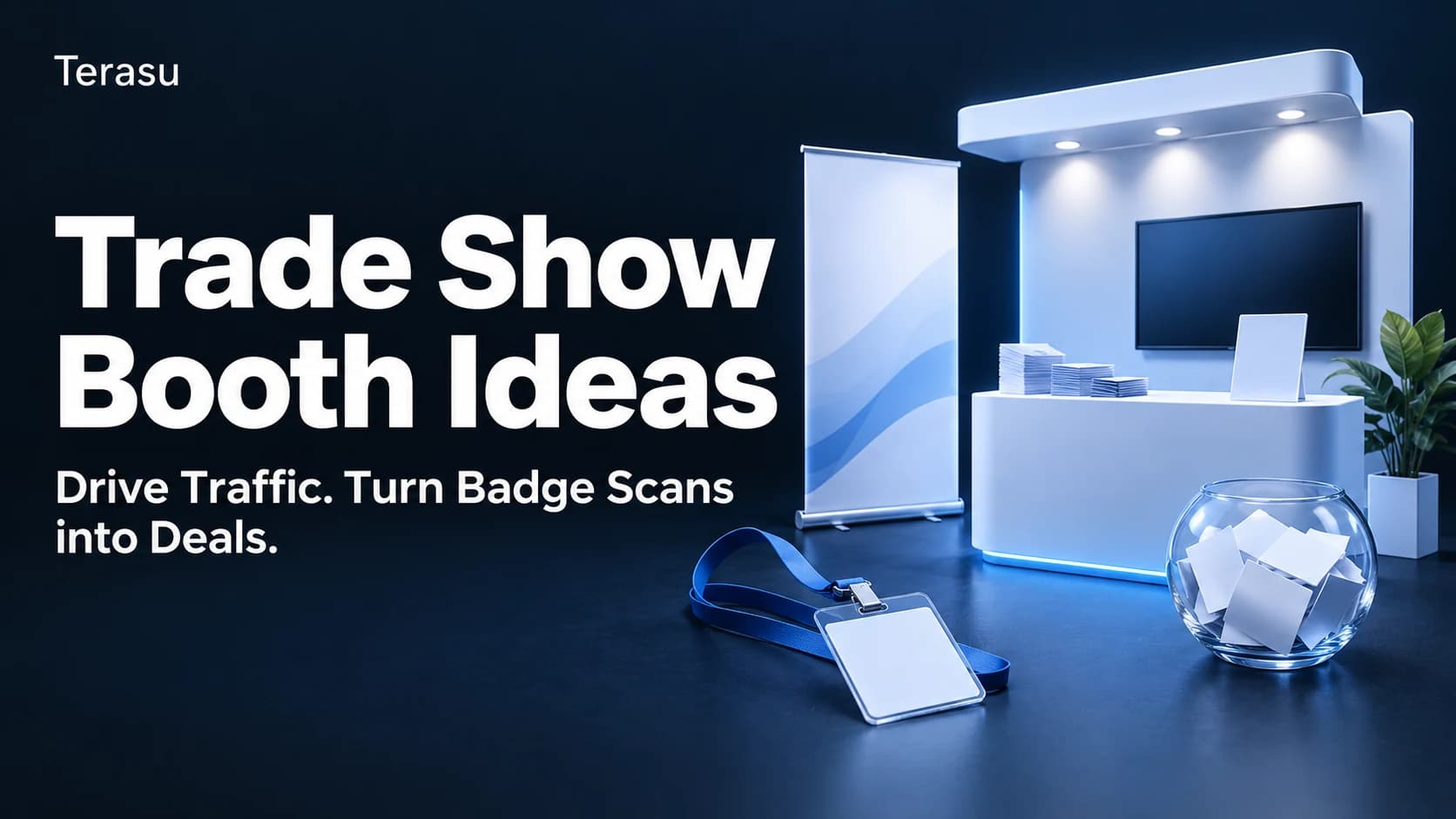
Trade Show Booth Attraction Ideas: How to Drive Traffic and Turn Badge Scans into Deals【2026】
Editor's note: This article is produced by the Terasu editorial team. Terasu is a digital sales room (DSR) platform. This guide is written from the exhibitor's perspective — for the marketing, sales, and event teams responsible for drawing visitors to the booth and converting the leads you capture into meetings. It does not cover booth construction logistics or the organizer's side of attendee acquisition. For the sales side — booth conversation scripts, cost-recovery KPI design, and post-show conversion — see the companion Trade Show Sales guide.
Trade show attraction is the set of activities an exhibitor runs to draw qualified visitors to its booth and convert the resulting leads — business cards and badge scans — into sales conversations. It is designed across three phases: pre-show outreach, on-site booth engagement, and post-show follow-up.
Key Takeaways:
- Trade show results are decided not by on-the-day improvisation but by deliberate design across three phases: pre-show, on-site, and post-show
- The biggest failure mode isn't a quiet booth — it's letting captured leads go cold. US research shows companies that attempt contact within an hour of an inquiry are about 7x as likely to qualify the lead as those that wait even an hour longer
- Use the phase-by-phase checklist (starting 4 weeks out) in this article to eliminate preparation gaps
- What stops foot traffic isn't clever pitching — it's signage that communicates in 3 seconds and a demo experience people can see from the aisle
- Run post-show follow-up with a simple system: tier leads by temperature (hot/warm/cold) → first touch within 24 hours → nurture the rest
What Is Trade Show Attraction? Results Are Decided Across Three Phases
Trade show attraction means maximizing qualified traffic to your booth and converting the best of that traffic into leads, meetings, and revenue. The word "attraction" evokes day-of crowd-pulling, but in practice your results are largely determined by what happens before the doors open and after they close.
Here is the full picture in three phases:
| Phase | Timing | Goal | Core tactics |
|---|---|---|---|
| ① Pre-show | 4 weeks out to the day before | Give prospects a reason to visit before they arrive | Invitation emails, direct mail, social posts, press releases, paid ads |
| ② On-site | During the show | Stop aisle traffic and pull visitors into the booth | Signage and headline copy, live demos, giveaways, engagement scripts, lead capture flow |
| ③ Post-show | Close of show to 4 weeks after | Turn captured leads into meetings | Thank-you emails, tiered follow-up, nurturing, meeting conversion |
The critical insight: the three phases multiply, they don't add. With zero pre-show outreach, your booth depends entirely on walk-by luck. With zero post-show follow-up, even a record stack of badge scans produces no revenue. The winning strategy is to run all three phases — even thinly — as one connected pipeline, rather than over-investing in any single one.
Trade shows are one of several major B2B lead generation channels. If you're still deciding between channels (web, webinars, content marketing, events), start with our overview of lead generation and come back here once exhibiting is locked in. This article focuses on what to do after the decision to exhibit is made.
Three Kinds of Outcomes a Trade Show Can Produce
If your only goal is "collect as many business cards as possible," your tactics will drift. Exhibiting can produce three distinct outcomes:
- Net-new leads — first contact with prospects who don't know you yet, including buyers in industries and roles that don't research vendors online
- Deepened relationships — reviving dormant leads, introducing new products to existing customers, and hearing the unfiltered pain points people only share face-to-face
- Awareness and brand presence — being visibly present in your industry, plus serendipitous contact with media and partners
Decide which of the three is your primary objective before anything else. If it's net-new leads, weight your budget toward giveaways and the lead capture flow; if it's relationship depth, weight it toward customer invitations and meeting space. The objective sets the priority order for every other decision.
The Three Structural Reasons Trade Show Attraction Fails
Trade show failures are rarely about luck or attendance numbers — they are almost always structural, baked in before the show starts. Check which of these three patterns describes your last exhibition; it will tell you which sections of this guide matter most for you.
Failure #1: Day-of bias — "If we exhibit, people will come"
The most common failure is pouring energy into booth decoration and day-of staffing while doing almost nothing before or after the show. Attendees walk the floor with limited time and prioritized agendas. The odds that a prospect who never heard from you will stumble onto your booth among hundreds of exhibitors are not in your favor.
The quality of your day-of leads is determined by how many people arrive already planning to see you — booked demo slots, RSVP'd visits, personal invitations. Don't bet on serendipity; bank confirmed visitors in advance.
Failure #2: Vague objective and target — who should walk away with what?
When the goal is "collect lots of cards," you end up with a stack of giveaway-hunters who will never buy. When the team is passive ("our product is niche anyway"), traffic walks straight past. Before the show, lock down three things:
- Target: which industry, department, and seniority should stop at your booth
- Message: can your signage state that person's pain in one line?
- Goal action: what should a visitor do — try the demo, complete a survey, book a meeting, request materials?
With these three fixed, every decision about booth design, scripts, and giveaways can be judged against the same question: does this resonate with the target?
Failure #3: Lead neglect — the most expensive mistake in exhibiting
The most serious and most underestimated failure is letting captured leads sit untouched. The show ends, the team returns to their day jobs, the card stack becomes a "someday" list, and two or three weeks later a generic email goes out — and gets no reply. Most exhibitors know this story firsthand.
Slow follow-up costs more than most teams realize. In research analyzing over 1.25 million sales leads received by 42 US companies (James Oldroyd et al., Harvard Business Review, March 2011, "The Short Life of Online Sales Leads"), firms that attempted contact within an hour of an inquiry were about 7x as likely to qualify the lead as those that waited even an hour longer — and more than 60x as likely as those that waited 24 hours or more. That study covered web-generated leads, but the underlying mechanism — interest and memory decay fast — applies equally to trade show leads. Attendees visit dozens of booths; within days, they can't recall which booth showed them what.
That's why this guide gives its deepest coverage to the post-show follow-up system (temperature tiering → first-touch email → nurturing) — the part most competing guides barely mention.
The Phase-by-Phase Trade Show Attraction Checklist
The most reliable way to manage trade show prep is a checklist counted backward from 4 weeks out. The schedule below assumes a standard mid-size exhibit; slide the timeline earlier for larger builds (8–12 weeks out is typical for big footprints).
4–3 weeks out: strategy and foundations
| Timing | Task | Owner |
|---|---|---|
| 4 weeks out | Finalize objective, target, and KPIs | Marketing lead |
| 4 weeks out | Decide the main headline and booth message | Marketing |
| 4 weeks out | Lock the demo / experience concept | Marketing + Sales |
| 3 weeks out | Select and order giveaways (watch lead times) | Marketing |
| 3 weeks out | Publish the exhibit landing page and visit-booking form | Marketing |
| 3 weeks out | Draft the press release | PR |
2–1 weeks out: pre-show outreach execution
| Timing | Task | Owner |
|---|---|---|
| 2 weeks out | Send invitation email #1 to the house list | Marketing |
| 2 weeks out | Personal 1:1 invitations to key prospects and customers (from their reps) | Sales |
| 2 weeks out | Start social posting (continue through the show) | Marketing |
| 2 weeks out | Distribute press release (if there's news) | PR |
| 1 week out | Invitation email #2 (reminder + preview of highlights) | Marketing |
| 1 week out | Run engagement-script role-plays with all booth staff | Sales |
| 1 week out | Finalize the lead capture flow (who records what, how) | Sales lead |
| 1 week out | Write the post-show follow-up email templates in advance | Marketing + Sales |
Day before — during the show: on-site operations
| Timing | Task | Owner |
|---|---|---|
| Day before | Booth setup and demo equipment check | Everyone |
| Day before | "See you tomorrow" email to booked visitors | Marketing |
| Daily | Morning huddle: roles and KPI progress | Lead |
| Daily | Tag every captured lead with a temperature note the same day | Everyone |
| Daily | Send same-day thank-you emails to hot leads | Owning rep |
Close of show — 4 weeks after: post-show follow-up
| Timing | Task | Owner |
|---|---|---|
| By next business day | Thank-you email to all leads completed | Marketing |
| Within 3 business days | Personal outreach to every hot lead (call + meeting ask) | Sales |
| Within 1 week | All leads tiered and entered in CRM | Sales + Marketing |
| Within 2 weeks | Nurture track started for warm leads | Marketing |
| Within 4 weeks | KPI retrospective (traffic, meeting conversion) and lessons shared | Everyone |
The most commonly missed item is writing follow-up email templates one week before the show. If you start writing after the show ends, your first touch will be late — guaranteed. Follow-up isn't something you do after the show; it's something you set up before it.
Six Pre-Show Outreach Ideas: Create the Reason to Visit
Pre-show outreach means delivering your exhibit story to targets before the show so they decide in advance to visit your booth. Instead of relying on walk-bys, you bank committed visitors. Six tactics, in rough chronological order:
① Invitation emails to your house list — highest ROI, do this first
Emails to existing contacts — prospects, past badge scans, dormant accounts — are the workhorse of pre-show outreach. The key is to go beyond "we're exhibiting":
- Subject line = the visitor's benefit, not your announcement: "We're exhibiting at X" → "Be first to try the new release, live at our booth"
- One concrete reason to come: a first-public demo, a show-only offer, free 1:1 consultation slots
- Drive to a visit-booking form: a booked time slot raises show-up rates and lets you plan meeting-space capacity
- Two-wave structure: wave 1 at 2 weeks out, wave 2 (reminder + highlights) at 1 week out to catch non-responders
② Personal 1:1 invitations to key prospects
Separately from the bulk send, have reps personally invite active prospects: "We'll be demoing exactly the workflow you're evaluating — would Wednesday afternoon work?" A booth meeting is a low-friction midpoint touch for deals in flight, and often restarts stalled conversations.
③ Direct mail with the admission pass
Mailing the organizer's free passes in a plain envelope gets opened and forgotten. Add a handwritten line, a one-page highlights leaflet, and a visitor-only offer so it reads as "sent specifically to me." In industries with light digital habits — manufacturing, construction, healthcare — print invitations still pull real weight.
④ Sustained social and website promotion
Post on LinkedIn and X from two weeks out — not one announcement, but a countdown drumbeat: behind-the-scenes prep, demo sneak peeks, staff introductions. Add a banner on your site pointing to your booth number and highlights.
⑤ Press release
If you have genuine news — a launch or first-public demo — distribute a press release so trade media can carry your story beyond your own list. If the news value is thin, skip it and reinvest the effort in ① and ②.
⑥ Paid ads and the organizer's promotional slots
With budget, run targeted ads pointing at your exhibit landing page. Also: organizers typically bundle exposure — exhibitor directory pages, attendee newsletters — into the booth fee. Check whether you're actually using every promotional slot you've already paid for. Directory listings left as placeholder text from the application form are remarkably common.
On-Site Part 1: The Booth Engagement Playbook
On-site attraction is a three-stage design problem: get noticed → stop the walk → get them inside. Attendees triage booths in seconds as "relevant to me / not relevant." Before any conversation technique matters, your booth has to pass the 3-second relevance test from the aisle.
Stage 1: Get noticed — signage readable from a distance
- Lead with "whose problem, what outcome" — not your company name: most attendees don't know your brand. "Still closing the books by hand?" stops more people than your logo ever will
- Layer information by distance: far (5m+) = the pain in one line; mid (2–5m) = the solution category; near (booth edge) = the demo and specifics. Information should deepen as people approach
- Big type, few words: walking visitors cannot read feature lists. One sign, one message
Stage 2: Stop the walk — motion and crowds create gravity
People are drawn to things that move and places where others have gathered:
- Put a live demo where the aisle can see it: for software, run the actual product on a large display — visible motion is its own barker
- Schedule mini-sessions at fixed times: "10-minute live demo at the top of every hour" gathers a crowd at :00, and crowds attract crowds
- Seed the crowd: a staff member playing customer in the demo, or colleagues standing on the audience side, legitimately creates the "someone's watching" state that makes others comfortable stopping
- Light and contrast: simply being brighter and visually cleaner than neighboring booths measurably improves noticeability
Stage 3: Get them inside — approachable layout and openers
- Don't blockade the entrance: a line of staff facing the aisle reads as an ambush. Stand to the side and keep the path to the demo clear
- Create a "browse without being caught" zone: panels and products people can study without being approached let cautious visitors self-select in; approach when interest visibly deepens
- Give people a reason to move deeper: place the hands-on demo, consultation counter, and giveaway redemption at the back to create natural inward flow
Engagement scripts — opener anti-patterns and replacements
Standardize the first line across all staff. The classic mistakes and their fixes:
| Weak opener | Why it fails | Replacement |
|---|---|---|
| "Hello! Welcome!" | A greeting gives nothing to respond to; only wariness remains | "We're demoing how teams fix ◯◯ (the pain) — got 30 seconds?" |
| "Are you looking for something?" | Invites "no, just browsing" and ends the conversation | "A live walkthrough is just about to start — it's two minutes" |
| "Please, take a brochure!" | Paper accepted, contact lost | "Let me give you the one-minute version of what's in here — are you on the ◯◯ team?" |
| "We're Company X, and we…" | Your company intro is not the visitor's benefit | "Are you in ◯◯ industry? The thing people in your field react to most is this feature" |
| (Silently extending the badge scanner) | Feels like being harvested | Scan after the conversation, with a reason: "So I can send you the follow-up materials" |
The principle: open with a question about the visitor's pain or industry, or an invitation to something happening right now — never with your name, a greeting, or a pitch.
Staffing roles and the lead capture flow
Assign three roles minimum: a catcher (aisle-side opener who hands interested visitors inward), a demo/explainer (deep product conversations inside), and a floater/lead (surge support, break rotation, KPI tallies). Pre-plan break rotations — exhausted staff postures are booth-killers — and ban resting or chatting inside the booth.
Standardize lead capture: the person who had the conversation records the temperature immediately after the visitor leaves. Even a three-level mark — "active evaluation," "researching," "swag only" — transforms the precision of your post-show follow-up.
On-Site Part 2: Choosing Experiences and Giveaways
Choose experiences and giveaways by balancing crowd-pulling power against lead quality — work backward from your objective rather than copying whatever is trendy.
Experience selection matrix
| Experience | Crowd pull | Lead quality | Prep cost | Best when |
|---|---|---|---|---|
| Live product demo | ◎ | ◎ | Mid | Your product visibly moves — the default choice |
| Hands-on stations (visitors operate it) | ○ | ◎ | Mid | SaaS/software; operating it builds memory |
| Scheduled mini-seminars / live demos | ◎ | ○ | Mid | Knowledge-led products; you want crowds |
| On-the-spot assessments / diagnostics | ○ | ◎ | High | Consultative products; you need a conversation starter |
| Prize wheels and games | ◎ | △ | Low | Awareness-first objectives; accept lower lead quality |
| VR / photo-op spectacles | ◎ | △ | High | Social buzz and branding objectives |
For net-new lead generation, the standard play is quality-first experiences (hands-on, diagnostics) as the core, with scheduled mini-demos to manufacture crowds.
Giveaway selection matrix
A giveaway is not the goal — it's a tool to create a contact moment and trigger recall after the show.
| Giveaway | Cost | Awareness | Lead capture value | Notes |
|---|---|---|---|---|
| Tote bags | Mid | ◎ | △ | Walking billboards inside the hall; print logo + one-line hook |
| Pens / sticky notes | Low | △ | △ | Easy to hand out, easy to forget; bulk distribution |
| Power banks / gadgets | High | ○ | ◎ | Gate behind a survey or demo to create the contact |
| Drinks / snacks | Low | ○ | ○ | Pairs with fatigue; handing it inside the booth starts conversations |
| Folders / practical stationery | Low | ○ | △ | Travels with your materials; print booth number |
| Product miniatures / samples | Mid | ○ | ◎ | Directly relevant; a natural conversation piece |
Two operating rules:
- Run a two-tier system: a cheap item for everyone (awareness) and a premium item gated behind a survey or demo (lead capture). The condition is what creates the conversation
- Print the path back on everything: not just your logo — your booth number (for return visits during the show) and a QR code to the product page (for the desk, days later)
The Post-Show Follow-Up System — Where Trade Show ROI Is Actually Decided
Post-show follow-up means tiering captured leads by temperature and contacting each tier with the right speed and content to convert them into meetings. This is where exhibiting succeeds or fails. As covered above, leads decay fast: the HBR-published research found first-hour contact attempts were roughly 7x as likely to qualify a lead as attempts made an hour later, and A study by James Oldroyd et al. (InsideSales.com/MIT Lead Response Management Study (2007; PDF capture of the original page), Internet Archive capture) found that waiting until 30 minutes instead of calling at 5 minutes drops the odds of qualifying the lead by about 21x. Trade show leads don't demand minutes-level response — but "faster is better, late is fatal" holds.
Run follow-up as three steps:
Step 1: Tier by temperature — hot / warm / cold
Using the temperature notes captured during the show, sort every lead into three tiers, with criteria agreed before the show:
| Tier | Example criteria | Follow-up approach | First-touch deadline |
|---|---|---|---|
| Hot | Named a specific pain, timeline, or budget; watched the full demo; asked for a meeting | Personal outreach from the rep (call + email); propose a meeting | Same day – 3 business days |
| Warm | Showed real interest but no timeline; "just researching" | Personalized email + materials; enter the nurture track | Next business day – 1 week |
| Cold | Swag-driven; courtesy exchange; outside the target profile | Bulk thank-you email + newsletter opt-in only | By next business day |
The single most important rule: never let hot leads wait for the bulk thank-you blast. While your all-hands email is being drafted, your hot leads are receiving your competitor's follow-up. Hot leads travel a separate, personal route within 3 business days — this fork determines your meeting conversion rate.
Step 2: The first-touch email — a template you can use as-is
The first email's job is not to sell — it's to continue the conversation that started at the booth, quoting it specifically and offering an easy next step:
Subject: Following up from [Show name] — the ◯◯ materials I promised (Your name, Company)

Hi ◯◯,

Thank you for stopping by our booth at [Show name] yesterday.
I'm ◯◯ from [Company].

What stuck with me was your comment about [the pain you noted
at the booth] — it's exactly the problem we focus on.

As a follow-up to the demo, I've put together a page for you with:
- A short overview of how teams solve [the pain]
- Case studies from the [visitor's industry] space

▼ Your materials are here:
{personalized URL}

If it would be useful, I'd be happy to walk you through the details
in 30 minutes online. Next week I have openings on Tuesday and
Thursday afternoon.

Best regards,
Three things make this work:
- The show name in the subject line — instantly answers "where do I know this person from" and lifts open rates
- One quoted line from the booth conversation — the single strongest signal that this is not a blast; this is where your temperature notes pay off
- A concrete two-option next step — dated meeting slots or a materials page; not "please consider us"
The warm/cold bulk thank-you stays simple — thanks + materials link + newsletter permission — and ships by the next business day after the show closes.
Step 3: Nurture — develop the "not yet" majority
Most trade show leads aren't ready to buy. Rather than abandoning warm leads, keep providing value until their buying window opens:
- Start from the show context: "the 5 most-asked questions at our booth, answered" or a recap of the popular demo keeps the first nurture touch connected to a memory
- Build a cadence: rotate monthly newsletters, case studies, and webinar invitations; score engagement (opens, clicks, downloads) and hand leads to sales past a threshold
- Reunite at the next show: nurtured leads are the top-priority invite list for your next exhibit — think in annual cycles of show → nurture → show
For the full methodology of designing nurture tracks — scenarios, content, scoring — see our lead nurturing guide.
Eliminate Lead Neglect with a Digital Sales Room (DSR)
The hardest part of post-show follow-up is that you can't see what happens after you hit send — did they open the deck? Is the evaluation moving? A PDF attachment tells you nothing. The result is inefficient "call everyone on the same schedule" follow-up that misses the leads who are actually heating up.
A digital sales room (DSR) solves exactly this "temperature is invisible after the handoff" problem. A DSR is a dedicated web space created per prospect, where you share proposals, demo videos, and case studies in one place — and crucially, you can see who viewed which materials, when, and for how long. For the full concept, see what is a digital sales room.
Applied to trade show follow-up, the flow looks like this:
- Route the thank-you email into a DSR: instead of PDF attachments, send "your materials page" — a room stocked with product overviews, demo recordings, and industry-specific case studies the prospect can browse at their own pace
- Use viewing data to surface hot leads: "opened the pricing page three times," "watched the demo video to the end," "the room link was shared with two new colleagues" — these behavioral signals reveal evaluation temperature before any email reply does. Think of it as continuously updating the temperature note you wrote at the booth
- Prioritize outreach by signal: concentrate rep time on leads showing strong viewing activity; keep quiet leads in the nurture track. Follow-up priority shifts from guesswork to data
This also improves the buyer's experience. Attendees collect materials from multiple vendors and compare internally; an organized personal page beats a pile of attachments for internal sharing, which moves evaluations forward. This philosophy — actively helping the buyer buy — is called buyer enablement, and trade show follow-up is one of its highest-leverage applications.
Trade Show KPIs: Don't Measure Badge Scans Alone
Trade show KPIs should combine stage-by-stage conversion metrics, not just the lead count. Chasing card volume alone optimizes for swag distribution and produces exhibits that never pay back.
| Phase | KPI | How to measure | What it tells you |
|---|---|---|---|
| Pre-show | Booked visits | Booking form registrations | Pre-show outreach effectiveness; guaranteed traffic |
| Pre-show | Invitation email response rate | Clicks ÷ sends | List quality and message resonance |
| On-site | Booth visits | Counter or badge scans as proxy | Total pulling power (signage + demo + scripts) |
| On-site | Qualified lead rate | Leads matching target profile ÷ total leads | Lead quality; swag-bias detection |
| On-site | Temperature-note coverage | Tagged leads ÷ total leads | Day-of operational discipline; target 100% |
| Post-show | First-touch completion rate | Followed up within deadline ÷ owed | Follow-up execution muscle |
| Post-show | Meeting conversion rate | Meetings booked ÷ qualified leads | The exhibit's real output |
| Post-show | Pipeline contribution | Total value of show-sourced opportunities | Return against exhibit cost |
Three operating principles:
- Benchmark against your own last show: published averages for booth traffic and conversion vary wildly by industry, show, and footprint — improvement over your own baseline is the realistic target
- Review daily during the show: tally visits, leads, and tag coverage at the daily huddle, and adjust scripts and staffing for day two based on day one. A trade show is a live experiment you can tune mid-flight
- Make "through to meetings" the team's scope: don't celebrate the card count and disband — the project ends at the 4-week meeting conversion review. This single scoping decision transforms follow-up execution
Model Case: A Mid-Size SaaS Company's Trade Show Playbook (Fictional Scenario)
To show how the pieces connect, here is a fictional model case — not a real company, and no real performance figures.
Company A sells back-office SaaS and exhibits at its industry's annual show. Last year they spent heavily on booth design, collected plenty of cards, and generated almost no meetings. This year they run the three-phase playbook.
Pre-show (4 weeks out): They narrow the objective to "net-new contact with finance managers," and replace the company-name signage with "Still closing the books by hand?" Two waves of invitations go to the house list; reps personally invite active prospects with "we'll show you the new release first." Demo slots fill through the booking form.
On-site: The booth has a browse-friendly display zone in front and a hands-on corner at the back. The standard opener is "Are you in finance? Our month-end close demo is just starting." Mini-demos run at the top of every hour to build crowds. Every lead gets a temperature tag on the spot, and hot leads receive thank-you emails the same evening.
Post-show: All leads get the thank-you email by the next business day. Hot leads get personal outreach within three days, each routed to a personal DSR holding the proposal and demo recording. A week later, viewing data surfaces a lead repeatedly opening the pricing page — and the team prioritizes the meeting ask there, concentrating limited follow-up capacity on the leads that are visibly moving.
Nothing in this scenario is exotic. Executing the three-phase basics with checklists and templates — that alone separates you from the exhibitors who skim listicles and improvise.
FAQ: Trade Show Attraction
How far in advance should pre-show outreach start?
For a standard exhibit, lock strategy 4 weeks out and start executing outreach 2 weeks out. The proven email pattern is two waves: the first invitation 2 weeks before, a reminder with highlights 1 week before. Giveaway orders and press releases need 3–4 weeks of lead time. For large footprints or international shows, count backward from 8–12 weeks.
How do you get attendees to stop at your booth?
Before any conversation technique, the key is signage that passes the 3-second relevance test — a single line naming the target's pain, placed high and readable from the aisle, instead of your company name. Combine it with visible motion (live demos, scheduled mini-sessions) and an approachable layout where staff don't blockade the entrance and visitors can browse without being intercepted.
What giveaways work best at trade shows?
It depends on the objective. For awareness, tote bags that get carried around the hall; for lead capture, premium items like power banks gated behind a survey or demo. The standard play is a two-tier system: a cheap item for everyone plus a conditional premium item that creates a conversation. Always print your booth number and a QR code on the item so it can trigger contact after the show.
What are the worst openers and behaviors at a booth?
The classic failed openers are "Hello! Welcome!", "Are you looking for something?", and "Please take a brochure" — all of which end conversations before they start. Open instead with a question about the visitor's pain or an invitation to something happening right now. Behavior-wise: staff lined up facing the aisle, aggressive hawking, silently extending a badge scanner, and chatting or resting inside the booth all drive visitors away.
What are some creative booth engagement ideas?
Scheduled mini-seminars and live demos, hands-on stations visitors operate themselves, on-the-spot diagnostics that output a result, prize wheels and games, and photo-op installations. The selection criterion isn't creativity for its own sake but whether your specific target stops and a conversation starts. High-pull, low-quality formats (games, spectacles) fit awareness objectives; hands-on and diagnostic formats fit lead generation.
How should you follow up on leads captured at a trade show?
Use the three-step system: tier by temperature → first-touch email → nurture. Tag every lead hot/warm/cold during the show itself; hot leads get personal outreach from their rep within 3 business days, and every lead gets a thank-you email by the next business day after the show. Leads with longer timelines enter a nurture cadence of newsletters, case studies, and webinars until their buying window opens.
What do companies that fail at trade shows have in common?
Three patterns: ① day-of bias — no pre-show outreach or post-show follow-up, betting everything on walk-by traffic; ② vague objectives — counting cards without defining who the booth is for and what they should do; ③ lead neglect — following up after the prospect's interest and memory have decayed. The third is the costliest: research shows qualification odds drop sharply with every hour of delay.
Which KPIs should you use to measure trade show results?
Measure stage-by-stage conversion, not just lead count: booked visits and email response rates pre-show; booth visits, qualified lead rate, and temperature-tag coverage on-site; first-touch completion, meeting conversion, and pipeline contribution post-show. Benchmark against your own previous show rather than published averages, and review the on-site numbers daily so you can adjust mid-show.
Can a small booth with a small team still attract effectively?
Yes — small exhibitors win through pre-show outreach and post-show follow-up, which scale with discipline rather than budget. Booth size and decoration correlate with spend, but personal invitations, follow-up speed, and follow-up quality don't. On-site, concentrate on one message and one demo, then convert a smaller number of leads at a higher rate — small footprints regularly out-ROI big ones this way.
Conclusion: Trade Show Attraction Is a Three-Phase Design Problem
This guide organized trade show attraction into pre-show, on-site, and post-show phases, with the checklists, scripts, and templates to execute each one.
The essentials:
- Results are the product of pre-show outreach × on-site engagement × post-show follow-up — a zero in any phase pulls the whole result toward zero
- Pre-show: bank committed visitors with two-wave invitations plus personal 1:1 invites to key prospects
- On-site: stop traffic with 3-second pain-led signage and visible experiences; tag every lead's temperature on the spot
- Post-show: run tier → deadline-driven first touch → nurture, with templates written before the show
- Lead temperature after the handoff is visible through DSR viewing data — shift from "call everyone equally" to "reach the moving leads first"
Few B2B channels reward preparation as directly as trade shows. For your next exhibit, start with two actions: share the phase-by-phase checklist with the team, and write the follow-up templates before the show opens. The machinery that turns card stacks into meetings will compound with every exhibit after that.
Turn your trade show leads into meetings
Terasu is a digital sales room that gives every prospect a personal page for your proposals, demo videos, and case studies — and shows you who viewed what, for how long. Make post-show follow-up a data-driven sprint to your hottest leads.
Get started free