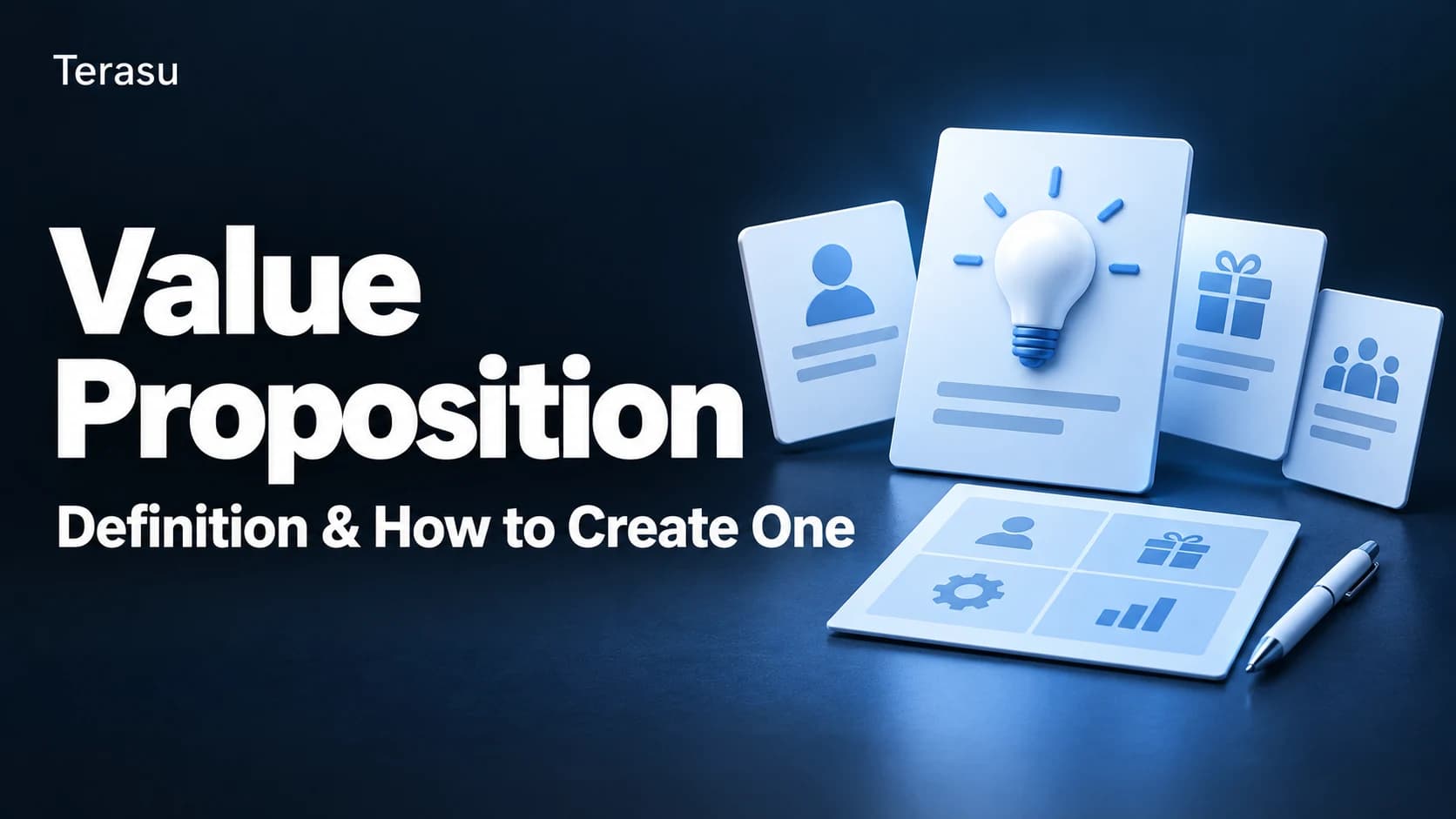
Value Proposition: Definition, How to Create One, Canvas Template & B2B Examples by Industry (2026)
A value proposition is a clear statement of the value that your customers want, that your company can deliver, and that your competitors cannot. It articulates the single reason a customer should choose you among all available options, and it serves as the foundation for everything from marketing messaging to sales proposals and talk tracks.
Ask everyone in your company to "explain your strengths in one sentence," and you will rarely get the same answer twice. Sales talks about features, marketing uses a different tagline, and the CEO tells yet another story about the vision. When you walk into a sales meeting in that state, the customer never hears a consistent answer to "how are you actually different?"—and the conversation inevitably drifts toward price.
A value proposition is the framework for fixing that inconsistency. The problem is that most guides on the topic end with famous B2C examples like Slack and Airbnb, and never get to the part that matters in practice: how to write—and actually use in sales conversations—a value proposition when your customer is an organization with multiple decision-makers. This guide covers that entire journey.
Key Takeaways
- A value proposition is the overlap of three values: what customers want, what your company can deliver, and what competitors cannot offer. Miss any one of the three and you get one of three failure modes: never considered, never chosen, or dragged into a discounting war.
- The order of thinking is customer → competitors → company. Start from your own strengths and you will build something unique that nobody wants.
- The Value Proposition Canvas (VPC) was systematized in Osterwalder et al.'s Value Proposition Design (2014). The iron rule: fill in the right side—the customer profile (jobs, pains, gains)—first.
- This article provides a blank VPC template, a completed sample, and a B2B worked-example matrix for SaaS, manufacturing, finance, healthcare, and staffing—all inline, no download form required.
- A value proposition is not "done" when written. The full loop includes using it in deals and recording which value resonated with each customer so the team keeps refining it.
What Is a Value Proposition? Putting Your "Reason to Be Chosen" on One Page
A value proposition is the articulation of the unique value a company delivers to its customers. It is not a list of company strengths. It is the specific area where three conditions hold simultaneously: the customer wants it, your company can deliver it, and competitors cannot.
The Definition: The Overlap of Three Values
A value proposition is commonly illustrated as the intersection of three overlapping circles.
| Element | The question | What happens if it's missing |
|---|---|---|
| ① Value the customer wants | What is the customer trying to achieve? What are they struggling with? | Unique but unwanted—you never make it onto the shortlist |
| ② Value your company can deliver | Can your product, service, and organization actually deliver it? | Over-promising erodes trust right after the deal closes |
| ③ Value competitors cannot offer | Can no alternative substitute for it? | You get compared side by side and pulled into a price war |
The key point: only the overlap of the three circles is your value proposition. Value that customers want and you can deliver—but competitors can too—is not a reason to choose you. Value that only you can deliver—but nobody wants—is self-satisfaction. This three-way filter is the foundation for everything that follows, including the canvas.
Note that "competitors" here does not only mean rival vendors. In B2B, the biggest competitor is often "we'll keep doing it in Excel" or "we'll do nothing" (the status quo). Always include every alternative—including inaction—when you think about competition.
Where the Term Comes From: A 1988 McKinsey Paper
The term "value proposition" is generally credited to Michael Lanning and Edward Michaels, who used it in a 1988 McKinsey & Company staff paper titled "A Business Is a Value Delivery System" (source: Wikipedia, "Value proposition"). The paper defines a value proposition as "a clear, simple statement of the benefits, both tangible and intangible, that the company will provide, along with the approximate price it will charge each customer segment for those benefits."
In other words, this is not a buzzword—it is a foundational strategy concept that has been in use for nearly four decades. Alexander Osterwalder and colleagues later placed the "value proposition" block at the center of the Business Model Canvas in Business Model Generation (2010), and then dedicated an entire toolkit to it—the Value Proposition Canvas—in Value Proposition Design (2014) (source: Strategyzer), which is what brought the concept into everyday business practice.
Why It Matters More Than Ever in B2B Sales
Three shifts in how B2B buyers behave have made the value proposition newly critical.
First, comparison shopping is now the default. Buyers research online before they ever talk to sales, and they arrive at the first meeting with a shortlist already in hand. A feature walkthrough just turns you into one more column in their comparison spreadsheet.
Second, decisions involve more people. B2B purchases pass through end users, managers, IT, procurement, and executives—each of whom values different things. Whatever charm your rep delivers verbally gets diluted in the internal game of telephone. You need a written, consistent statement of value that survives being passed around.
Third, feature gaps close fast. In most markets, competitors catch up on functionality quickly. The durable differentiator is not the feature itself but the definition that sits upstream of it: whose problem you solve, and why you solve it better than anyone else.
Value Proposition vs. USP, Benefits, and Taglines
The value proposition has several look-alike concepts. Here is how they relate.
| Term | Meaning | Relationship to the value proposition |
|---|---|---|
| USP (Unique Selling Proposition) | Your product's unique selling point | Starts from your strengths. A value proposition starts from what the customer wants, with delivering value as the goal itself |
| Benefit | The gain a customer gets from the product | A component of the value proposition. A benefit alone doesn't include the "competitors can't offer it" condition |
| Tagline / copy | The promotional phrasing used in ads and landing pages | One output of the value proposition, tailored to a specific medium and audience |
| Mission / vision | Why the company exists and where it's going | Internal and long-term. The value proposition is customer-facing and about value delivered today |
The most common point of confusion is the USP. A USP is a company-centric concept ("here is where we are strong"); a value proposition is a customer-centric one ("of everything the customer wants, where are we the only ones who can deliver?"). Because the starting points are opposite, the same company's USP and value proposition often differ. For where the value proposition sits among other sales frameworks, see our complete guide to sales frameworks.
Value Proposition vs. Value Proposition Canvas: Differences and When to Use Each
The value proposition is the deliverable—the articulated reason customers choose you. The Value Proposition Canvas (VPC) is the working tool you use to get there, by mapping the customer and your value side by side. They are not competing concepts: you analyze with the canvas, then articulate the value proposition.
In practice, though, teams often wonder which diagram to start from. The deciding factor is market maturity.
| Aspect | Value proposition (3-circle / 3C model) | Value Proposition Canvas (VPC) |
|---|---|---|
| Best suited for | An existing market with established competitors | An immature market with no real competitors yet (new ventures) |
| Starting point of analysis | Comparing customer, competitor, and company | Deep understanding of one customer (or one account) |
| Granularity | 3 elements (coarse, fast) | 6 elements (fine-grained, deep) |
| Typical use | Differentiating an existing business, repositioning the message | Designing value for a new product or business |
In a crowded existing market, comparing the three circles to isolate "value competitors can't offer" is the faster route. For a brand-new market with nothing to compare against, the VPC's fine-grained customer deep-dive works better. Most real projects move back and forth: rough out the territory with the 3C view, then refine it with the VPC.
A related tool with a similar name—the Business Model Canvas (BMC)—maps the entire business across nine blocks (customers, channels, revenue, costs, and so on). The VPC zooms into just two of those blocks, "value proposition" and "customer segment," for precision design. Use the BMC for the whole picture, the VPC for the value deep-dive.
How to Create a Value Proposition in 5 Steps
Creating a value proposition is the process of starting from customer understanding, isolating your difference versus competitors, and condensing it into a single sentence. The steps below assume an existing business in an existing market.
The Prerequisite: Think Customer → Competitors → Company, in That Order
Before the steps, the single most important principle: start from the customer.
Most failed value propositions fail because the order was reversed. Starting from "we have this technology" or "we should leverage this asset" produces propositions that are unique but unwanted—the most common failure pattern, which we cover later. Working through ① what customers want → ② what competitors offer → ③ what we can deliver, in that order, protects you from "uniqueness without a customer."
Step 1: Specify the Target Customer
First, lock down whose value proposition this is. In B2B, specify down to industry, company size, department, role, and the mission that person carries.
Critically, B2B targets have two layers: the organization and the individual. A manufacturer's procurement department (the organization) wants cost reduction and stable supply; the individual buyer handling your account wants "to not get blamed for a supply disruption" and "to spend less time on tedious RFQ rounds." A value proposition lands hardest when it touches both the organization's logic and the individual's emotions.
The fastest route is to mine your own evidence: analyze existing customer data, review win/loss reasons, and join sales calls to identify where you already create the most value.
Step 2: Dig Into Customer Needs and Problems
Unpack what the target is trying to achieve (jobs), what they struggle with (pains), and what would delight them (gains). Go below surface-level requests to the underlying purpose—the Job to be Done.
Useful methods include customer interviews, reviewing call recordings, analyzing support tickets and churn reasons, and field observation. In B2B especially, discovery conversations in live deals are your richest source of needs data. For what to ask and how, see our guide to SPIN selling and discovery questions.
One caution: this is not the same as asking customers what they want. Customers often cannot articulate their own problems. Your job is to observe the situation, behavior, and emotion behind their words and discover the value yourself.
Step 3: Inventory the Value Your Company Can Deliver
Do not list product features. Translate each feature into the outcome it produces for the customer—time saved, cost reduced, risk lowered, revenue grown, workload lightened, peace of mind. You can tell features from value by the grammatical subject: if the subject is your product, it's a feature ("it aggregates automatically"); if the subject is the customer, it's value ("they are freed from building the monthly report").
Include emotional and social value too—ease of adoption, support quality, the reassurance of a track record. These widen your differentiation options later.
Step 4: Analyze Competitors and Isolate What They Cannot Offer
Now cross-check steps 2 and 3 against what competitors offer. Include not just direct rivals but spreadsheets, outsourcing, and "doing nothing."
The work here is simple: take your value inventory from step 3 and delete everything a competitor could equally claim. "High quality," "attentive support," "easy-to-use UI"—if the same words appear on a competitor's website, they are not differentiators. What survives the deletion—or what exists only in your particular combination—is your value proposition candidate.
Step 5: Condense It Into One Sentence
Finally, compress the analysis into a concise statement. Templates speed this up and prevent omissions.
[Basic formula]
For [target customer] who want to [job / problem to solve],
our offering—unlike [competitor / alternative]—
gets them to [the state the customer achieves].

[Positioning-statement formula]
For [target customer], [product name] is a [product category]
that delivers [the single most important benefit].
Unlike [competitor / alternative], it provides [unique differentiator].
What separates a good statement from a bad one is specificity and testability.
- Bad: "We support your digital transformation with high-quality services."—No specific customer or problem, and any competitor could say it.
- Good: "For B2B sales teams whose deals stall in invisible internal reviews, we consolidate proposals, content, and deal status into one room shared with the buyer—so deals stop going dark after the meeting."—Target, problem, mechanism, and outcome are all specified.
Once written, test it three ways: Would the customer recognize themselves in it? Could a competitor copy-paste this sentence onto their own site? Can you actually keep the promise? The third question is the one teams skip—promising beyond your real capability destroys trust after the sale, so choosing which needs not to serve is part of finishing the value proposition.
A Completion Checklist
Before you publish or roll out the statement, run these seven checks. Any "no" sends you back to the relevant step.
- Is the target specified down to industry, size, department, and role? ("SMBs everywhere" doesn't count)
- Is the customer problem grounded in things real customers said or did—not internal guesswork?
- Is the value written as a change in the customer's state, not a feature list?
- Did you include the status quo ("do nothing," "keep using Excel") among the competitors?
- Could a competitor copy this sentence onto their website? (If yes, the differentiator is too weak)
- Can your current organization and product actually deliver what's promised?
- Would sales, marketing, and leadership all interpret the sentence the same way?
Manage client projects more efficiently. Try it free.
Start for freeHow to Fill In the Value Proposition Canvas (VPC): The 6 Elements, in Order
The Value Proposition Canvas (VPC) is a framework that maps the customer profile (jobs, pains, gains) against your value map (products & services, pain relievers, gain creators)—six elements on one page—to eliminate the gap between what customers need and what you offer. It was systematized by Alexander Osterwalder, Yves Pigneur, and colleagues in Value Proposition Design (2014, the Strategyzer series) (source: Strategyzer, "Value Proposition Design").
The canvas consists of a circle on the right (customer profile) and a square on the left (value map). The rule: always fill in the right side—the customer—first. Start from the left and you will quietly redraw the customer to fit what you wanted to say anyway.
The Right Side: Customer Profile (Fill This In First)
The customer profile describes one chosen customer segment through three lenses.
① Customer Jobs The tasks the customer is trying to get done. Include functional jobs (finish the work, hit the number), social jobs (be recognized internally), and emotional jobs (proceed without anxiety). In B2B, as noted above, splitting jobs into the organization's jobs and the individual's jobs sharpens the whole canvas.
② Pains The frustrations, obstacles, and risks the customer experiences while pursuing those jobs: "it takes too long," "mistakes are scary," "I can't explain this to my boss," "if it fails, it's on me."
③ Gains The outcomes and benefits the customer wants—ranging from required, to expected, to delightful surprises. Gains are not just pains inverted; write the positive aspirations (achievement, growth, recognition) independently.
The Left Side: Value Map (Only After the Right Side)
④ Products & Services The products, services, and features that help the customer get their jobs done. A plain factual list is fine here.
⑤ Pain Relievers How your offering removes the pains in ②. You don't need to address every pain—focus on relieving the severe ones, strongly.
⑥ Gain Creators How your offering produces or amplifies the gains in ③. Again, focus on the gains the customer actually cares about.
Telling Pain Relievers and Gain Creators Apart
Almost everyone who fills in a VPC hits the same wall: pain relievers and gain creators start to look identical. The test is whether the customer's starting point is negative or zero.
- Pain relievers move the customer from a negative state (struggling, losing, fearful) back to zero or better. If you can phrase it as "no longer has to..." or "stops worrying about...," it's a pain reliever.
- Gain creators move the customer from zero to plus one or plus ten. If you phrase it as "becomes able to..." or "gets more of...," it's a gain creator.
For a sales tool: "proposals stop getting buried in email attachments because everything lives at one URL with view tracking" relieves a pain; "the team can prioritize follow-ups based on customer viewing data" creates a gain.
Blank VPC Template (Copy and Use)
No download form required. Copy the block below into your team's docs. Fill it in numbered order: ① → ② → ③ (customer side), then ④ → ⑤ → ⑥ (value side).
■ Value Proposition Canvas: ______ (product / service name)
■ Target segment: ______ (specify industry, size, department, and role)

[RIGHT SIDE: Customer profile] *Always fill this side first
① Customer jobs (what they're trying to get done)
   - Organization's job:
   - Individual's job:
② Pains (current frustrations, obstacles, risks)
   -
   -
③ Gains (desired outcomes, expectations, delights)
   -
   -

[LEFT SIDE: Value map]
④ Products & services (what you offer)
   -
⑤ Pain relievers (how you remove ②—focus on severe pains)
   -
⑥ Gain creators (how you produce ③—focus on key gains)
   -

[FINISH: Value proposition (one sentence)]
For [target segment] carrying [job from ①],
[core of ⑤/⑥] gets them to [most important gain from ③].
Unlike [competitor / alternative], which lacks [your unique element].
Completed Sample (Fictional B2B SaaS)
A blank template doesn't convey the right level of detail, so here is a worked example using a fictional "proposal management SaaS for mid-size IT companies."
■ Value Proposition Canvas: Proposal management SaaS (fictional example)
■ Target segment: IT companies, 100–500 employees, sales department, sales manager

[RIGHT SIDE: Customer profile]
① Customer jobs
   - Organization's job: improve win rates and hit the quarterly target
   - Individual's job: know the status of every deal and report to leadership with evidence
② Pains
   - No visibility into the buyer's internal review after the proposal; follow-up timing is guesswork
   - Every rep uses different decks and talk tracks; winning patterns never spread
   - Hours lost every week collecting updates for the pipeline report
③ Gains
   - Catch stalled deals early and intervene
   - Turn the top rep's approach into the team standard
   - Reports assemble themselves, freeing time for actual management

[LEFT SIDE: Value map]
④ Products & services
   - A shared room per deal that consolidates proposals and meeting notes
   - View tracking that shows buyer engagement with shared content
⑤ Pain relievers
   - Follow-ups are driven by buyer viewing data instead of gut feel
   - Deal information lives in one place; report-collection work disappears
⑥ Gain creators
   - Winning proposals and talk tracks become reusable team assets
   - Alerts surface deals whose buyer activity has gone quiet

[Value proposition]
For sales managers at mid-size IT companies who can't see what happens
after the proposal is sent, a shared deal room with view tracking lets them
catch stalling deals early and standardize winning patterns—visibility that
the traditional email-attachment workflow simply doesn't have.
Note that every line is written as a situation or behavior, not an adjective. Abstract words like "efficient" or "convenient" are avoided throughout—including in the industry matrix below—because they feel complete while specifying nothing.
B2B Value Proposition Examples by Industry: A Worked-Example Matrix
This section is the part most guides skip. Explanations built on Slack, Airbnb, and the iPhone don't help when your customer is an organization. Here are worked reference examples for five major industries, covering customer jobs, pains, gains, and the direction of the value statement.
These are generalized examples meant to show granularity and angle of attack. Always validate real jobs and pains through your own customer interviews.
In B2B, Write Jobs in Two Layers: the Organization's and the Individual's
One B2B-specific principle before the matrix. A B2C canvas can describe one consumer; in B2B the buyer is an organization, and multiple people shape the decision. Write jobs at the organization level (business goals, department KPIs) and the individual level (the person's evaluation, self-protection, workload)—and where possible, note how the value differs for each decision-maker (end user, manager, executive, IT, procurement). You will reuse this directly in talk tracks and proposals later.
The Industry Matrix
| Industry (seller → buyer) | Customer jobs (org / individual) | Typical pains | Typical gains | How to frame the value |
|---|---|---|---|---|
| SaaS (→ mid-size company, line of business) | Hit department KPIs / avoid being the one who picked a failed tool | Manual work and tribal knowledge; a past tool rollout that never stuck | Fast time-to-value, proven adoption, visible impact | Lead with elements that directly remove the adoption-failure pain: a structured onboarding program, phased rollout that coexists with current tools |
| Manufacturing (components/materials → manufacturer) | Stable procurement and consistent quality / avoid being blamed for a supply incident | Single-supplier dependency, quality variance, explaining delivery delays | Supply stability, less inspection effort, design-stage input | Make risk reduction explicit: quality data transparency, multi-site supply capability. For many buyers, "never stops" beats "cheapest" |
| Finance / insurance (→ corporate clients) | Optimize cash flow and risk / want defensible grounds for internal approval | Slow reviews and paperwork, regulatory complexity, re-explaining after every staff change | Faster decisions, compliance confidence, material for the board | Include ease of internal justification and audit-readiness: transparent criteria, documentation support aligned with regulation |
| Healthcare (→ hospitals & clinics) | Balance care quality with operations / don't add burden on frontline staff | Staff shortage, frontline resistance to new systems, difficult internal consensus | Shorter admin hours, staff retention, patient satisfaction | Prioritize removing the rollout-burden pain: training included, phased adoption that never interrupts care |
| Staffing / recruiting (→ hiring companies) | Hit hiring targets / avoid owning a failed hire | Weak applicant flow, inconsistent candidate quality, early attrition | Better candidate pool quality, less screening effort, improved retention | Differentiate from "introduce-and-disappear" competitors on retention and quality: post-hire follow-up, reach into talent pools the company can't access alone |
How to Use the Matrix: Three Checks
This table is a checklist for writing your own canvas, not a gallery.
Check 1: Do your pains include the individual's self-protection and evaluation? Across all five industries, the common thread is the individual's "I don't want to fail / be blamed / explain this again." A value proposition built only on organizational logic lacks the force to move the individual who has to champion your deal internally.
Check 2: Did you put the status quo in the competitor slot? In every industry, the biggest rival is not another vendor—it is continuing the current way. Until your statement outweighs "Excel sort of works" and "we've been with this supplier forever," it isn't ready for a sales conversation.
Check 3: Is the value written as the post-adoption world? Not feature lists, but state changes on the customer's side: "procurement never stops," "frontline staff adopt without resistance," "stalled deals get caught early."
Mini Value Statements by Industry
Condensing the matrix into single sentences looks like this. All are fictional, but note that each contains the full chain: who → what problem → by what means → to what state.
SaaS (sales enablement tool) "For mid-size sales teams burned by tools that never stuck, a phased rollout that fits the current workflow—plus a structured adoption program—means they finally start accumulating sales data without repeating the 'bought it, nobody uses it' cycle." The differentiation axis is adoption, not features.
Manufacturing (component supplier) "For procurement teams exposed to single-supplier risk, multi-site supply capacity and openly shared quality data deliver procurement that doesn't stop—and that stands up to an audit." The center of value is "never stops, always explainable," not price.
Finance (business lending) "For growth-company CEOs who can't afford to miss a funding window, transparent criteria and clearly pre-stated documentation let them make financing decisions when needed, without losing weeks to paperwork." Aimed at customers whose pain is slowness and opacity, not interest rates.
Healthcare (clinic system) "For clinic directors facing staff shortages and strong frontline resistance to new systems, a phased rollout that never interrupts care—with hands-on staff training—cuts admin hours without adding attrition risk." The buyer's job is "don't break the frontline," not "efficiency."
Staffing (recruiting service) "For HR leaders stuck in a cycle of hires who leave early, support that extends through post-hire retention lets them report 'hires who stayed'—not just hires—to leadership." Connects the difference versus introduce-and-disappear competitors to the individual's reporting responsibility.
What all five share: the competitor is implicitly built into the wording. "Phased rollout," "quality data transparency," "transparent criteria," "post-hire follow-up"—each phrase presupposes that the alternative lacks it. After writing yours, verify that the implied comparison actually holds by checking competitors' websites.
3 Common Failure Patterns—and What They Cost You
Value proposition failures are predictable. Here are the three big ones, each paired with the downstream consequence of leaving it unfixed. All examples are generalized, fictional scenarios.
Failure 1: Writing From the Company's Point of View → Proposals Don't Land
The most common failure. "Cutting-edge AI," "decades of track record," "rich feature set"—a proposition assembled from what the company wants to say connects to no customer job or pain, so the only thing left in the reader's head is "...and what does this have to do with us?"
The typical consequence: first meetings that keep ending with "looks like a good product, but we don't really feel the need right now." When a decent product can't get evaluations started, the thing to suspect is not the rep's pitch but a company-centric value proposition. Technology and track record belong in the evidence slot—supporting why you solve the customer's specific pain better—not in the headline.
Failure 2: Confusing Pains With Gains → The Message Goes Blurry
Writing "Pain: operations are inefficient / Gain: operations become efficient"—the same fact mirrored on both sides of the canvas. It looks filled in; the information content is zero.
Messaging built on this becomes "we make your operations more efficient"—a claim anyone can make and no one feels. The consequence: ads, landing pages, and proposals all fill up with the same abstractions, and you become indistinguishable from competitors. Write pains as concrete negative experiences of the current way ("the last three days of every month disappear into report assembly") and gains as independent positive aspirations ("freed-up time goes into visiting key accounts").
Failure 3: Skipping the "Can Competitors Do This Too?" Check → The Discounting War
Confirming customer-need fit but skipping verification that competitors can't match it. Teams convince themselves "this is our strength" while the same claim sits on a competitor's website.
The consequence is blunt: in the final round of a competitive evaluation, "the other vendor says they can do that too—so it comes down to price." When your believed differentiator turns out to be a shared feature, price is the only axis left. Recurring discount wars are usually not a negotiation-skill problem; they trace back to a skipped competitive check at design time. The fix is mechanical: run the deletion pass from Step 4—cross out every value a competitor could equally claim.
Putting Your Value Proposition to Work in Sales: Talk Tracks, Proposals, and Team Refinement
A value proposition is not a strategy document to file away—it only produces results when used in live deals. If the proposition defines what you offer, this section is about how to communicate and operate it.
Folding It Into Talk Tracks
You never read the statement aloud in a meeting. Instead, you pull out only the parts that match the jobs and pains you confirmed during discovery.
A practical method is to feed the proposition into a proposal structure like FABE (Feature → Advantage → Benefit → Evidence). Your VPC's ④ products & services map to Features; the "value competitors can't offer" maps to Advantage; ⑤ pain relievers and ⑥ gain creators map to Benefits. If the canvas is done, the raw material for your pitch already exists. Conversely, when a FABE pitch sounds thin, the problem is rarely the delivery—it's an unfinished value proposition upstream. For turning discovered needs into solution narratives, see our guide to solution selling.
The other high-leverage practice is varying the emphasis by decision-maker. From the same proposition, lead with the individual's pain relief for end users (freed from the grunt work), the organization's gains for department heads (KPI improvement, team standardization), and business impact for executives (revenue, risk). This is exactly why the matrix asked you to write jobs in two layers.
Reflecting It in Proposals and Sales Collateral
In a proposal document, the value proposition belongs right after the cover—in the "why this proposal" position. A deck that opens with a feature list and a deck that opens with "here is your specific problem, and here is why only we can solve it" produce completely different internal conversations on the buyer side. B2B proposals are read by decision-makers who never attended your meeting, so the value statement must stand on its own in writing, with no verbal commentary available. We cover proposal structure in depth in how to write a winning sales proposal.
Consistency with marketing matters too. When the landing page, the ads, the sales deck, and the live pitch all derive from one value proposition, the customer receives the same "reason to choose you" at every touchpoint, and the message compounds instead of fragmenting.
Recording Which Value Resonated—and Refining as a Team
This is the step most organizations drop. A value proposition is not finished at version 1—it is a hypothesis you test in every sales conversation.
Every deal produces findings: "they reacted far more strongly to pain B than the pain A we expected," "that phrasing did nothing for the executives." But this primary data usually lives and dies in individual reps' notes and memories. When the rep moves on, the validation results leave with them.
The practical fix is centralizing deal information. With a digital sales room, where each deal's proposals, content, and meeting history live in one room shared with the buyer, you get a record of which pages of which deck the buyer actually viewed and which value framing preceded real movement in the deal. Compare what resonated across customers as a team, and the value proposition starts being refined on data instead of anecdotes. Making the loop—articulate (this article) → test in deals → record → revise—a team habit is the differentiation competitors cannot copy.
Manage client projects more efficiently. Try it free.
Start for freeWhen to Use Which Framework: A Reverse Lookup
The value proposition defines what you offer. Other sales problems call for other frameworks. Use this table to navigate from your current bottleneck.
| Where you're stuck | Framework to use | Relationship to the value proposition |
|---|---|---|
| Can't articulate why customers should choose you | Value proposition / VPC (this article) | The starting point of everything—defines what you offer |
| Value is defined, but the pitch structure is weak | FABE (Feature → Advantage → Benefit → Evidence) | Converts the proposition into how you tell it in meetings |
| Struggling to surface customer problems in discovery | Questioning methods like SPIN selling | The information-gathering engine that fills the VPC's right side |
| Want to shift to problem-led, consultative selling | Solution selling | The selling style that applies your proposition to each customer's context |
| Deal qualification and forecasting are inconsistent | Qualification frameworks like BANT / MEDDIC | Deal management after the proposition has landed |
For the full landscape and how the frameworks combine, see the complete guide to sales frameworks. The mental model: the value proposition is the strategy-layer foundation; discovery, pitching, and qualification frameworks operate on top of it.
Value Proposition FAQ
What is a value proposition?
A value proposition is the articulation of value that customers want, that your company can deliver, and that competitors cannot offer—the reason a customer chooses you, expressed in one statement. It underpins marketing messaging, sales proposals and talk tracks, and product priorities. The term is generally credited to a 1988 McKinsey staff paper, making it a foundational strategy concept rather than a passing buzzword.
What is the difference between a value proposition and the Value Proposition Canvas?
The value proposition is the deliverable—the articulated reason to be chosen. The Value Proposition Canvas (VPC) is the analysis tool used to get there: it maps the customer profile (jobs, pains, gains) against your value map (products & services, pain relievers, gain creators) across six elements to expose gaps between customer needs and your offering. As a rule of thumb, use a customer-competitor-company comparison for differentiation in an existing market, and the VPC's deep customer dive for new ventures.
How do you create a value proposition?
Five steps: (1) specify the target customer down to industry, size, department, and role; (2) dig into the customer's jobs, pains, and gains; (3) inventory your deliverable value as customer outcomes; (4) compare against competitors and alternatives—including the status quo—and delete every value a competitor could equally claim; (5) condense it into one sentence: "For [customer] who want [job], our offering—unlike [alternative]—gets them to [outcome]." Always think customer → competitors → company. Starting from your own strengths produces unique value nobody wants.
How do you fill in the Value Proposition Canvas, and in what order?
Always fill in the right side—the customer profile—first: ① customer jobs (what they're trying to get done), ② pains (current frustrations and risks), ③ gains (desired outcomes), then the left side: ④ your products & services, ⑤ pain relievers (how you remove the pains), ⑥ gain creators (how you produce the gains). Starting from the left lets you redraw the customer to fit your pitch, which defeats the tool. Distinguish pain relievers (move the customer from negative back to zero) from gain creators (move them from zero to plus).
Is there a value proposition template or example?
Yes—this article includes a copy-paste blank template and a completed sample. The basic formula: "For [target customer] who want to [job / problem], our offering—unlike [competitor / alternative]—gets them to [outcome]." A good statement specifies the target, problem, mechanism, and outcome; cannot be copy-pasted by a competitor; and promises only what you can actually deliver. Statements like "high-quality services that support your digital transformation" fail all three tests.
What is the difference between a value proposition and a USP?
Both deal with unique value, but they start from opposite ends. A USP (Unique Selling Proposition) is company-centric—your product's unique selling point, used to emphasize differentiation and sell. A value proposition is customer-centric—the territory where, among everything the customer wants, only you can deliver. Because the starting points differ, the same company's USP and value proposition often have different content.
What is the difference between the Value Proposition Canvas and the Business Model Canvas?
The Business Model Canvas (BMC) maps an entire business across nine blocks—customer segments, value proposition, channels, revenue streams, cost structure, and so on. The Value Proposition Canvas (VPC) extracts just two of those blocks—value proposition and customer segment—and expands them for precision design. Both were systematized by Osterwalder and colleagues; they complement each other: BMC for the whole picture, VPC for the value deep-dive.
How do you use a value proposition in B2B sales?
Three main applications. (1) Talk tracks: pull out the parts matching the pains confirmed in discovery and deliver them through a structure like FABE—leading with individual pain relief for end users, KPI gains for managers, and business impact for executives. (2) Proposals: place the value proposition in the "why this proposal" position so decision-makers who never attended the meeting still receive it intact. (3) Team refinement: record which value resonated in each deal, and revise the proposition on real evidence rather than anecdotes.
What are the most common value proposition mistakes?
Three patterns. (1) Writing from the company's view—listing technology and track record disconnected from customer jobs, so proposals don't land. (2) Confusing pains with gains—mirroring "inefficient/efficient" on both sides of the canvas, producing messaging like "we improve efficiency" that no one feels. (3) Skipping the competitor check—discovering at the final evaluation that rivals claim the same strength, leaving price as the only differentiator. All three are prevented by keeping the customer → competitors → company order and mechanically deleting any value a competitor could equally claim.
Conclusion: A Value Proposition Is Refined, Not Just Written
A value proposition articulates the value customers want, you can deliver, and competitors cannot. The essentials:
- The overlap is everything: customer-wanted × company-deliverable × competitor-impossible. Each missing element has its own failure mode—ignored, distrusted, or discounted.
- Order: customer → competitors → company: the moment you start from your own strengths, you are on the road to unique value nobody wants.
- Fill the VPC from the right: customer jobs, pains, and gains first; then distinguish pain relievers (negative → zero) from gain creators (zero → plus). The framework was systematized in Osterwalder et al.'s Value Proposition Design (2014).
- In B2B, write two layers: the organization's jobs and the individual's jobs, with value emphasis varied by decision-maker. The biggest competitor is the status quo, not another vendor.
- Deals are the test bench: deploy the proposition through talk tracks and proposals, record which value resonated with each customer, and keep revising as a team.
Start by copying the template above and writing one canvas for your single most important segment. Even one page will reveal where your current messaging has been company-centric. Then test it in your next meeting. To build the refinement loop—seeing buyer engagement and deal status per account—a digital sales room gives you the visibility to do it on data.
Run client projects more intelligently.
Manage client projects more efficiently. Try it free.
Start for free![18 Essential Sales Frameworks: A Use-Case Map and How to Choose [2026]](/_next/image?url=%2Fimages%2Fblog%2Fbrand-20261011-all-en-sales-frameworks-guide.webp&w=828&q=75)