RFI vs RFP: Key Differences and How Vendors Should Respond to Each (2026)
An RFI (Request for Information) is an early, non-binding request a buyer uses to learn what the market can offer and who can deliver it. An RFP (Request for Proposal) comes later, once the need is defined: it asks a shortlist of vendors for a full proposal—approach, team, timeline, and price—that will be scored against stated criteria. In short, an RFI helps the buyer decide what to ask for; an RFP decides who wins.
TL;DR
- The core difference is commitment. An RFI gathers information for planning and does not lead directly to an award. An RFP is a formal solicitation: your response is evaluated and can become the basis of a contract.
- Your response should change with it. Answer an RFI briefly and strategically—your goal is to get shortlisted and to influence the requirements. Answer an RFP completely—your goal is to win the scored evaluation.
- The RFI is where the RFP gets written. Buyers use RFI answers to decide which requirements and evaluation criteria go into the RFP. A vendor that answers the RFI well can see its framing carried into the next document.
- RFQ and RFT sit on the same spectrum. An RFQ asks for a price on a fully specified need; an RFT (request for tender) is the term many public buyers outside the U.S. use for a formal bid request.
- U.S. federal buyers follow written rules. Under FAR 15.201(e) (15.101(c) in the overhauled FAR that some agencies now use), responses to an RFI "are not offers and cannot be accepted by the Government to form a binding contract."
Most comparisons of RFIs and RFPs are written for procurement teams deciding which document to send. This guide is for the other side of the table: the account executive, solutions engineer, or proposal manager who has just received one and has to decide how much effort it deserves and what to say. You will get a side-by-side comparison, a map of the whole "RFx" family, a practical way to answer an RFI so it sets up the RFP, and the U.S. federal rules that apply if your buyer is a government agency.
RFI vs RFP at a Glance
An RFI asks "who can help and how?"; an RFP asks "which of you should we hire, on what terms?" The table below lines the two up on the points that matter when you are the one responding.
| RFI (Request for Information) | RFP (Request for Proposal) | |
|---|---|---|
| Buyer's question | "Who can solve this, and how?" | "Which approach and team is best?" |
| Buying stage | Early research, before requirements are final | Evaluation, after requirements are written |
| How defined the need is | Loosely defined; the buyer is still learning | Defined in detail, with mandatory and desired requirements |
| Who receives it | A broad set of possible vendors | A shortlist (often built from RFI answers) |
| What you send back | Short capability response | Full proposal |
| Pricing | Optional, usually a range or pricing model | Required, usually itemized |
| How it is judged | Informally, to narrow the field | Scored against published evaluation criteria |
| Binding? | No—information only | Your proposal can become the basis of the contract |
| Your main goal | Shape the criteria and get shortlisted | Win the evaluation |
| Typical effort | Light: one owner and an expert or two | Heavy: a cross-functional team for days or weeks |
The effort row is where most vendor mistakes start. Loopio's 2026 RFP benchmark report, based on data from more than 1,500 teams, puts the average RFP response at 33 hours of work with about nine contributors, and finds that organizations respond to only 55% of the RFPs they receive. An RFI rarely deserves that level of investment—but it deserves more than a forwarded brochure, because it decides whether you get the RFP at all.
What Is an RFI?
An RFI is a fact-finding document a buyer sends to many vendors to understand the market before committing to requirements. It usually arrives when the buyer knows the problem but not yet the best solution, the realistic budget, or the full list of credible suppliers.
A typical RFI asks for:
- Company overview: size, years in business, customers in the buyer's industry, locations.
- Capabilities: what your product or service does, how it is delivered, and which use cases it fits.
- Approach: how you would tackle a problem like theirs, often in a few paragraphs.
- Technical and security basics: integrations, hosting, certifications, data handling.
- Commercial model: how you price (per user, per project, fixed fee) and sometimes a ballpark range.
- References or case studies: proof that you have done this before.
Buyers send RFIs for three reasons: to build a shortlist, to test whether their budget and timeline are realistic, and to learn enough to write a good RFP. The third reason is the one sellers underestimate. The questions you answer now often become the requirements you are scored against later.
What Is an RFP?
An RFP is a formal solicitation that asks vendors for a complete proposal to meet a defined need, and tells them how proposals will be evaluated. By the time an RFP is issued, the buyer has usually decided what it needs and is choosing between vendors.
U.S. federal rules give a useful picture of what a complete RFP contains. FAR 15.203 says RFPs "are used in negotiated acquisitions to communicate Government requirements" to prospective contractors, and that a competitive RFP must, at a minimum, describe:
- The buyer's requirement.
- The anticipated terms and conditions of the contract.
- The information the proposal must contain.
- The factors and significant subfactors that will be used to evaluate proposals, and their relative importance.
Commercial RFPs vary more, but most follow the same logic: a statement of need (often with a scope of work or statement of work), mandatory versus desired requirements, submission instructions, a Q&A window, pricing forms, and evaluation criteria. The RFP stage is where a structured response process pays off; our step-by-step guide to responding to an RFP covers the Go/No-Go decision, compliance matrix, and response structure in detail.
Where RFQ, RFT, and Sources Sought Fit
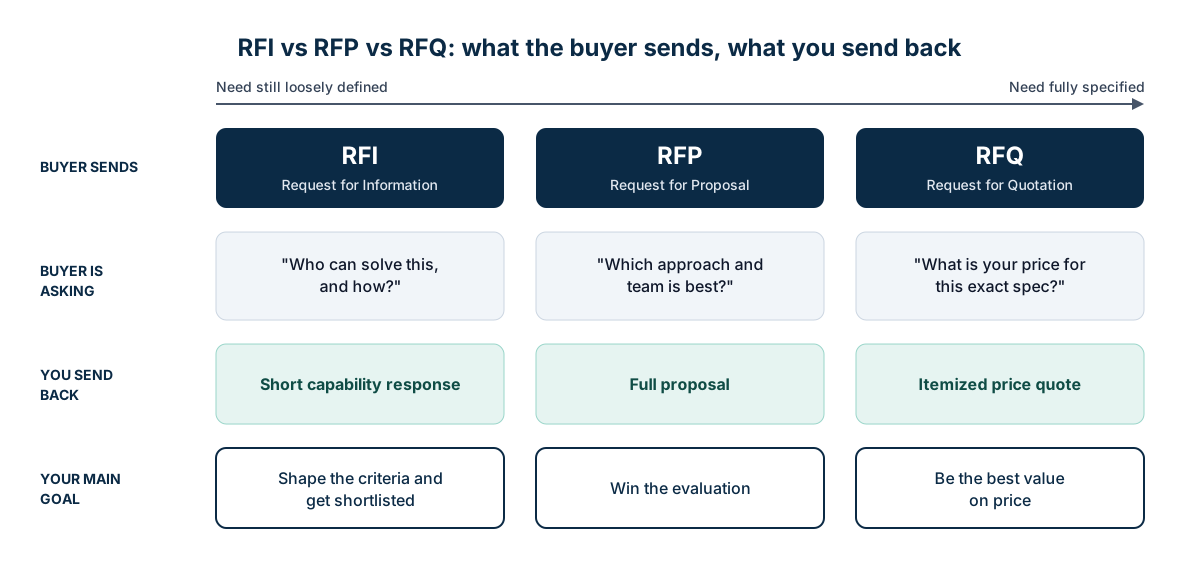
RFI, RFP, and RFQ are points on one spectrum: the more precisely the buyer has defined the need, the more the request focuses on price and the more binding your answer becomes. The diagram below shows what the buyer sends at each point, what you send back, and what you are trying to achieve.
The wider "RFx" family includes a few more terms you will meet in practice:
| Document | What the buyer wants | What you send back | When you will see it |
|---|---|---|---|
| RFI (Request for Information) | Market and vendor information for planning | Short capability response | Early research |
| Sources sought notice | Whether capable vendors exist (common in U.S. federal buying) | Capability statement | Before a federal solicitation |
| RFP (Request for Proposal) | The best overall solution, not just the lowest price | Full proposal | Formal evaluation |
| RFQ (Request for Quotation) | A price for a clearly specified product or service | Itemized price quote | When the spec is fixed |
| RFT / ITT (Request or Invitation to Tender) | A formal bid; the usual term in many public-sector markets outside the U.S. | Tender response | Public-sector buying outside the U.S. |
| IFB (Invitation for Bids) | Sealed bids judged on price and price-related factors | Sealed bid | U.S. federal sealed bidding |
| SOW (Statement of Work) | Not a request—the scope document inside an RFP or contract | You respond to it, and later deliver against it | Inside the RFP and the final contract |
Two practical notes. First, the names are not used consistently: some companies call a full proposal request an "RFI," and some RFQs ask for a technical approach. Read what the document actually asks for and how it will be judged, not just its title. In construction, "RFI" usually means something else entirely: a contractor's question to the architect or engineer during a project, not a pre-bid market survey. Second, a buyer can skip stages. A team that already knows the market may go straight to an RFP; a team buying a commodity may go straight to an RFQ.
How the Difference Should Change Your Response
Answer an RFI to be shortlisted and to influence the requirements; answer an RFP to win a scored evaluation. Treating them the same—either by over-investing in every RFI or by sending a thin answer to an RFP—is the most common and most expensive mistake.
| Responding to an RFI | Responding to an RFP | |
|---|---|---|
| Length | Short: answer what is asked, typically a few pages | As long as the requirements demand, structured to the buyer's format |
| Tone | Consultative: show how you think about their problem | Precise: prove compliance requirement by requirement |
| Team | Account owner plus one subject-matter expert | Proposal lead, solutions, security, legal, and finance |
| Pricing | A pricing model or a range, with stated assumptions | Itemized, comparable, and usually held for a stated validity period |
| Customization | Light, but reference their industry and stated problem | Heavy: mirror their language, criteria, and section numbering |
| What success looks like | You are invited to the RFP, and your framing appears in it | You are selected, or you learn exactly why not |
| Follow-up | Ask for a short call to clarify their goals | Use the formal Q&A window and the buyer's stated channel |
The table also explains why an RFI deserves a decision, not a reflex. Before you answer, ask three questions:
- Can we credibly solve this? If the core need is outside what you do, a polite decline protects your time and your credibility.
- Is there a real project behind it? Look for a named sponsor, a budget range, or a target date. An RFI with none of these may be pure market research.
- Can we influence what comes next? If you can reach the person writing the RFP, an RFI response is one of the cheapest ways to shape a deal. If the RFP is clearly written around another vendor, weigh that before investing.
For the RFP itself, the decision gets more rigorous—relationship, requirement fit, profitability, effort, and strategic value. The RFP Go/No-Go checklist scores those five axes, and qualification frameworks such as MEDDIC help you test whether the buying process is real.
How to Respond to an RFI So You Shape the RFP
A strong RFI response is short, specific to the buyer's problem, and leaves the buyer with better questions to put in the RFP. The goal is not to close the deal on paper; it is to become the vendor whose perspective the buyer trusts while the requirements are still being written.
Answer exactly what is asked, in the buyer's order
Follow the buyer's structure and numbering, even if your standard deck is organized differently. Evaluators often compare RFI answers side by side, and a response that makes them hunt for answers is easy to drop. Keep each answer to the point; if the RFI sets a page or word limit, stay under it.
Lead with their problem, not your company history
Open with two or three sentences that restate the buyer's goal in your own words and explain how you would approach it. Then show capability. A buyer who reads "you understand our situation" in the first paragraph reads the rest more generously.
Suggest criteria that a good solution should meet
This is the step that turns an RFI into an advantage. Where it fits naturally, explain what the buyer should look for in any vendor: the integration that will matter in year two, the security control their industry expects, or the implementation risk that most projects underestimate. Frame these as questions the buyer should ask everyone, not as a list of your features. If they are genuinely important, they tend to appear in the RFP—and you will already be the vendor who explained them.
Handle pricing questions without boxing yourself in
If the RFI asks about price, explain your pricing model and give a range with the assumptions behind it (users, scope, term, services). Make clear that the figure is indicative and will be confirmed against final requirements. A range anchors the buyer's budget conversation without committing you to a number before the scope is known.
Keep proof light but specific
One or two short, relevant examples beat a long list of logos. Name the type of customer, the problem, and the result you can verify. Save detailed case studies and references for the RFP, where they are scored.
Mark confidential information and keep a record
Label proprietary details as confidential and share only what you are comfortable having compared with competitors. Keep a copy of exactly what you submitted: your RFP answers later need to be consistent with what you said in the RFI.
Ask for a conversation
End with a specific, low-friction next step, such as a 30-minute call to understand their evaluation timeline and the requirements they are still weighing. Buyers who are still writing the RFP often welcome it, because it helps them ask better questions. In U.S. federal buying, check the notice for a stated point of contact and follow its instructions.
A simple outline keeps RFI responses fast and consistent:
RFI RESPONSE OUTLINE (keep to the buyer's page limit)

1. Cover note (3-4 sentences)
   - Your understanding of their goal
   - How you would approach it, in one line
   - Named contact and a proposed next step

2. Answers to the RFI questions (in the buyer's order and numbering)

3. Approach summary (half a page)
   - How you would deliver: phases, typical timeline, who is involved
   - What a good solution should handle (criteria worth asking every vendor)

4. Relevant experience (1-2 short examples)
   - Customer type, problem, verifiable result

5. Commercial model
   - How you price, an indicative range, and the assumptions behind it

6. Technical and security basics
   - Integrations, hosting, certifications, data handling

7. Next step
   - A specific request: a short call, a demo, or a site visit
What to Do Between the RFI and the RFP
The period between an RFI and an RFP is often the only time a vendor can talk openly with the buyer before formal rules restrict contact. Use it.
- Follow up on your response. Send a short note a few days after submitting, offering to clarify anything. A well-timed follow-up email keeps you visible without pressure.
- Map the buying group. RFI answers are often read by a different person than the one who signs. Find out who will write the RFP, who evaluates, and who approves the budget; a stakeholder map keeps this visible to your whole team.
- Test fit honestly. If what you learn shows the project is not a fit, step back now. It costs far less than a lost RFP.
- Prepare your RFP materials early. Draft the compliance matrix structure, update case studies, and line up security documentation so the RFP response starts from a strong base. Reusable sales collateral and a proposal template shorten the work.
- Stay consistent. Keep the RFI response, call notes, and anything you promised in one place. Evaluators notice when the RFP answer contradicts the RFI answer.
Once the RFP is released, the rules usually tighten. Many buyers route all questions through a single contact and a formal Q&A window, and in U.S. federal buying that is a requirement (see below). From that point, the playbook in How to Respond to an RFP takes over.
RFI vs RFP in U.S. Federal Contracting (FAR)
In U.S. federal buying, the Federal Acquisition Regulation (FAR) defines how agencies use RFIs and RFPs, and the difference has legal weight. If you sell to federal agencies, these are the provisions to know (this is a summary, not legal advice—confirm details with the contracting officer or your counsel).
One caution on section numbers. Under the Revolutionary FAR Overhaul (RFO), carried out under Executive Order 14275, the FAR Council has been releasing rewritten FAR parts as model deviation text—Part 15 on September 30, 2025—and agencies are adopting them one by one through class deviations. The Department of Energy, for example, adopted RFO Part 15 in Policy Flash 2026-20 on January 2, 2026, including RFO text in place of the applicable provisions among FAR 52.215-1 through 52.215-42. The core rules below carry over, but the numbers move: in the overhauled Part 15, RFIs sit in 15.101(c) and the uniform contract format (Sections L and M) in 15.109. The table gives both numbers; always check which version and which clauses your solicitation cites.
| Topic | What the FAR says | Overhauled (RFO) section | What it means for you |
|---|---|---|---|
| RFIs are for planning | FAR 15.201(e): RFIs may be used when the Government "does not presently intend to award a contract" but wants price, delivery, market, or capability information for planning | 15.101(c) | Treat an RFI as market research: an invitation to inform, not to bid |
| RFI answers are not offers | FAR 15.201(e): responses "are not offers and cannot be accepted by the Government to form a binding contract" | 15.101(c)(2), same wording | Nothing you send can be accepted as a contract; you still want it accurate, because it shapes the requirement |
| No contract, no payment | FAR 52.215-3, the standard RFI provision, states the Government does not intend to award a contract on the basis of the solicitation and will not otherwise pay for the information (other than as an allowable cost under other contracts) | Adopting agencies may use the RFO Part 52 text instead; check the clause the notice cites | Budget RFI work as business development, not billable effort |
| RFIs are a market research tool | FAR 10.002 lists publishing formal requests for information among market research techniques, alongside presolicitation conferences and reviews of the System for Award Management (SAM) | The RFO Part 10 text leaves methods to agencies; check the notice | Your answer helps the agency decide how it will buy |
| Talk early, before the solicitation | FAR 15.201(a) and (c) encourage exchanges with industry from the earliest identification of a requirement | 15.101(a) | Industry days, one-on-ones, and RFI calls are the window to shape requirements |
| After release, one point of contact | FAR 15.201(f): after release of the solicitation, the contracting officer "must be the focal point" of exchanges with potential offerors | 15.201(c)(1) | Once the RFP is out, route every question through the contracting officer |
| What an RFP must contain | FAR 15.203: the requirement, anticipated terms, required proposal content, and evaluation factors with their relative importance | 15.102(b)(3), which applies when the uniform contract format is not used; otherwise 15.109 and 15.109-4 (RFO 15.203 covers award without negotiation) | Make sure your proposal answers every required content item and evaluation factor |
| Instructions and evaluation factors | Uniform contract format in FAR 15.204-1: Section L (instructions to offerors) and Section M (evaluation factors for award) | 15.109-4 (RFO 15.204-1 covers the competitive range) | Follow Section L to the letter and write to Section M |
| RFQ answers are not offers either | FAR 13.004: "A quotation is not an offer"; the Government's order is the offer, and a contract forms when the supplier accepts it | Check the clauses the RFQ cites | Know when your quote can turn into an order |
| Sealed bids are judged on price | FAR 14.101: sealed bids are evaluated without discussions, and award considers only price and price-related factors | 14.203(d) and 14.307(a)(3) | An IFB is not the place for a value story; compliance and price decide |
FAR 15.201(f) also says that when an agency gives specific information about a proposed acquisition to one or more potential offerors, it must make that information available to the public promptly, and that it must not disclose information that would reveal a potential offeror's confidential business strategy. The overhauled text keeps the public-release rule in 15.101(d), worded as information that "should be made available to the public as soon as practicable," but its Part 15 does not include the confidential-business-strategy language. In practice: expect what you learn in a one-on-one to be shared broadly if it is acquisition-specific, and mark your own confidential material clearly.
State, local, and education buyers in the U.S. follow their own procurement codes, and private-sector RFIs follow no common rulebook at all. The FAR is still a useful model of how a disciplined buyer separates information-gathering from evaluation.
Common Mistakes Vendors Make with RFIs and RFPs
| Mistake | Why it hurts | Do this instead |
|---|---|---|
| Ignoring RFIs because "there is no deal yet" | You miss the shortlist and the chance to shape requirements | Answer the RFIs that pass your three-question check |
| Treating an RFI like a full RFP | Burns proposal time on a document that cannot be awarded | Keep it short and focused on their problem |
| Sending a generic brochure | Signals low interest; easy to filter out | Answer each question in their order and language |
| Quoting a firm price at RFI stage | Anchors you before scope is known | Give a pricing model and range with assumptions |
| Pitching features as requirements | Reads as a sales pitch; buyers discount it | Suggest criteria worth asking every vendor |
| Contradicting the RFI in the RFP | Evaluators lose trust in both answers | Keep the RFI response and notes on file and reuse them |
| Contacting evaluators after the RFP is released | Many RFPs prohibit it, and some disqualify vendors who do | Use the stated point of contact and Q&A window |
Keep RFI and RFP Materials in One Shared Place
An RFI and the RFP that follows it can stretch over months, with several people on each side. Answers live in email threads, the latest proposal sits in someone's downloads folder, and nobody can say whether the buyer's evaluator ever opened your security document.
Terasu is a client work OS: a shared workspace where your team and the client see the same documents, tasks, and updates for each client project. For RFI and RFP work, that means:
- One Room per RFI or RFP. Share your RFI response, the proposal, case studies, and security documents in a single Room, so everyone on the buyer's side sees the current version.
- Document view analytics. See who opened a shared document and, for PDFs, which pages they read and for how long. If the evaluator spends time on your implementation section, that is a signal for your follow-up call—treat it as a cue to ask, not proof of intent.
- Messaging in context. Keep clarification questions next to the documents they refer to, with @mentions, instead of scattered across inboxes. For formal RFPs, still follow the buyer's required Q&A channel.
- Mutual action plans. Once you are shortlisted, agree next steps with the buyer in a shared mutual action plan so dates and owners are visible to both sides.
Terasu has a free plan for up to 2 users and 3 Rooms, and paid plans include a 14-day free trial; see pricing for details.
Share your RFI and RFP materials in one Room
Put your response, proposal, and supporting documents behind one link, see who on the buyer's side viewed what, and keep questions next to the documents. Free plan available.
Start freeFrequently Asked Questions
What is the main difference between an RFI and an RFP?
An RFI gathers information so the buyer can understand the market and decide what to ask for; it does not lead directly to an award. An RFP asks a shortlist of vendors for a complete proposal and scores it against stated criteria to choose a winner. The RFI shapes the requirements; the RFP decides who gets the contract.
Does an RFI always come before an RFP?
No. An RFI is optional. Buyers use one when they are unsure about the solution, the budget, or the vendors available. A buyer that already knows the market may go straight to an RFP, and a buyer purchasing a fully specified product may skip to an RFQ.
Is an RFI response binding?
Generally not. An RFI response is information, not an offer. In U.S. federal buying, FAR 15.201(e) states that responses to RFIs are not offers and cannot be accepted by the Government to form a binding contract. Still answer accurately: buyers rely on RFI answers when they write the RFP.
Should I include pricing in an RFI response?
Only if asked, and then as a pricing model and indicative range with clear assumptions such as users, scope, and term. State that final pricing depends on the confirmed requirements. A range helps the buyer set a realistic budget without locking you into a number before the scope is known.
How long should an RFI response be?
As short as the questions allow. Follow any page or word limit, answer in the buyer's order, and keep the whole response to a few pages unless the RFI asks for more. Evaluators compare many RFI answers side by side, so clarity matters more than volume.
What is the difference between an RFP and an RFQ?
An RFP asks for the best overall solution—approach, team, timeline, and price—and is used when vendors' offerings differ. An RFQ asks for a price on a clearly specified product or service, so the comparison is mainly on cost. If the buyer can write an exact specification, an RFQ is usually enough.
Can I talk to the buyer after an RFI?
Usually yes, and it is the best time to do it, before formal RFP rules limit contact. Offer a short call to clarify their goals. Once an RFP is released, follow its communication rules; in U.S. federal buying, the contracting officer becomes the focal point for all exchanges.
Conclusion
An RFI and an RFP look similar in your inbox, but they ask for different things. The RFI asks who can help and how; answer it briefly, specifically, and with a few well-chosen criteria that make the buyer's RFP better—and make you the vendor who explained them. The RFP asks who should win; answer it with the full discipline of a Go/No-Go decision, a compliance matrix, and itemized pricing.
The next time an RFI arrives, run the three-question check, use the outline above, and ask for a conversation before the RFP is written. When the RFP follows, move straight to the RFP response process with your RFI answers and notes already in one place.